Shallow Thoughts : : 2004
Akkana's Musings on Open Source Computing and Technology, Science, and Nature.
Fri, 31 Dec 2004
I don't have anything enlightening to say about the terrible
disaster in south Asia. But I did see a link to a useful page
ranking
some charities in terms of efficiency and transparency.
It's one place to start, anyway, for anyone looking for a way to
help.
Tags: headlines
[
13:12 Dec 31, 2004
More headlines |
permalink to this entry |
]
Sun, 26 Dec 2004
Did you know that basically all staplers have an adjustable foot
which offers a mode where the staple prongs get pushed outward,
rather than inward?
Me, neither.
I discovered this by accident.
I was organizing some boxes of office supplies, and happened to notice
that an upside-down stapler had a spring-loaded foot. How odd, thought
I, and poked at it, and discovered that you can pull the plate
(held by the spring) out far enough to rotate it 180°, which
brings to bear a pair of slots more widely spaced than the normal
bend-the-prongs-inward pair of slots.
So I checked Dave's stapler, and it had exactly the same feature.
This afternoon I checked my mom's old Swingline (which may be older
than I am); it, too, offers the adjustment, but instead of a spring-loaded
rotatable plate it has a sliding plate.
I wondered whether I was the only person who didn't know this,
after a lifetime of using staplers,
so I polled Dave and my mom; they had never noticed it either.
Nor have we figured out what circumstance might
warrant prongs bent outward -- a circumstance once so common that to
this day, every stapler is still designed to make it easy.
I wonder what other surprises are hiding in common household objects?
Tags: misc
[
16:59 Dec 26, 2004
More misc |
permalink to this entry |
]
Fri, 24 Dec 2004
There's still a hummingbird (male, Anna's) hanging around the feeder!
Last year, all the hummingbirds lost interest and left my yard in
October, so it's nice to see them staying through December this year.
We also have a lovely black phoebe who has adopted the yard,
and flycatches from the power lines most of the morning.
The mockingbirds have finally left -- their renewed singing in late
October had given me hope they might stay the winter, but it looks like
they were just readying their traveling tunes. Long trips are so
much nicer when you have good music. 300 miles south, at my mom's
house, mockingbirds are still singing sporadically -- I thought I
remembered them remaining in LA all year, unlike the bay area,
and so indeed they do.
Audubon's (yellow rumped) warblers have been a nice surprise this
year. Perhaps they've been here every year; I joined a few local
bird-watching mailing lists, which has been great for helping me
notice birds I never noticed before. It turns out the birds I
used to see in Los Altos which I thought were pine siskins were
in fact Audubon's warblers (I found an old photograph); but even
so, I'd never seen them in San Jose before.
I used one of the warblers for this year's
Christmas card,
with the colors desaturated, and a nice colorful autumn leaf stapled
to each card. (Watching Rivers and Tides must have gone to
my head; I saw the striking leaves beneath a neighbor's tree and
knew I had to use them for something.)
Wishing everyone a happy holiday season on this Christmas Eve!
Tags: nature, birds, urban wildlife
[
13:49 Dec 24, 2004
More nature/birds |
permalink to this entry |
]
Thu, 23 Dec 2004
My mother lives on an intersection with a 4-way stop sign,
across from an elementary school. One day when we were visiting,
Dave came up with a game to play when the weather is nice (which
it almost always is, in southern California) and we're not
doing anything in particular:
sit on the porch and note how many people actually stop.
Today's results were typical. We sat in the sunshine for maybe
15 minutes, during which approximately thirty cars came by (from
various directions).
- Total cars: 30
- Complete stops (rock back on suspension): 0
- Barely stop (wheels stop turning for an instant): 1
- Slow way down somewhere vaguely near the crosswalk: 5
- Slow way down way before the crosswalk, then roll through
crosswalk: 2
- Roll briskly through the crosswalk then slow way down just past it:
3
The rest either slowed down to maybe half their cruising speed,
or just barely touched the brakes and slowed down only a few miles per
hour from their previous cruising speed.
The highlights were the city maintenance truck who slowed way down
but didn't stop even though there was a cop coming up to the
intersection; and the cop himself, who was also one of the "slow way
down but not stop" data points. (Dave amused himself by shouting
reproofs after the cop, who did not appear to hear them.)
I'm sure this makes me sound like some sort of traffic law gestapo
(except to people who know me, who are giggling at the very idea).
Not at all; it's mostly an amusing diversion while sitting in
the sunshine reading or drinking coffee. But it is surprising
and striking to see that basically nobody stops at a stop sign,
even one in front of an elementary school. (School is not in
session today -- out for winter break -- but the numbers don't
change very much even when school is in session.) Do I stop at
every stop sign, enough to rock back? Probably not. But I'm
pretty sure I do better than the people we watch roll past
this intersection.
Try watching some time! You'll be amazed.
Tags: misc, driving
[
15:30 Dec 23, 2004
More misc |
permalink to this entry |
]
Mon, 20 Dec 2004
I've forever struggled with Debian's printing system.
A few months ago, Debian unstable introduced a new package called
printconf which, once I discovered by accident it required
the parallel port to be in EPP mode, actually detected and
configured my trusty Epson Photo 700. It was a happy day!
But since then, the printing system has broken again.
It wasn't so bad when printing did nothing at all, or printed
random garbage characters or postscript instead of a picture.
But now (for the past month or so), what it does is print out
a centimeter or so of reasonable graphics, after which the printer
starts to issue horrible grinding noises
and has to be powered off in order to stop the destruction.
I discovered through much fiddling that I could get the printer
working again (on a non-Debian system) by powering it off and
leaving it that way for quite a while (a few minutes doesn't seem to
be enough, but 20 minutes is), then plugging it into the SuSE 9.1
machine and running a series of clean/nozzle test/clean cycles.
Eventually, after the second round where the nozzle test prints
clean, the printer works normally again from SuSE or Redhat.
I still don't know whether all that loud grinding is doing
any permanent damage to the printer.
I suspect the actual problem may be something like paper size.
In the few months during which printing actually worked,
I had lots of problems with mozilla's printouts overrunning the
page, which turned out to be due to Xprint having its own idea of
paper size (A4) rather than following the system setting (usletter).
I never did find a place to configure Xprint's idea of paper size,
so I uninstalled Xprint, and mozilla magically became able to print
on usletter paper. But it's possible there are other parameters
buried in the debian printing system somewhere, perhaps telling
the printer to print to paper wider than it's capable of.
I've filed bugs, but they never get any response which might offer
a clue how I could help debug this; I suspect Debian's print
spooling system is basically orphaned. I've tried installing
and uninstalling every combination of the myriad print spooling
components I can find. I'd love to uninstall it all and build the
whole spooler from source, and then perhaps try to track down
the problem and fix it, but there are so many pieces which all
work together in undocumented ways that I don't know where to start.
(Perhaps by installing exactly the component set that SuSE does?)
I'm reluctantly giving up on Debian for my primary desktop machine.
I like almost everything else about Debian, and I've run it for
several years on my primary machine; but during that time I've
only had a few months here and there where printing briefly worked
before breaking again. There must be a distro that can do easy
software updates like Debian, yet is still capable of driving
a printer without damaging it!
Tags: linux, debian, printing
[
23:46 Dec 20, 2004
More linux |
permalink to this entry |
]
Tue, 14 Dec 2004
This story has been floating around for a few days now, but I've
hesitated to write about it because it sounds potentially fishy
and I was hoping some of the questions would get answered.
In a nutshell: Florida programmer Clint Curtis has filed documents
with the FBI claiming that while he was working for Yang Enterprises,
Tom Feeny (then a FL state representative and lobbyist for Yang,
now a US Congressman) asked him to develop prototype software
in order to rig the vote in Florida. (story
in Wired) (story on Blue
Lemur)
All rather suspicious, but there are lots of questionable aspects
to the story.
Why did Curtis wait so long to come clean? He claims that he
assumed any such software would be easily detectable through source
code inspection, and it was only after recently reading that voting
software was proprietary that he had the shocking realization that
perhaps there wasn't much source code review going on. It's hard
to believe that a programmer who had worked on such a project would
have been able to miss this point for so long.
Curtis has apparently also been to the FBI complaining about Yang's
ethics before, on an unrelated charge. Details are skimpy about
what that charge was, or what the resolution was, but until those
details are available, one has to be slightly skeptical.
On Curtis' side, the fact that Yang nor Sweeney are willing to
comment on the story suggests that there may be some truth to it.
If his past allegations against Yang, or other aspects of the case,
cast doubt on his claims, wouldn't they be pointing to that?
That the FBI is unwilling to comment is not surprising:
investigation is ongoing, and I wouldn't expect any comment from
investigators at this point.
It seems unlikely that Curtis' actual code was used, in any case.
He had no access to
the voting machine software, and simply wrote some scripts in Visual
Basic as a proof of concept. But we'll likely never know for sure,
since the public hasn't had access to the voting machines for quite
some time and it would be quite easy for any such evidence to have
been long since wiped from memory. (Though perhaps forensic
analysis of the disks might reveal something?)
Still, it's an interesting story, and it'll be fun to see how it
resolves.
Tags: politics, election04, elections, voting
[
14:20 Dec 14, 2004
More politics/election04 |
permalink to this entry |
]
Mon, 13 Dec 2004
I've been alternating between icewm and openbox for my window manager,
but I'm not entirely happy with either one. They're both fast to
start up, which is important to me, but I've had frustrations
mostly relating to window focus -- which window becomes focused when
switching from one desktop to another (icewm's biggest problem) or
when a window resizes (openbox), and also with initial window positioning
and desktop location (e.g. making one window span all desktops without
having to select a menu item every time I run that app).
Someone was opining on IRC about fvwm and its wonderful configurability,
and that made me realize that I haven't really given fvwm a chance in
a long, long time. Time to see if I was missing anything!
The defaults are terrible. No wonder I didn't stick with fvwm after
newer windowmanagers came out! It's definitely not an install-and-go
sort of program. Nor is the documentation (a long and seemingly
thorough man page) clear on how to get started configuring it.
Eventually I figured out that it looks for ~/.fvwm/config, and
that some sample configs were in /usr/share/doc/fvwm/sample.fvwmrc
(which is a directory), and I went from there. After several hours
of hacking, googling, and asking questions on #fvwm, I had a setup
which rivals any window manager I've found: it's fast, lets me configure
the look of my windows, lets me bind just about anything to keys,
and seems pretty well behaved focus behavior. More important,
it also allows me to specify special behavior for certain windows,
for example, making xchat always occupy all desktops:
Style "xchat" Sticky
which is something I've wanted but haven't been able to do in
any other lightweight window manager. That alone may keep me
in fvwm for the forseeable future.
Tips for things that were non-obvious:
Rotating through three desktops
In other window managers, I define three desktops, and use ctrl-alt-right
and left to cycle through them, rotating, so going right from 3 goes to
desktop 1. fvwm has both "pages" (a virtual desktop can be bigger than
the screen, and mousing off the right side scrolls right one page) and
desktops. I didn't want pages, only desktops, so
DeskTopSize 1x1
turns off the pages, and it was clear from the man page that
PointerKey Left A CM GotoDesk -1
would go left one desk (the only unclear part about that is that A
in the modifier list means "Any", not "Alt", and "M" (presumably for
"meta" means alt, not the windows-key which some programs use for meta).
"PointerKey" is needed instead of "Key" because otherwise fvwm gets
confused when using the "sloppy focus" model (the man page warns
about that).
The question was, how to limit fvwm to three
desktops, and wrap around, rather than just going left to new desktops
forever? The answer (courtesy of someone on IRC) turned out to be:
PointerKey Left        A CM     GotoDesk -1 0 2
PointerKey Right       A CM     GotoDesk 1 0 2
PointerKey Left        A CMS    MoveToDesk -1 0 2
PointerKey Right       A CMS    MoveToDesk 1 0 2
The only problem at this point is that MoveToDesk doesn't then change
to the new desktop, the way other window managers do, but I'm confident
that will be easily solved.
Titlebar buttons
I had the hardest time getting buttons (e.g. maximize, close)
to appear on the titlebars of my windows. You'd think this would
happen by default, but it doesn't. It turned out that titlebar buttons
aren't drawn unless there's a key or mouse action bound to that button,
which they aren't by default. So to get buttons for window menu,
maximize, and close, I had to do:
Mouse 1 6       A       Close
Mouse 1 8       A       Maximize
Mouse 1 1       A       Menu Window-Ops Nop
But then showing buttons 6 and 8 (the even buttons are numbered
from the top right) automatically turns on 2 and 4 (I chose 6 and
8 because their default shapes were vaguely mnemonic), so they have
to be turned off again:
Style * NoButton 2
Style * NoButton 4
Smaller titlebar and window frame
I also wanted to reduce the titlebar height and the width of the window
frame: I don't like wasting all that screen real estate. That, too,
took a long time to figure out. It turns out I had to define my own
theme in order to do that, then add a couple of undocumented items
to my theme. There's lots of documentation around on how to make
buttons and background images and menus and key bindings in themes,
but none of the documentation mentions simple stuff like titlebar height.
DestroyDecor MyDecor
AddToDecor   MyDecor
+ TitleStyle Height 16
+ Style "*"       BorderWidth 5, HandleWidth 5
+ ButtonStyle All -- UseTitleStyle
Style "*" UseDecor MyDecor
New windows should grab focus
Most window managers do this by default, but fvwm doesn't, and requires:
Style * FPGrabFocus
Full config file
For any other settings, see my
fvwm config file.
Tags: linux, X11, window managers
[
18:14 Dec 13, 2004
More linux |
permalink to this entry |
]
Wed, 08 Dec 2004
I ran out of space on the backup drive today (must replace that 40G
with a newer, bigger disk!) and decided I wanted to consolidate the
last two partitions into one. The filesystem (ext2) was on sda3,
and sda4 was blank.
Supposedly parted and qtparted can resize a filesystem,
but when I select the relevant partition in qtparted (delete sda4,
then select sda3) and tell it to resize, it gives an error message:
No Implementation: This ext2 filesystem has a rather strange layout! Parted can't resize this (yet).
I ended up using cfdisk to resize the partition, then resize2fs
to grow the filesystem.
Since there doesn't seem to be a howto on resizing filesystems,
here are the steps:
- cfdisk /dev/sda
- Select hda4 and delete it.
- Select hda3 and delete it. (Partitioning programs like fdisk
and cfdisk don't have "resize", they only have delete and recreate.)
- Create a new partition, using all the available space.
- Write and quit.
- resize2fs -p /dev/sda3
(there's also a resize_reiserfs). This required that I run fsck
first (even though the filesystem had been unmounted cleanly).
It's possible that that was why qtparted failed to resize, but
if so, it should have said so.
Tags: linux, filesystems
[
17:58 Dec 08, 2004
More linux |
permalink to this entry |
]
Tue, 07 Dec 2004
Something to do while sick, when I couldn't stand lying in bed
reading any more ...
A few of us got to talking about video formats and our confusion
about which formats were which, which ones were open, and so forth.
I've never found a web document that really explains that clearly,
but since I wasn't up to going anywhere or doing anything hard,
I spent some quality time with google and wrote up my findings:
Digital
Video Formats.
It's still very rough, but at least it tries to make clear what's
a codec vs. what's a container, and how to identify the container
and codec used in a particular file. And it's a good place to store
a few references that I found useful.
Tags: linux, video
[
23:05 Dec 07, 2004
More linux |
permalink to this entry |
]
Sat, 04 Dec 2004
I've always read that the reason that animals congregate in flocks,
schools, and swarms is that it's more difficult for a predator to
attack an animal in a swarm. The predator goes for one animal,
gets confused and veers off after another animal, veers after a
third, and ends up catching none at all.
Today, I experienced this effect more directly, from the
vantage point of both predator and prey.
We were flying model airplanes with the folks at Baylands.
We brought the Pocket
Combat Wings out of retirement, because there's been chatter
on BayRC about people dogfighting
Mini Speedwings, and we wanted to try dogfighting with more than
just the two of us in the air.
We hit the jackpot today! The combat session had seven planes in
the air at once, though it seemed like twice that as they twisted
and twined and screamed and whined and tried to hit each other.
Beautiful!
There's been some talk about rules and engine classes and that
sort of thing. Speaking as a pilot of the smallest and least
powerful plane there (I think I was the only one with a stock
IPS motor), it doesn't matter a bit whether some planes are faster
than others, or slightly bigger. Nobody can make contact anyway.
In some twenty minutes of intense dogfighting (and sore hands and
raw thumbs!) there were maybe four hits total
(and no kills -- in every case both wings continued flying).
People tried different strategies: pick out one target
and follow it (invariably to lose it quickly in the melee), fly
straight and let everyone else attack you (except mini wings don't
fly straight all that well, especially in high winds), fly straight
back and forth through the center of the bait-ball, fly into the
bait-ball and start doing tight loops, fly above the bait-ball and
spin down through it ...
Didn't matter. It turned out to be impossible to aim for a
particular plane as they all swarmed and twisted, and impossible
to pick one and follow it. Life in a swarm is chaos, and all you
can do is join in the chaotic dance.
Tags: nature, planes
[
22:21 Dec 04, 2004
More misc |
permalink to this entry |
]
Fri, 03 Dec 2004
It was
cold on the trails at RSA this afternoon!
After flying for a little while at the electric plane flying area,
we took an afternoon hike. We should have reversed the order.
Nearly all of the trails were in shadow by the time we got there,
and parts were covered with ice! (Non-Californians are laughing;
but it's awfully rare in coastal California to slip on ice covering
the trail, and we weren't dressed for that sort of weather.)
The squirrels were active, calling to each other and dropping
buckeye and acorn bits from the treetops. One squirrel decided
we didn't belong on his trail. We watched him make flying leaps
from one bay tree trunk to another, until finally he rested on the
trunk at the edge of the trail, just above our eye level and perhaps
three feet away. He peeked around the tree and glared at us,
grunting at our effrontery.
I grunted back, and the obstreperous squirrel leapt into action,
racing up the treetrunk to where it bowed over the trail, barking
down at us (I barked back), racing to another vantage point,
barking again.
Belligerence was rewarded. The simian trespassers quailed
under such a display of squirrel valor, and retreated down the trail,
leaving the precious buckeye stash unmolested.
(The invaders may also have been giggling a bit as they
continued their hike. But let that be.
The important thing is, they are gone and were not able
to steal any nuts.)
Tags: nature, squirrels
[
23:40 Dec 03, 2004
More nature/squirrels |
permalink to this entry |
]
Wed, 01 Dec 2004
My article on
Wireless on the
Road,
based on experiences getting wi-fi connections on our recent
southwest
trip, is in Linux Journal online, with a reference in Linux Today.
My first official byline, Yeehaw!
Master wordsmith
Carla Schroder
helped, with both encouragement and proofreading. Thanks, Carla!
(BTW, Carla's new book, The
Linux Cookbook, just came out. I saw a couple of early
pre-production chapters, and it's already solved several Linux
problems I was struggling with. I'm sure the rest of the book is
just as good, and I'll be buying it. Don't confuse it with the
other book by the same name but a different author.)
Tags: writing
[
14:17 Dec 01, 2004
More writing |
permalink to this entry |
]
Thu, 25 Nov 2004
For years I've been using CD-R for backups, especially of photos.
Every now and then I see an article about CD longevity (people are
all over the map about how long these things are supposed to last;
here's
one useful article)
and wonder if I should worry.
It turns out the answer is yes. Yesterday I was looking for some
photos from mid-2001, and discovered that about 80% of the files on
the CD wouldn't read in my DVD reader -- "I/O error". Fortunately,
my DVD writer could read about 80% of the files (maybe it's a little
slower, or something? Or just newer?)
A subsequent flurry of copying my older CD-Rs found read errors on
many discs two and three years old.
The two worst both had sticky labels on them.
In one case (some images I didn't want to lose), I burned two
copies of the same disc, printed a pretty label on one and marked
the other with a Sharpie. The Sharpie disc read fine; the
labelled disc had massive errors and was all but unreadable.
The advice saying not to print labels for CDs meant for
backup appears to be accurate; but even without labels,
they're not reliable.
I'm not sure of a better backup solution, though. I don't trust
longevity for anything magnetic (I've seen too many tapes and floppies fail).
One solution I'm trying is an IDE disk sitting in an external
USB2/firewire enclosure: it can stay powered off most of the
time, and copies are fast. But a disk has a lot of failure modes
(magnetics, head crash, motor). Safer would be two external drives,
kept in sync.
Tags: tech
[
14:40 Nov 25, 2004
More misc |
permalink to this entry |
]
Mon, 22 Nov 2004
My Epson 2400 Photo scanner is finally working again. It used to
work beautifully under 2.4, but since the scanner.o module
disappeared in 2.6 and sane started needing libusb,
I haven't been able to get it to work. (sane-find-scanner
would see the scanner, but scanimage -L would not, even as
root so it wasn't a permissions problem.)
Working with someone on #sane tonight (who was also having problems
with libusb and 2.6) I finally discovered the trick: I had an old
version of /etc/sane.d/epson.conf which used a line:
usb /dev/usb/scanner0
but I was completely missing a new, important, section which
includes a line that says simply
usb
preceeded by a couple of all important comment lines:
# For any system with libusb support
# (which is pretty much any
# recent Linux distribution) the
# following line is sufficient.
So I replaced the old libusbscanner script with the new one,
commented out scsi, left /dev/usb/scanner0 commented out,
and uncommented the standalone usb line. And voila, it worked!
<geeky_hotplug_details>
The old /etc/hotplug/usb/epson.scanner script (which I'd
gotten from a SANE help page long ago) was no longer being
called, since it's been replaced by libusbscanner.
The main function of either of these scripts is to do a
chown/chmod on the scanner device, so that non-root users
can use it. An interesting variation on this is a
bugzilla
attachment which changes scanner ownership to the person who is
currently logged in on the console. Might be worth doing on a
multiuser system (not an issue for my own desktop).
I have a line for my scanner in /etc/hotplug/usb.usermap (and
indeed that's the only line in that file):
libusbscanner 0x0003 0x04b8 0x011b 0x0000 0x0000 0x00 0x00 0x00 0x00 0x00 0x00 0x00000000
which is probably redundant with the 0x04b8 0x011b line in
libsane.usermap (
/etc/hotplug/usb.agent, which gets called
whenever a USB hotplug event occurs, looks at usb.usermap and also
usb/*.usermap)
</geeky_hotplug_details>
Tags: linux, imaging
[
19:03 Nov 22, 2004
More linux |
permalink to this entry |
]
Sat, 20 Nov 2004
Installment one of Bev Harris and
BlackBoxVoting.org's
Freedom of Information Request: the
Stinking Poll
Tapes.
Harris & company went to Volusia County, Florida to request the
"poll tapes" from the election: the printed record that each machine
produces at the end of the day, signed and dated by election
workers.
What they were given was unsigned printouts dated November 16,
the day before their arrival.
Upon investigating, they found several curious things:
- Elections officials meeting clustered over poll tapes, who
shut the door on them when they asked what was going on;
- A garbage bag full of original, signed poll tapes, dated the
day of the election;
- Another garbage bag of original poll tapes at a different
location;
- Apparent discrepancies between the original, signed, dated
poll tapes and the supposed copies which the elections officials
had originally tried to give them.
This is all over the blogosphere, but doesn't appear to have hit
much of the mainstream press so far, not even Wired, except for
one early article
in the East Volusia News-JournalOnline.
But the story making the rounds claims Black Box Voting has it all on video.
Stay tuned!
Tags: politics, election04, elections, voting
[
00:12 Nov 20, 2004
More politics/election04 |
permalink to this entry |
]
Fri, 19 Nov 2004
Reading the ingredients on a bottle of calamine lotion turned up
something
interesting.

Funny, it didn't feel quite that hot going on!
(And yes, calamine implies that my earlier
comment about poison oak being gone only means that the visible
leaves are gone. Oops! Current theory is that it happened when
Dave touched the baby newt while moving it off the trail, and that
the newt had been crawling in poison oak. Though it's slightly
possible that it could have been the newt itself: it turns out
that California
newts are indeed poisonous, though only if you eat them.
From that page:
When a predator approaches the newt strikes a warning posture
showing its brightly colored underside. This is a warning that the
newt is poisonous. If the predator continues the newt will secrete
white milky oil out of the skin on its back. If the predator eats
the newt, the predator will die quickly from the poison. The newt
will then crawl back out of the animal's mouth and continue on its way.
)
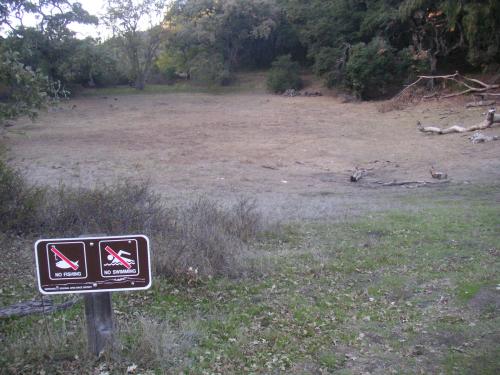
Unrelated to newts or poison oak is
another humorous picture I took a while ago and have been meaning
to upload: No
Swimming.
Tags: humor
[
11:55 Nov 19, 2004
More humor |
permalink to this entry |
]
Wed, 17 Nov 2004
Fedora Core 3 is finally out, so I tried it this evening.
The install itself went apparently smoothly, looking just like a
normal Redhat graphical install, with a few new options,
such as SElinux (which I turned off).
The first problem came during the first boot of the newly installed
system, when the boot process complained that fsck.ext3 was finding
errors on hda2.
hda2, on this disk, is a SuSE partition: I didn't tell the FC3
installer about it at all, so, correctly, it's not mentioned in
/etc/fstab; and it's reiser, so FC3 has no business running
fsck.ext3 on it!
It dumped me into a single-user shell, in which mount shows / as
mounted "rw,defaults", but any attempt to modify anything on the
root partition complains "Read-only file system".
I got around that with mount -o rw,remount / -- it turns out
that typing "mount" doesn't actually give an accurate picture of
mounted filesystems, and cat /proc/mounts is better.
Now able to edit /etc/fstab, I noticed the "LABEL=/" and
"LABEL=/boot" entries that Redhat is so fond of, and speculated
that this is what was causing the problems. After all, there are
several other OSes installed on this system (a Redhat 7.3 and a SuSE
9.1) and either or both of them might already have claimed the label
"/". So I changed the fstab entries to /dev/hda6 and /dev/hda1.
A reboot, and voila! things worked and I found myself in the
first-time boot configuration process.
(Note: Redhat bug
76467 seems to cover this; I've added a comment describing what
I saw.)
I really wish Redhat would get over this passion for using
disk partition labels, or at least detect when the labels it wants
to use are already taken.
Onward through hardware configuration. It didn't detect my LCD monitor,
but that was easy to correct. It correctly detected and configured
the sound card. It didn't try to configure a printer. At the end
of hardware configuration, it took me to a graphical login screen
(no option for non-graphical login was offered), and I logged in to
a gnome desktop, with a rather pretty background and some nicely
small and professional looking taskbars. The default gnome theme
looks nice, and the font in the terminal app (gnome-terminal)
is very readable on this 1280x1024 monitor.
The default browser is Firefox, one of the 1.0 preview releases,
with nice looking fonts.
The first step was to try and configure a printer. Double-clicking
on the "Computer" desktop icon offered only my two optical drives,
the hard drive, and "Network". The Redhat menu in the panel,
though, offered "System Settings->Printer", which ran printconf-gui,
which revealed that FC3 had in fact autodetected my Epson Photo 700
and configured it. Strangely, printconf-gui's "Test" menu was
greyed out, so I wasn't able to "print a test page" that way.
I tried quitting printconf-gui, restarting it (still grey),
left-clicking on the printer (still grey), right-clicking on the
printer (nothing test-y in the context menu) -- and the Test menu
finally ungreyed! The test page printed beautifully -- centered on
the page, something Debian's CUPS setup has never managed.
Clicking on the red ! in the taskbar took me to up2date;
clicking through the screens ended up updating only the kernel,
apparently because updates aren't auto-selected and I have to
manually "Select all" in order to update anything. Once I figured
this out, up2date, via yum, got started updating the other 75
available packages. But it only got halfway through before it
hung (the window wouldn't repaint). It turned out that kill -1
on the up2date process didn't help, but kill -1 on the
/usr/bin/python -u /usr/sbin/up2date made the window wake up and
start updating again. I had to repeat this several times during the
multi-hour update. Then it died, apparently with no memory of which
systems it had already updated.
A Fedora expert suggested that I should
- Go to /etc/yum.repos.d and add .us.west to the end of the url
in every file that has a mirrorlist entry, then
- Use yum -y update instead of up2date, because up2date doesn't
seem to work right for anyone.
Indeed, that seems to be working much better, and it turns out that
I can move the RPMs already downloaded from /var/spool/up2date to
/var/cache/yum/updates-released/packages so I don't have to
re-download them (whew!)
Mixed review
So overall, FC3 gets a mixed review.
The installer is pretty good. It's a bit light on feedback: for
instance, not telling me that a printer was configured (or giving
me an option to change it), which would have added a warm fuzzy
since it turned out it handled it so well; or not giving me a
non-graphical login option. The desktop look is clean and usable.
OTOH, the boot totally failed due to the LABEL=/ problem, and
up2date totally failed. A novice user, wiping out the disk,
wouldn't see the partitioning problem, but if up2date is as
flaky as it seems (everyone I talked to has had problems with it)
it's hard to understand why they don't just use yum directly,
and offer more mirror options (up2date only gave me a choice
of one server, which was obviously overloaded).
Tags: linux, redhat, fedora
[
23:58 Nov 17, 2004
More linux |
permalink to this entry |
]
Tue, 16 Nov 2004
I biked down to the perc ponds today (the Los Gatos Creek
Percolation Ponds, a part of the local water storage system where
creek water percolates down through layers of sand, clay, and rock
into the aquifer) to look for birds. Rumour had it that there was
a female wood duck hiding out among the mallards. I'd never seen
a wood duck, so I hoped to find her.
Not only did I find her, but she has a boyfriend! Or, at least,
there's a male wood duck in the perc ponds as well as a female,
though they weren't hanging out together -- she was consorting
with the mallards (and a curious ground squirrel) up by the trail,
while he was out swimming in the pond.
I also saw some gadwalls (a new duck for me) and got better pictures
than I previously had (for my bird photo project
of several birds, including a belted
kingfisher (always a tough subject). Nifty!
Today's
pictures are here.
Yesterday we went for a short hike at Alum Rock, and saw some more
turkeys and even more deer, including a magnificent buck and a
couple of little spike bucks, and lots of young deer play-butting
each other. They've been added to the
older Alum Rock
turkey/deer photos from a few weeks ago.
Tags: nature, birds
[
21:14 Nov 16, 2004
More nature/birds |
permalink to this entry |
]
Mon, 15 Nov 2004
Teed Rockwell, of the Philosophy Department, Sonoma State
University, published a few days ago a
sizzling
article on ballot totals in Cuyahoga County, Ohio.
Using the numbers from the county's
official
election results web site, he shows 29 different precincts which
report vote counts well in excess of the total number of registered
voters, for a grand total of 93,136 more votes than registered
voters. For example, Highland Hills Village, which has 760
registered voters, had 8,822 ballots cast.
One possible explanation comes in an AP story, Kerry
campaign lawyers checking Ohio vote, which says that
"the numbers also include absentee votes in congressional and
legislative districts that overlap those cities", which
wrongly inflates the numbers, and quotes Ohio elections board
chairman Michael Vu as saying "All the numbers are correct.
You have to first understand what an absentee precinct is."
The story doesn't go on to explain what an absentee precinct is;
it looks like absentee ballots are assigned to counties other than
the county of registration, or possibly absentee voters aren't
included in registration numbers at all.
Meanwhile, a blog called "Political Strategy" reports on an
editorial on the Zogby pollling web site, in Zogby
Website Asserts 'Massive Voter Fraud'. I can't actually read
the linked Zogby page (either they've pulled it, or they
have some sort of bug in their server code) but in addition to
calling attention to the fishy Cuyahoga results, they discuss the
statistical unliklihood of some of the Florida results already
showcased elsewhere.
Recount update: Cobb (Green) and
Badnarik (Libertarian) are officially requesting an Ohio
recount, while Nader
and Camejo have requested a recount in New Hampshire.
There's more recount news on ReDefeat Bush (which
I found by way of their Google ad when I googled for recount
news -- cool!)
A final giggle: on the subject of why the exit polls were so wrong
(I still haven't seen anyone quoting numbers!),
Craig Crawford of Congressional Quarterly and CBS
suggested that the exit polls may have been wrong about Bush
because of the "David Duke effect," an election in which he got
many more votes than was reflected in what pollsters found because
"people didn't want to admit to exit pollsters they'd voted for
David Duke, the head of the Ku Klux Klan, because they didn't want
to admit they were a racist. So perhaps a lot of voters didn't
want to admit they voted for Bush."
Tags: politics, election04, elections, voting
[
22:11 Nov 15, 2004
More politics/election04 |
permalink to this entry |
]
Fri, 12 Nov 2004
Last
Sunday I mentioned seeing one newt remaining in the newt pond, and
wondered whether the rest were migrating already.
Today at Rancho San Antonio, we encountered a half-grown young newt,
sitting on the trail nearly a mile uphill from the creek.
After some photos
(all but the first there are of this young 'un) we moved the
newtlet off the trail where it wouldn't get stepped on.
Later, Dave noticed a part of the trailside
lurching repeatedly in and out. Obviously some small burrowing
animal, perhaps a mole, was beneath the rain-loosened dirt,
trying to decide whether to burst out into the open.
We watched for a while as the animal
tunnelled from one place to another, but every time we thought it
might be getting ready to poke a nose out, another herd of hikers
would come by and all burrowing would cease; time would pass,
then dirt would begin to lurch somewhere else.
We never did see the burrower.
Other notable critter sightings: a wrentit (only the second time I've
ever seen one, though I hear them all the time; the first one I saw was
also at RSA, and I didn't manage a photo then either), a ruby-crowned
kinglet, lots of fluffy white feathers along one trail (what
bird there has white feathers? Perhaps the white-tailed kite we
saw later, but I've never seen a kite in the more wooded part of
the park where we saw the feathers),
and an extended bout of animated loud chatter from the
treetops which sounded more like geese than anything,
but eventually turned out to be squirrels.
(Akk's rule of birdsong: if it's loud and really weird sounding,
it's probably a squirrel.)
Tags: nature
[
22:14 Nov 12, 2004
More nature |
permalink to this entry |
]
I've been hearing a lot of talk about how the official results don't
match the exit poll numbers: how the exit polls show a Kerry win,
and that's evidence of a hacked vote. For example,
Those faulty
exit polls were sabotage in
The Hill, or
A
Tour of the 2004 Exit Poll: What It Says and What It Doesn't,
part one and
part
two on Donkey Rising.
What I haven't been able to
find is anything with data to confirm this, one way or the other.
CNN has an
interactive page allowing checks of specific aspects of exit
poll data, but that's no help for analyzing nationwide data, say,
by county. And in any case, it seems that CNN
changed the online data after the fact, so there's no telling
what this means in terms of raw numbers.
Lawrence Lessig gives the answer, in Free the
Exit Poll Data: the poll numbers are privately held, not
publically available. Lessig calls for the data to be made
public, so that it will be possible to find out why the numbers
were so misleading compared to the final election tally.
You'd think both sides would be interested in knowing what
went wrong.
Terrific maps for visualizing the election
Maps and
cartograms of the 2004 US presidential election results gives a
wonderful set of maps showing "purple states" by county, with the
sizes adjusted for population.
Other stories about voting irregularities:
Outrage
in Ohio: Angry residents storm State House in response to massive
voter suppression and corruption (Michigan Independant Media
Center):
Protests on November 3 in Ohio over all the voting problems the
state experienced. Includes lots of anecdotes about voters who
experienced problems.
Surprising
Pattern of Florida's Election Results (US Together):
a comparison of party registration data to reported election
results in Florida counties using different types of voting
equipment. In counties using touchscreen machines, the percentage
vote for Kerry matched the party registrations fairly closely;
in counties using optical scan machines, there's a huge shift
over to Bush votes, completely uncorrelated with party affiliation.
The article includes a data table by county.
Evidence
Mounts That The Vote May Have Been Hacked (Common Dreams):
a text discussion of the US Together results, their correlation
with exit poll results, and some discussion of possible explanations
other than foul play (and why those reasons are unlikely to be
the actual explanation).
Palm
Beach County Logs 88,000 More Votes Than Voters (Washington
Dispatch):
Palm Beach County's official election results web site showed 542,835
ballots were cast for a presidential candidate while only 454,427 voters
turned out for the election. Apparently they've since updated the
web site to show numbers that add up. I guess this tells us how
far we can trust the "official" numbers on the web site.
Tons of other links on the Op Ed News:
Votergate 2004 page.
Bev Harris of Black Box Voting, Ralph Nader and others have teamed
up for Help America
Recount, a project to buy recounts in Ohio and other states.
They're soliciting donations. I'd love to see recounts, but
what they don't explain is where the money is going. What's
involved in getting a recount, and does it cost money, or is
this to pay salaries and expenses of the (volunteer?) people
doing the counting, or what? The effort sounds like it might
be a little disorganized at the moment.
Kerry Won.
. . (Tom Paine.common Sense):
Editorial about irregularities in various states. No new data, though.
Tags: politics, election04, elections, voting
[
12:31 Nov 12, 2004
More politics/election04 |
permalink to this entry |
]
Tue, 09 Nov 2004
Crikey 0.5
is out, with some changes contributed by Efraim Feinstein
-- it can read from stdin now, and has a debug flag.
Reading from stdin means you can generate multi-line text now.
It's so cool when people send patches to my programs!
Especially when they're nice clean code implementing useful
features. Thanks, Efraim!
Tags: programming
[
22:39 Nov 09, 2004
More programming |
permalink to this entry |
]
Sun, 07 Nov 2004
We went for a "mander meander" up at Montebello this afternoon,
curious how late in the season the California Newts hang around
the newt pond. A month ago, the pond was full of newts, but today,
only one was left. The rest must be migrating to wherever they go
in winter. We didn't see any migrators.
Interestingly, the poison oak disappears at the same time as the
newts: a month ago the trail was full of poison oak, but today,
nearly all of it was gone.
Having nothing to do with newts, my fun project last night
concerned an article
in New Scientist about a new Hubble photo
of a triple shadow transit on Jupiter. (They make it sound like
a much more unusual event than it is; amateur astronomers get to
see Jupiter double transits pretty much every year, and triple transits
every few years, weather permitting, of course.) The article
comments that the moons would look to an observer on Jupiter
about the same as our moon looks to us, and that these eclipses
as viewed from Jupiter would be similar to an earth eclipse.
That seemed unlikely -- that all four Galilean satellites would just
coincidentally have the same size as each other and as the sun, just
like our moon does from here -- so I wrote a little program to
calculate the apparent sizes in arcseconds, and came up with:
       Sun : 6.1
        Io : 35.6
    Europa : 18.0
  Ganymede : 18.1
  Callisto : 9.1
So a Callisto eclipse might be somewhat like an earth eclipse, with
Callisto being one and a half the sun's apparent size, but the other
moons appear much much larger than the sun. And Io is about the
same apparent size in Jupiter's sky as our moon is here (about half
a degree).
Tags: nature
[
21:00 Nov 07, 2004
More nature |
permalink to this entry |
]
Sat, 06 Nov 2004
An older style touchscreen machine made by Danaher Controls
gave Bush
3,893
extra votes in suburban Columbus.
In one North Carolina county, more
than 4,500 votes were lost because officials believed a computer
that stored ballots electronically could hold more data than it did.
UniLect, the manufacturer of the touchscreen machines used, told
officials that each storage unit could handle 10,500 votes, but the
limit was actually 3,005 votes. The missing votes are gone forever;
there is no way to retrieve them.
In Broward County, FL (remember the missing absentee ballots?)
it was discovered that a bug in an
ES&S machine changed the outcome on at least one proposition.
Seems that the software (for counting votes on absentee ballots)
doesn't expect more than 32,000 votes in a precinct; so when the
tally crosses that number, the machine starts counting backward!
Meanwhile, the ACLU
is suing over the lost Broward County absentee ballots.
A national voting rights group has reported
hundreds
of voting irregularities in the south affecting poor and
minority voters.
Latest word (from Equal
Vote) is that Ohio Secretary of State Ken Blackwell has said
that Ohio's provisional votes
will not be counted for 11 days (if at all).
Black Box Voting has filed
a massive Freedom of Information Act request for computer logs
(including internal audit logs, transmission logs, and others),
voting results slips, any email or other communication relating to
problems with voting systems, and other information relating to the
operation of electronic voting machines.
Voters
Unite has an excellent listing of stories on many other voting
problems found so far.
Tags: politics, election04, elections, voting
[
11:05 Nov 06, 2004
More politics/election04 |
permalink to this entry |
]
Fri, 05 Nov 2004
Printing's been broken on my Debian machine forever.
For one brief shining moment back in July I
briefly
got it working, then a week later a dist-upgrade broke it again
and it's been broken ever since.
Last week Debian Weekly
News mentioned a new package called "printconf" which supposedly
autoconfigures usb and parallel printers for CUPS. Now, setting
aside for the moment that there's already a package called
printconf, which configures a completely different spooler than
CUPS, and that it's very confusing of Debian to resurrect an old
name for a completely different purpose, of course I wanted to try
it.
At apt-get time, it asked me whether I wanted to configure my
printers now, and of course I said yes. The package installed,
it printed a message about restarting CUPS, and no more details.
Did it do anything?
I visited the CUPS configuration url (CUPS is configured via a web
browser) and the entry looked like my old printer entry. Just for
ducks I clicked "print a test page". Nada. So I removed the entry,
went back to my root shell and typed printconf. It printed
"Restarting cups ... done." No other info. Back to the web
configuration page ... no printer there.
Eventually I discovered the -v option, which at least told me that
it wasn't finding any parallel printers. I know this printer can be
detected via the parallel port (SuSE and Mandrake both autoconfigure
it), so something was wrong. Time to look at the BIOS.
A bunch of reboots later, I finally managed to get into my machine's
BIOS screen (hint: repeatedly press DEL during boot. The screen saying
DEL is the right key only flashes for a fraction of a second, so
there's no hope of ever reading it and I wasted several boot cycles
pressing function keys instead) and changed the parallel port from
"ECP" to "ECP/EPP". Back into Debian -- and voila! printconf saw
the printer, autoconfigured it with some magic the earlier entry
hadn't had, and after a year and a half I have a debian printer again!
(Incidentally, the parallel port setting isn't why the printer
wasn't working before; it was something about the CUPS
configuration. Printing used to work on this machine several
years ago and the BIOS settings haven't changed since then.)
All hail printconf! I wonder if it's ever occurred to anyone to
mention in the man page that it needs an EPP (or ECP/EPP?) parallel
port?
Tags: linux, debian, printing
[
22:05 Nov 05, 2004
More linux |
permalink to this entry |
]
A few days ago, we took a break from Election madness and went for
a late afternoon bike ride at Alum Rock.
We were hoping for tarantulas, but had no luck on that count.
But what we did find, at dusk as we rode past park headquarters,
was wild turkeys! Dozens of wild turkeys, all random-walking
and gobbling like mad, the males displaying their tail feathers.
The handful of deer (a few fawns and several bucks with antlers
sprouting) grazing nearby were nervous of the turkeys, and backed
off when they came near.
We stood and watched for quite a while, and neither turkeys nor
deer seemed particularly worried about our presence. Alas, the
light was low, so the photos
didn't come out very well.
Tags: nature
[
20:02 Nov 05, 2004
More nature |
permalink to this entry |
]
Wed, 03 Nov 2004
I knew the Demo-wimps were going to fold, just like they did in
2000 -- but I didn't think they'd do it before the first vote count
was even finished!
I can't believe Kerry conceded already. What about all the promises
the Democrats have been making us for the past several months about
pushing lawsuits on voting technology and voter eligibility?
What about all the lawsuits already filed?
I guess nobody cares any more that there's no way to verify anyone's
vote, that the voting technology of the country is entirely in the
hands of one party. A show of democracy is all that's required;
the actual votes, from actual citizens, are far less important
than the pretense of voting.
The morning's quick summary of voting machine glitches reported
yesterday, at Wired: Watchdogs
Spot E-Vote Glitches. The stories include ballots already
pre-filled in Palm Beach County, FL, reports of misvoting (touching
the box for one candidate and seeing an "X" appear by a different
candidate) in FL, TX, and other states, machines in Texas instructed
to vote straight party tickets actually casting votes for candidates
outside that party, and voters in six Pennsylvania
precints prevented from voting due to voting machine failures,
I should mention that Wired has had the best and most comprehensive
coverage all along of the e-voting fiasco, beginning many months
before any of the other mainstream media would mention the subject.
Follow the links from that story, or just search for keywords like
voting machines or Diebold. Or check out the original anti voting
machine activist site: BlackBoxVoting.com and its
sister site BlackBoxVoting.org.
Also, two excellent Cringley columns on the subject:
A
Year Into the E-voting Crisis, Shouldn't We Have Noticed the Printer
That's Already Built into Each Diebold Voting Machine?,
and
Why
the Best Voting Technology May Be No Technology at All
But Kerry and the DNC aren't fighting against any of that.
They signed on until November 2, and now that's past and they can go
back to having garden parties or whatever they do for three and a half
years between conceding elections.
Tags: politics, election04, elections, voting
[
11:00 Nov 03, 2004
More politics/election04 |
permalink to this entry |
]
Tue, 02 Nov 2004
As long as I'm collecting links to news stories, here are some about
attempts to block voter registration or otherwise intimidate or
discourage voters. States involved: Nevada, Florida,
Oregon, Michigan, Ohio, and Iowa.
Tags: politics, election04, elections, voting
[
23:07 Nov 02, 2004
More politics/election04 |
permalink to this entry |
]
I mentioned to someone the problems that have been showing up for a
week where voters think they've voted for one candidate, then
realize upon getting to the final review that the machine has
recorded votes for a different candidate, and discovered that
I didn't have handy links to any of those stories. So here's a
collection of stories from Texas and New Mexico:
Unfortunately the stories seldom say what type of touchscreen voting
machine was being used.
And keep in mind that changing
only a single vote per voting machine in the 2000 election could
have made a difference of 25 electoral votes, according to a
recent ACM study (which unfortunately isn't readable online unless
you're an ACM member).
Tags: politics, election04, elections, voting
[
22:43 Nov 02, 2004
More politics/election04 |
permalink to this entry |
]
BoingBoing seems to be slashdotted (probably not by slashdot) but
two other sites with excellent up-to-date news on election problems
are
E-Voting Experts,
covering reports of problems with touchscreen and optical scan
voting machines,
and
Equal Vote,
covering some of the legal challenges against voters, in states
such as Ohio and (of course) Florida.
Tags: politics, election04, elections, voting
[
14:07 Nov 02, 2004
More politics/election04 |
permalink to this entry |
]
I'm happy to report that voting with paper in my neighborhood was
surprisingly low hassle.
The registrar did not ask me whether I wanted paper, but when I
saw her circle "E" I hastily told her "I want a paper ballot".
She looked momentarily surprised, but recovered quickly, scribbled
over the "E" and marked "P". They didn't offer a pen, but I had
brought one so I didn't ask.
Then came the wait. They had four or five touchscreen machines,
but only one booth (made from a cardboard box) for paper voters,
already occupied. The ballot is long (in fact, there are two
paper ballots, each 2-sided) so it takes quite a while to finish it.
That was fine, because it gave me a chance to hear that they began
asking the people registering behind me whether they wanted paper
or electronic. They often had to explain the difference to voters
who had no idea what the options were, which didn't sound easy;
they were very patient about helping people understand the options
and didn't try to brush anyone off.
Roughly half of the people there chose paper.
Voting was straightforward except that the booth's ledge was very
low (for wheelchair access; the voter ahead of me was in a
wheelchair). I probably should have grabbed a chair.
While I was marking my paper ballot, I heard a woman who was having
a lot of trouble getting the touchscreen machine to work. The
pollworker worked with her for quite a while. I think they
eventually straightened it out; it sounded like maybe she had
to press really hard to get it to register her votes.
When I had finished, my ballot went straight into a box, no
provisional envelopes or anything like that. Paper voters get
a different sticker, not the new "I voted, touchscreen" sticker
(so I don't get to draw a circle-slash with a Sharpie like I'd
planned).
Reports I hear from other Santa Clara county voters: most have been
asked "electronic or paper?" and I haven't heard any reports of
provisional envelopes or other weirdness. Many who voted paper
report people voting outside booths; in one case no booth was
available, and paper voters sat at a folding table. There wasn't
much privacy on the machines either, though: they don't have much of
a wing to hide the screen from onlookers, so if you wanted to snoop
on someone's votes, it's not difficult.
All in all, I was pleased with how easy it was to vote with paper,
with the competence of the poll workers,
and with how many people chose the paper option.
Tags: politics, election04, elections, voting
[
12:44 Nov 02, 2004
More politics/election04 |
permalink to this entry |
]
BoingBoing
(the esteemed Cory Doctorow) already has coverage of some
of the problems people are encountering trying to vote here in
Santa Clara County (California) this morning.
Like the Vote
Save Error #9. Use the Backup Voting Procedure." message one
voter got when trying to use the touchscreens.
But about that backup voting procedure: it seems that even if you
can persuade them to give you a paper ballot (bring your own pen,
even though the Voter Information Guide specifically says on page
164 that after signing in at the polls the voter "receives a paper
ballot along with an approved marking device"), the ballots
cast on paper are being put in "provisional" envelopes,
yet without the identifying information on the envelope which is
used to approve provisional ballots. One really wonders if such
votes will be counted.
I wonder if it will be possible to get statistics after the fact for
the total number of paper ballots counted in each precinct (and how
many of them were provisional)? For comparison, I wish someone was
doing exit polls to get an idea of what percentage of people are
requesting paper ballots.
Meanwhile, Kelly Martin reports that in Cook County, Ill. voting
is no longer by secret ballot. Each ballot has a number on it
which is correlated with the voter's name.
One of the boingboing comments points out that voting problems should be
reported to voteproblem.org.
The EFF suggests using the Election Incident Reporting
System.
Stay tuned.
Tags: politics, election04, elections, voting
[
10:58 Nov 02, 2004
More politics/election04 |
permalink to this entry |
]
Sun, 31 Oct 2004
Every time I see someone ask about image formats, I think "Someone
really ought to write up a howto explaining the difference between
GIF, JPG and all the other formats, and what they're good for."
There probably are documents like this, but I've never seen one.
So I wrote one.
Image
Formats for the Web and Elsewhere.
(I'll probably give a Toastmasters talk on the subject as well.)
Tags: writing
[
15:25 Oct 31, 2004
More writing |
permalink to this entry |
]
Thu, 28 Oct 2004
The Florida post office has somehow
lost
58,000 absentee ballots in Broward County, FL.
They say they're mailing out new ballots, but that
(not mentioned in the article) blithely assumes that everyone
who voted absentee did so frivilously, not because they were,
say, going to be out of town during the election.
By a staggering coincidence, Broward was the county which gave
Gore the biggest margin in 2000.
Meanwhile, news from the EFF from last week when I was out of town:
Santa
Clara County poll workers are being trained not to offer voters a
chance to use paper ballots instead of electronic voting
machines.
I've been rather hoping that the EFF (or someone) would organize
protests near polling places, trying to inform voters of their
rights. But no such luck. Instead, they've set up a site with
a big flash movie with monotonous music and no information that
couldn't have been shown better in a simple fast-loading html page.
If you want to watch the flash movie, it's at
PaperOrPlastic2004.org
but there's really nothing else there besides the movie.
Spread the word anyway. Tell everyone you know in the affected
counties (Santa Clara, Orange, Alameda, and Riverside Counties.
Napa, San Bernardino, Merced, Plumas, Shasta, Tehama, and Riverside
counties) that they can request a paper ballot, and that way leave a
paper trail that can be verified in case of a recount.
Tags: politics, election04, elections, voting
[
23:43 Oct 28, 2004
More politics/election04 |
permalink to this entry |
]
Wed, 27 Oct 2004
Photos from the
trip are up (except for panoramas which still need to be
stitched).
Tags: travel, anasazi
[
11:18 Oct 27, 2004
More travel/anasazi |
permalink to this entry |
]
Mon, 25 Oct 2004
Yesterday and today were travel days -- supposedly nothing much to
report. But it turned out otherwise.
Nothing much yesterday except the herd of bighorn sheep grazing by
the side of the road as we left Moab. (We had planned to stay in
Moab for a few days, but the weather turned sour.) The drive
through the San Rafael Swell is always impressive, but I've written
about that
already.
Today, first, a quick stop by Kolob Canyons, a small branch of Zion
National Park accessed right off I-15. It's marvelous: a very
short road loop with stunning views, and three hikes of varying
lengths. We didn't do any hikes due to weather and health issues,
but we'll be back!
After leaving St George and Utah and before entering Nevada,
I-15 briefly passes through Arizona in the impressive Virgin River
Gorge. Arizona doesn't bother with trivialities like nice roadside
view areas like Utah and Colorado do.
But there's a BLM area flaking the north side of the gorge, with a dirt
road: the Beaver Dam Mountains Wilderness Area. We went a little
way up the road; we didn't find views of the gorge from there,
either (perhaps farther up?) but the rocks were quite interesting,
evidently a mixture of rhyolite and basalt with some bits of
tuff and river cobbles (did the Virgin make it up this high before
the area was uplifted, or are the cobblers from streams which used
to run from higher still?) We'll be back to explore further (with
a BLM map, I hope).
Returning to I-15 and crossing into Nevada, we chose a detour:
instead of following the interstate through the rush-hour traffic of
Las Vegas, we swung left onto a little highway that cuts down by Lake
Mead, marked as "scenic" on the map?
Getting through the tiny town of Overton took longer than we
expected; its "so ridiculously excessively low as to be obviously
a speed trap" speed limit zone went on forever. But we finally
emerged out the other side, passing the Lost City Museum (curiously,
just last week we'd read an article in the LA Times about an old
town near there which had been buried for most of last century by
Lake Mead, but which had re-emerged in the last few weeks due to
record low water levels, creating great interest among historians).
The scenery began to get interesting right away. It offers very
little in the way of views of the lake (unless you drive down the
side roads leading to the lake itself), but the area is "painted
desert" of bentonite or a similar ash, punctuated by jagged peaks
of volcanic rock. Most of the land is part of the Lake Mead National
Recreation Area. Numerous parking areas are located at small oases
named This-or-that Spring. Some of the springs are visible from some
distance as a grove of palm trees. Are any palm trees actually
native to the American southwest, or were they all introduced by
settlers?
Update: Apparently the origin of these palms is a point of
dispute, but there's quite a bit of evidence arguing for their
being native to the area.
William Spencer sent me a link to
a page discussing the issue
and the fight to save the palms.
This goes on for miles, and then gradually bits of brighter color
begin to appear, in the shape of red sandstone. We stopped at a
parking area on the left, and found a true jewel: Redstone, a little
rest stop with a trail of maybe a mile which goes out around the
vividly red rocks, with occasional interpretive signs which are
interesting and not patronizing. The rock is Aztec Sandstone,
formed from dunes which covered the area some 130 million years ago,
with wonderful cross-bedding and weathered textures, and nearby
mountains of black basalt to provide contrasting color.
After taking the Redstone hike, we continued on the highway,
stopping at some of the pullouts, including one which included
an interpretive sign describing the "bowl of fire", resulting from a
layer of Aztec sandstone which swelled into a domed shape, then
eroded from the top, leaving an outer ring. The fiery red ring is
easy to see among the darker layers surrounding it.
Presumably the nearby Valley of Fire state park is also Aztec
sandstone sculptures; it looks like it from a distance. We wished
we'd taken that route, and will next time.
The scenic highway ends in Henderson, leaving us to fight our way
through yet more heavy traffic (no matter which way you approach
Las Vegas, or at what hour, or how hard you try to bypass the center
of town, somehow you always end up in a traffic jam!) to return
to I-15 and head down to our destination of Primm, musing on the
long, gradual talus slopes so typical of the Mojave desert, and
how superficially similar they look to a shield volcano like Mauna
Koa. I wonder how the angles of repose compare? (Alas, there's no
internet in Primm, so that's a question for a later time.)
Photos of Kolob and
Redstone.
Tomorrow: home!
Tags: travel, anasazi
[
21:23 Oct 25, 2004
More travel/anasazi |
permalink to this entry |
]
Sat, 23 Oct 2004
I've wanted for years to see the confluence of the Green and
Colorado rivers: the place where the west's two biggest rivers
meet, mingling their different colored waters into the larger
river which is the lower Colorado, flowing down to become
Cataract Canyon.
The Confluence is hard to get to, though. The only viewpoint above
river level is located in the Needles district of Canyonlands
National Park. Sounds easy enough; but the only road that goes
near it is a technical jeep trail called "Elephant Hill",
involving tricks like five-foot rock drop-offs. A bit beyond
our skills or vehicle. So instead, we drove to the beginning of
Elephant Hill, then mountain biked from there. It's about 9 miles
to the confluence overlook (then a half-mile hike from there), and
about 6 miles back (it's a loop trail with one-way sections).
First we had to get to Canyonlands. We took the scenic route from
Monticello over the Abajo mountains, offering great views of the
lacolith triangle: the Abajo, Henry, and La Sal mountain ranges
are all rock which has been warped upward by subterranean magma,
without actually being made of volcanic rock themselves.
On the Saturday of Utah's week-long deer hunting season, the Abajo
route was crawling with trucks filled with blaze orange clad
passengers, pulling trailers laden with ATVs. Every pullout,
every campground, was full of hunters.
Ironically, twice during the day we had to slow down (and once,
stop) for large groups of does wandering near or across the road.
We never saw any bucks, but I guess the number of does on the road
suggests that the deer population isn't in any serious threat from
the hunters. But we nevertheless were glad we were going to be
doing our riding in a national park today.
Elephant Hill is as technical as we remembered it from our last
visit to Needles. We tried to ride up the hill, but gave up fairly
early and walked the steep sections. The trail alternates between
short, impossibly steep and technical rock sections (which we walked),
moderately steep and technical rock sections (which we mostly rode,
and enjoyed immensely) and long near-level stretches of deep fine
red sand (fun if you don't mind sliding sideways).
Dave rode more of the rocky uphills than I did, and I rode more of
the rocky downhills. I biffed on one downhill, coming off a rock
ledge into deep sand and landing hard on one hand. No permanent
damage.
No bikes are allowed on the half-mile section of trail from the end
of the road to the overlook, so we had to stash our bikes in the
bushes and continue on foot.
The confluence overlook is fabulous! It's just like the pictures:
you can see the boundary where the two differently colored rivers mix
to form one larger river. Apparently the colors vary depending on
what's been going on upstream; every picture is a little different.
Today, both rivers were muddy green, but different shades, with the
Colorado being darker and clearer than the Green. On the horizon,
you can see the three districts of Canyonlands: Island in the Sky
(between the two upper rivers), the Maze (along the west bank of the
Green) and Needles (where we stood, on the east bank of the Colorado).
The ride back was surprisingly easy, though going uphill through the
sandy stretches was a workout. We got back to Elephant Hill just as
a couple in a rented jeep began the first descent, so we had a
chance to see how it was done. The Jeep handled the tough descent
easily. I bet it didn't seem as easy from the driver's seat as it
looked from the outside.
Photos.
Tags: travel, anasazi
[
23:20 Oct 23, 2004
More travel/anasazi |
permalink to this entry |
]
Fri, 22 Oct 2004
Our scenic loop to the Valley of the Gods began with cold, windy,
overcast, drizzly skies. But as if to make up for the weather, we were
greeted with a rainbow almost as soon as we hit highway 95.
Or maybe that was to make up for the snow flurries we encountered
a few miles later. Whatever.
We headed down highway 261, eschewing Natural Bridges National
Monument. Been there, done that. We were headed for Muley Point,
which turned out to be an unmarked dirt road turnoff just before the
Moqui Dugway. Four miles of relatively good dirt road led us to
two stunning viewpoints overlooking the sinuous San Juan river
and points beyond, such as Monument Valley, Alhambra Peak, and
Valley of the Gods. The wind was icy, but the view was worth it.
Returning to the highway, we headed down the Moqui Dugway (variously
spelled Moki or Mokee, depending on which map you use; everyone
seems to spell Dugway the same). This is a steep (11%) grade,
gravel except on a few turns where pavement returns, winding 1100'
down the side of Cedar Mesa to the bottom. Why it's gravel when
the rest of the highway is paved isn't clear. But it's fun.
At the bottom of the Dugway, a BLM dirt road goes left into Valley
of the Gods. But we decided to see the Goosenecks of the San Juan
first.
At Goosenecks, the San Juan river travels over six river miles in
the space of only a mile and a half. It's held up as one of the
best examples anywhere of an entrenched meander, where a
lazily meandering river on nearly-level terrain cuts a shallow
channel, then rapid uplift of the area (in this case, the Colorado
Plateau) causes the river to cut a deep canyon.
There are entrenched meanders all over the area -- such as
Bowtie
Bend and Dead Horse Point -- but nowhere are there so many,
in such a short space. It's very impressive.
And that's all there is to Goosenecks of the San Juan State Park --
one amazing overlook. There's a trail somewhere (the Honaker Trail,
namesake for the rocks comprising the upper two-thirds of the San
Juan's canyon; the bottom third is the Paradox Formation, both
Pennsylvanian layers of limestone and shale) but it's accessed
from outside the park, and there's no information about it at the
park.
We backtracked to the west end of Valley of the Gods Road and began
our divine journey, following a guide we'd picked up at the
visitor's center in Blanding. The first rock on the list was
Balanced Rock -- I pointed it out. "No," said Dave, "that's got
to be Lady in a Tub. That's exactly what it looks like." "Um, I
don't see that on the list here." It turned out that this was an
alternate name for the same rock, listed on the map but not in the
guide. And indeed, it was a good name -- except that as we
proceeded down the road, it became a Man in a Tub.
It's a while before the next Named Rock on the guide, but that's
okay; there are fascinating rock formations everywhere. The light
was difficult for photography, since it was still mostly overcast,
but that made for dramatic light when the sun did come out.
And a few miles in, I spotted an even more interesting formation:
a tarantula making its way across the road. We go
tarantula spotting every year, but the season when the males go
wandering aboveground in search of females is so short that we
often miss it. This year we were sure we'd missed the season at
home; so finding one here was serendipitous. This one appeared to
have no inclination to get off the road, so we had plenty of time
to shoot photos (including "tarantula walks over the camera" and
"real tarantula completely ignores our rubber tarantula") while
we gently tried to persuade him to walk by the side of the road
and not in the middle.
We invented names for unnamed rock formations, like
"Mohawk with Squirrel on Head" and the nearby "Organ Grinder's
Monkey, with Drum". Rooster Butte should have been Senorita Butte
-- a Spanish dancer with full flowing skirts.
Occasionally the road became mildly technical, with rocks or gully
crossings. "Chacoan speed bumps!" exclaimed Dave.
Two painters had set up camp right in the middle of a wash,
with their easels right by the road -- maybe dust is part of
the art, and a flash flood just gives an artist more inspiration.
Setting Hen Butte (its official name)
has giant sandstone eggs all around it.
Too soon, we found ourselves at the other end of the road, and the
highway. But before heading back to Blanding, we took a detour
to Sand Island, near Bluff, to see what was there. What was there
was petroglyphs -- a whole wall of them, comparable to the much more
famous Newspaper Rock to the north near Monticello. Excellent rams
and elk, snakes, and other figures. But what interested me most was
all the Kokopelli-like figures. Kokopelli (the dancing flute-playing
trickster) shows up in nearly every gift shop in the southwest.
He's so prevalent that a mapmaker in Moab (Cheap is Real)
comments on the back of each map that it is a "100% Kokopelli-free
product"). Yet in the rock art I've seen, I have yet to see an
actual Kokopelli -- until Sand Island. Sand Island is definitely
not a Kokopelli-free zone. But it's a great set of petroglyphs.
Photos of
Goosenecks,
Valley of
the Gods, the tarantula, and
Sand
Island Petroglyphs.
Tags: travel, anasazi
[
22:48 Oct 22, 2004
More travel/anasazi |
permalink to this entry |
]
Thu, 21 Oct 2004
Driving around Farmington, NM is a little different from driving
around California.
Heading out of town, we passed the Permian Power Tong
building. I guess you'd better be careful when complaining
about your electricity bill in Farmington! Especially if you
want to assert that it comes from the Mesozoic, or something.
Not long after that, we passed Jimmy's Swabbing Service.
I don't think I want to know too many details about that,
nor about the Four Corners Bull Test Station we saw later.
Update 11/8/2006: Someone from the Permian Power Tong wrote
to let me know that they're an oilfield service company, not
an electric company.
We stopped at the Aztec Ruins, so misnamed because early
white settlers apparently thought these Anasazi ruins were left
by the Aztecs (?). It's a small park, with one trail, but the
ruins are excellent and the guide is full of information about
the architecture. The structures were originally built by
Chacoans and most of the lower masonry is similar to what
we saw in Chaco Canyon, but was later modified (for repairs
and additions) in a style more similar to Mesa Verde.
Then, much later, some of the masonry was re-done by the
park service in a well meaning but misguided attempt to
stabilize the fragile structures, with the result that there's
a lot of modern concrete, metal drains, and other anachronisms
and apparently it's sometimes hard for modern researchers to be
sure what came from which era.
The Chacoan work is the most beautiful. They liked to alternate
layers of large bricks with small, or red with other colors, whereas
the Mesa Verdeans used fairly uniform large bricks everywhere.
Someone who came along later (perhaps the Mesa Verde group, perhaps
a later tribe) added rounded river rocks in places, from the nearby
Animas river. The Animas may also have been used to float the
hundreds or thousands of logs needed for the roofs of the
structures; the wood apparently came from the mountains,
near Durango, since it's wood which wasn't available locally.
Although the park service tries to be much more careful now,
we saw some modern repairs on the structure while we took the
self-guided tour: Navajo bricklayers pounded sandstone
with a hammer, chipping flakes off to make it the right shape
to fit into the spot being repaired.
Outside of the park, we explored the town of Aztec, which has a nice
little suburban downtown area surrounded by miles of scrubland with
residential trailers. We noticed that the downtown area had a
predominance of Kerry signs, unlike Farmington and the rural areas
outside Aztec where Bush signs prevailed.
We took back roads from Aztec, eventually passing through Mancos
(the Mancos Motocross, Now Serving Elk Burgers -- what more
could you want? -- and the Reptile Reserve of Southwest Colorado)
and the poshest highway rest stop we've seen anywhere, at
Sleeping Ute Mountain, which offered its own hiking and pet
exercise trails.
Our plan was to stay tonight in Monticello, UT, which is close to
Canyonlands' Needles district and lots of other interesting places.
The first hotel we tried should have given us a clue as to what
was coming: the sign proclaimed "Big Buck Display!" A big dollar
bill? wondered Dave.
But it turned out this is the beginning of Utah's week-long
deer hunting season, and that Monticello is the deer hunting
capital of southeastern Utah (for some reason).
We pushed on to Blanding instead.
Blanding looked like a bigger town in the AAA guide (more hotels)
but isn't really. Fortunately, the Best Western has wi-fi
(the only place in town, unlike Monticello which has two hotels
and a cafe). The router gives the wrong address for the DNS server,
but we guessed at the right address and edited /etc/resolv.conf,
and things work okay as long as you remember to do that before
making any net connections (otherwise the wrong DNS info gets
cached by some proxy server somewhere).
Dave went to the office to see if anyone knew about this.
He was told: "They just fired up the system two weeks ago,
and it has been slow," but no one knew any more detail than that.
Photos.
Tags: travel, anasazi
[
21:08 Oct 21, 2004
More travel/anasazi |
permalink to this entry |
]
Wed, 20 Oct 2004
I've been curious about Chaco Canyon ever since as a kid I read an
article in
Sky & Telescope about the Anasazi Sun Dagger,
a rock structure whereby at the solstices and equinoxes the sun
creates a narrow sliver of light projected onto a spiral petroglyph.
Unfortunately, it turns out that the Sun Dagger is not open to
visitation (by the public or even by most researchers). In the
1980's it was deemed too fragile for visitors, and the site was
closed down. There are some other astronomically oriented
petroglyphs, but no one seems to know exactly where, or to
have a complete list.
Getting information on Chaco is a bit difficult. There's not much
useful information on the web, the park doesn't have specialized
handouts like a lot of other parks (many parks have one-page
handouts available for the asking on subjects such as geology,
astronomy, petroglyphs, etc) except for one giving a brief listing
of the available hiking trails. The ranger at the visitor's station
was somewhat reticent: he recommended a couple of hiking
trails, and told us that the Sun Dagger was located high on Fajada
Butte, but not much more. I noticed a picture of some petroglyphs
thought to depict a supernova, and asked where they were, but he
apologized "Sorry, I don't go out that trail much".
Nothing to do but go try some stuff and see what's cool. We visited
all the ruins along the park road, then headed up the steep trail
to Pueblo Alto and the Pueblo Bonito overlook, which begins by a
scramble through switchbacks over broken rocks, followed by a steep
ascent through a narrow gap in the rock wall. Fun! And daunting:
but it turns out that once you squeeze through the gap, you're up
on top of the mesa and mostly finished with climbing.
The mesa top is interesting rock: white, layered mudstone, full of
interesting embedded objects (presumably plant fossils, though some
of them actually look like bone).
The Fajada Butte interpretive sign, the only mention we
found of park geology, says of the butte:
Cliff House Sandstone forms the upper layer with deposits of fossil
shells, clams, shark teeth, and marine sand.
None of these fossils seem to correspond with what we saw embedded in
the rock along the Pueblo Alto trail. More research is required.
The view of Pueblo Bonito from above is marvelous and well worth
the short and interesting hike. The semicircular shape of the great
house, not obvious from below, is striking when viewed from above.
The hike up to Pueblo Alto was pretty, and enjoyable as a hike, but
Pueblo Alto itself is much less interesting than the ruins down in
the canyon. We wished we'd gone the other way on the loop trail
for more birds-eye views of the canyon houses.
Another interesting aspect of Chaco: their astronomy program.
They have a fixed observatory (a dome housing a truss-tube
dobsonian of about 18") and something outside on a tripod
(probably a big Schmidt-Cassegrain).
The visitor's center was full of photos of astronomical
objects, as well as some information about light pollution.
It's nice to see a park so interested in astronomy, especially
with the sort of skies they must get at Chaco. Alas, we weren't
able to stay the night.
But Chaco's big mystery is the "roads". The park literature
talks about the amazing roads the Chacoans built,
stretching for hundreds of miles between Chaco and neighboring
settlements in many directions, used for trade between tribes.
On the Pueblo Alto hike, a short
segment of one such "road" is roped off and signed: a wide
rectangle of more or less bare rock, perhaps ten or fifteen feet
on a side, lined generously with rocks on two sides. With a lot
of imagination, you could imagine a boulevard continuing in this
fashion, rocks lining the left and right sides of the "road" like
a huge version of some national park trails.
Dave smelled a rat, and dug further.
These "roads", apparently, were originally detected as unexplained
straight lines appearing in infra-red images, using NASA's
TIMS system.
Archaeologists subsequently searched the ground and found some
short segments which looked vaguely road-like, and drew maps
connecting the segments. Here's one such
map of the Chaco
road system. Notice anything unusual? Like the fact that the
ground map doesn't actually match the lines in the IR image?
Note also how straight the "roads" are in both theories.
It gets even weirder. One of the park's roadside pullouts points to
a "Chacoan stairway" high on a mesa, and comments that the stairway
was part of one of the roadways. The stairway is there, and it's
neat. There are other stairways elsewhere in the park -- we saw
photos (though the one section we saw up close, on the Pueblo Alto
hike, was a bit too subtle for either of us to find the "stairway"
on the indicated rock).
Why would the Chacoans build roads like this?
It makes no sense. Why would a prehistoric people with no wagons
or pack animals need rock-lined ten foot wide "roads", arrow
straight and made without respect to the local topography?
Let's look at this practically. You're a Chacoan heading
out to trade with someone in a pueblo to the south, or a southern
resident travelling to Chaco. You have a choice between
following a straight road, which requires you to climb up onto an
800 foot mesa, then down a precipitous set of rock stairs which lead
to a steep scramble back down to the canyon bottom; or you can walk
a quarter mile west and stroll through the huge gap between two
mesas, without having to climb or descend at all. You're travelling
on foot, carrying your pottery or baskets or whatever it is you're
bringing to trade. Perhaps you have your family and kids along.
Which route would you choose?
The stairways are there; and the "road" segments are there, too.
But that doesn't mean that they connected to form hundred-mile long
roads between communities. The stairways are useful for locals who
want access to the mesa tops -- perhaps for defense, or religious
purposes, or just for sightseeing. The short "road" segments on
the ground -- who knows? Perhaps parade grounds. Or maybe they
were malls, where vendors lined up to spread their wares out for
customers to view. There are lots of possible explanations!
Photos.
Tags: travel, anasazi
[
22:28 Oct 20, 2004
More travel/anasazi |
permalink to this entry |
]
Tue, 19 Oct 2004
The weather wasn't really much better this morning, but we decided
to hike the White House trail down into the canyon anyway.
Good move! It's a beautiful trail which definitely belongs on a
top-ten list of park trails (along with trails such as Hummocks
at Mount St. Helens). And as a bonus, it's not even particularly
strenuous -- the canyon is only 600 feet deep at that point, and
the trail is fairly gradual. It descends from the cross-bedded
riverine rock of the Shinarump member of the Chinle formation,
down into the thick de Chelly sandstone, where it winds through
little tunnels and around switchbacks, past shrieking squirrels
and soaring ravens,
giving ever-changing views of the canyon floor.
At the bottom, the trail skirts a Navajo ranch (no photography
please) then follows the stream bed, lined with cottonwoods in glorious
fall foliage, to the eponymous ruin, surrounded by fences to keep
out vandals and well-meaning but overly enthusiastic tourists.
Nearby, an unattended horse grazed, and a local rancher followed
his sheep herd as they browsed along the riverbed.
Impressive ruins. Lovely trail. Go see it.
After climbing back up to the trailhead, we went off to explore
the north rim (which is technically a different canyon, del Muerto
rather than de Chelly). The north rim viewpoints are sparse, but
well chosen; they show more ruins, from shorter distances, than the
south rim viewpoints.
After leaving the park, we debated whether to go south to Gallup,
or north to Shiprock and Farmington. Shiprock won.
But after turning onto highway 13 to cross the Chuska
mountains, we questioned the choice. Large signs
warned of upcoming highway construction, road closure, and seasonal
(winter) road closures over Buffalo Pass. This not being winter yet,
we proceeded with trepidation. Our fears (and the warning signs)
were unfounded: although the road is narrow and twisty, the
pavement is excellent and the views outstanding.
Just past the summit, we got our first view of the
immensity of northwestern New Mexico spread out before us
-- and immediately realized that Shiprock was not what we had seen
yesterday from Spider Rock overlook. Shiprock is unmistakable
and striking. It sails on an immense flat plain,
tossed on waves of sage, trailing a wake of basalt behind it.
It dominates the landscape for many miles in any direction.
Shiprock is a giant volcanic neck: lava which sat in the neck of
a volcano, and hardened there. Later, the volcano and its
surroundings eroded away, leaving only the neck. But there's more:
in addition to the neck,
Shiprock's lava also squeezed through a dike, a vertical seam
stretching for many miles on either side of the volcano. After the
surroundings eroded, what was left was an immense wall of lava, only
a few feet thick but some fifty feet high and miles long.
The triple-A map showed a dirt road just east of where the highway
crosses the dike, leading up alongside the rock. Sure enough, the
promised road appeared just where the map said it would. Woohoo!
It turned out to be an unmaintained jeep trail, a nice challenge for
our little RAV4 (which had no trouble with it). The road parallels
the dike up to the neck itself, giving wonderful views from any angle.
Unfortunately the area right next to the neck is spoiled by grafiti,
but the rest of the area is fabulous.
We pulled into Farmington later than expected, after stopping to
help a Navajo family whose truck had broken down. Unfortunately we
didn't have any mechanical insights they hadn't already tried,
but we gave one to the nearest store to call for backup.
I hope everything worked out all right.
Farmington is the Big Gorilla of the four corners area, by far the
biggest town around. Happily for us, it's also fairly well wired,
and nearly every motel sports wi-fi that actually works (the only
catch being that they fill up surprisingly early on weeknights;
we're still not sure why).
It's a deceptively large town, with a small college and the usual
assortment of restaurants and businesses, several rivers,
and plenty of farmland on the outskirts, befitting its name.
Photos of de Chelly
and Shiprock.
Tags: travel, anasazi
[
23:29 Oct 19, 2004
More travel/anasazi |
permalink to this entry |
]
Mon, 18 Oct 2004
I managed to wheedle Dave into taking the back roads from Winslow
to Chinle, crossing more of the Navajo nation rather than staying
on the interstate we've seen before.
Good move! The roads are fine (if a bit slower than an interstate
highway) and the scenery is terrific. Dave reciprocated by
making an impulse turn into the Little Painted Desert county
park's overlook -- empty except for us, the vista across
striped layers of bentonite (is that Moenkopi, or Morrison?)
rivals its namesake to the southeast in everything but size.
Near Castle Butte, a striking wall of basalt curves gracefully
across a plain, an obvious remnant of a vertical dike from which
the surrounding, softer rock has long since worn away.
This is what created Shiprock, a larger and more famous formation
of the same type which I'm hoping to get a chance to see later on
this trip; but the thin, curving walls near Castle Butte, with their
spiky towers, are marvellous examples.
The roads through this part of the Navajo reservation (perhaps it's
true everywhere) are open range. Cattle grazed near the road, and
at one point I had to stop suddenly when a horse decided to trot
across the road in front of us.
Canyon de Chelly sits right on the edge of Chinle, closer than we'd
realized from the map. In fact, Chinle, "where the water
flows out", is located right at the mouth of the canyon, where
the surrounding mesas drop to the level of the river
at the canyon's bottom.
De Chelly itself is really Tseyi, meaning "in the rock"
in the language of the Diné (i.e the Navajo).
The Spaniards had difficulty pronouncing this (sometimes spelling it
"Chegui"), and when early American settlers moved in, they mis-heard
it again and assumed they were hearing "cañon de chelly",
Spanish for "canyon of rock", pronounced, more or less, "dee shay".
But the Tseyi name is still prominent in town and in park
literature, this still being Navajo land. The park literature
says it's pronounced "say-yee", but a Diné woman in town
pronounced it for us more like "tsay-yeh".
The park literature mentions that there may be some stray dogs
wandering in the park, and warns not to feed them. The town of
Chinle has a problem with too many stray dogs; feeding them "only
makes the problem worse." It doesn't mention stray horses, though quite
a few wander the mesas above de Chelly and occasionally cross the
roads.
We followed Dave's Rule of Parks: go to the end of the road first,
because that's where the really good stuff is. The end of the road
for Canyon de Chelly is the end of the south rim road, or Spider
Rock Overlook. Spider Rock itself is an impressive spire of
sandstone (de Chelly sandstone, in fact: a thick desert dune
deposit like Navajo sandstone, only much older, at 230-260 million
years, and also much redder) standing in a wide, flat canyon
of green and autumn gold.
On the horizon far beyond Spider Rock stood a striking dark butte.
Our first view of Shiprock?
(No, as it turned out.)
The other attraction of Canyon de Chelly is the Indian ruins.
Anasazi cliff dwellings pepper the cracks in the canyon walls,
and are visible across the canyon from many of the overlooks.
Bring binoculars (and a good zoom lens, if photographing).
The star ruin of the park is called White House, and it's accessible
via a trail which climbs down from the south rim and crosses the
canyon. It was beginning to rain as we arrived there, as well as
nearing twilight; we hope for good weather tomorrow morning.
We had to drive around a tired looking black dog lying on the
(presumably warmer) roadway, seeming unperturbed by the cars going
by and disinclined to move. Another dog followed tourists around
with a hopeful expression.
And Dave's Rule of Parks? It doesn't work as well at Canyon de
Chelly as at most parks. White House is far better than any of the
ruins visible from the farther overlooks; and in fact, the very first
overlook (last for us, since we were visiting them in reverse order),
called Tunnel Canyon, gave a lovely view down a narrow
canyon to the riparian zone below. Maybe we were just lucky with
the light, arriving at Tunnel as the setting sun pierced through
a hole in the otherwise unbroken cloud layer.
There's a trail going down from Tunnel, too, but it's only open
for guided tours. (Access into Canyon de Chelly requires a guide,
except for White House trail, because some 40 Navajo families still
live and farm inside the canyon.)
After appreciating the lovely light, we chatted
with a Diné woman selling jewelry, and watched a couple of
puppies trot in, search for food, and then run off toward home.
The town of Chinle is neither depressing, like Tuba City or the
area around Monument Valley, nor modernized, like Kayenta.
It's small and sparse, with only two
hotels (plus the one inside Canyon de Chelly) and few restaurants
besides the two associated with the hotels -- a few fast food
eateries and a pizza parlor. Yet at night, lights (mostly
low-pressure sodium, I was happy to see) twinkle from a wide
area, hinting that there's quite a bit more to the town.
We tried to explore, but couldn't find our way to the pockets
of light we could see from the main part of town. So we reluctantly
settled for a dinner at the Holiday Inn's restaurant, which was
surprisingly good. Native American towns don't seem to succumb to
chain-hotel-itis quite so much as other towns do.
And the dogs! Everywhere you go in Chinle, a few dogs appear out
of nowhere to follow you. Dogs fade in and out of the plants along
the roadside, and haunt every park overlook and restaurant parking
lot. Most of them look quite young -- which may bespeak a short
lifespan -- though most of them also look fairly healthy and
friendly. They wag, and play, and appreciate a head scratch,
and otherwise behave pretty much like pet dogs everywhere.
Photos.
Tags: travel, anasazi
[
22:32 Oct 18, 2004
More travel/anasazi |
permalink to this entry |
]
Sun, 17 Oct 2004
I-15 follows the San Andreas fault as it cuts through the San
Bernardino mountains. The spectacular exposed hogbacks,
reminiscent of the Devil's Punchbowl a few miles north
along the same fault, or perhaps of Colorado Springs'
Garden of the Gods, leave no doubt that massive geologic
forces are at work.
Around Victorville, the power towers stand like four-footed
animals with huge wings outspread -- power pegasi.
But beyond Newberry Springs, at the western edge of the
Pisgah Crater lava fields, they change to the broad-shouldered
power kachinas seen in parts of Utah.
Nearby, a raven practices no-flap take-offs, presenting outspread
wings to the constant gale, lifting smoothly a few feet off the
ground, then floating gently back to earth to try again.
A commercial on the hotel TV advertised a laser level using
"refractive lens technology". Wow! What a breakthrough!
Tags: travel, anasazi
[
23:33 Oct 17, 2004
More travel/anasazi |
permalink to this entry |
]
Wed, 13 Oct 2004
I took a break from housepainting yesterday to try out a couple
of new linux distros on my spare machine, "imbrium", which is mostly
used as a print server since Debian's CUPS can't talk to an Epson
Photo 700 any more.
The machine is currently running the venerable Redhat 7.3 -- ancient
but very solid. But I wanted a more modern distro, something
capable of running graphics apps like GIMP 2 and gLabels 2.
I considered Fedora, but FC2 is getting old by now and I would
rather wait for FC3.
First I tried SuSE 9.1. It was very impressive.
The installer whizzed through without a hitch,
giving me lots of warning before doing anything destructive.
It auto-configured just about everything: video card,
ethernet, sound card, and even the printer. It missed my LCD monitor;
X worked fine and it got the resolution right, but when I went in to
YaST to enable 3D support (which was off by default) it kept whining
about the monitor until I configured it by hand (which was easy).
It defaulted networking to DHCP, but made it clear that it had done
so, which made it easy to change it to my normal configuration.
SuSE still uses kde by default, which is fine. The default desktop
is pretty and functional, and not too slow. I'll be
switching to something lighter weight, like icewm or openbox, but
SuSE's default looks fine for a first-time user.
I hit a small hitch in specifying a password: it has a limited set
of characters it will accept, so several of the passwords I wanted
to use were not acceptable. Finally I gave up and used a simple
string, figuring I'd change it later, and then it whined about it
being all lower case. Why not just accept the full character set,
then? (At least full printable ascii.)
Another minor hitch involved the default mirror (LA) being down when it
got to the update stage. Another SuSE user told me that mirror is
always down. Choosing another mirror solved that problem.
Oh, and the printer? Flawless. The installer auto-detected it
and configured it to use gimp-print drivers.
(from gimp-print) worked fine in a full "test page with photo",
and subsequent prints (via kprinter) from Open Office also worked.
Good job, SuSE!
The experience with Ubuntu Warty wasn't quite so positive.
The installer is a near-standard Debian installer, with the usual
awkward curses UI (I have nothing against curses UIs; it's the
debian installer UI specifically which I find hard to use, since
it does none of the "move the focus to where you need to be next"
that modern UI design calls for, and there's a lot of "Arrow down
over empty space that couldn't possibly be selectable" or "Arrow
down to somewhere where you can hit tab to change the button so you
can hit return". It's reminiscent of DOS text editors from the
early eighties.
But okay, that's not Ubuntu's fault -- they got that from Debian.
The first step in the install, of course, is partitioning.
My disk was already partitioned, so I just needed to select / to
be formatted, /boot to be re-used (since it's being shared with the
other distros on this machine), and swap. Seemed easy, it accepted
my choices, made a reiserfs filesystem on my chosen root partition
-- then spit out a parted error screen telling me that due to an
inconsistent ext2 filesystem, it was unable to resize the /boot
partition.
Attempting to resize an existing partition without confirming it
is not cool. Fortunately, parted, for whatever reason,
decided it couldn't resize, and after a few confirmation screens
I persuaded it to continue with the install without changing /boot.
The rest of the install went smoothly, including software update
from the net, and I found myself in a nice looking gnome screen
(with, unfortunately the usual proliferation of taskbars gnome
uses as a default).
Of course, the first thing I wanted to try was the printer.
I poked through various menus (several semi-redundant sets) and
eventually found one for printer configuration. Auto-detect didn't
detect my printer (apparently it can't detect over the parallel
port like SuSE can) so I specified Parallel Port 1 (via an option
menu that still has the gtk bug where the top half of the menu is
just blank space), selected epson, and looked ... and discovered
that they don't have any driver at all for the Photo 700. I tried
the Photo 720 driver, which printed a mangled test page, and the
generic Epson Photo driver, which printed nothing at all. So I
checked Ubuntu's
Bugzilla, where I found a bug
filed requesting a driver for
the Epson C80 (one of the most popular printers in the linux
community, as far as I can tell). Looks like Ubuntu just doesn't
include any of the gimp-print drivers right now; I signed up
for a bugzilla account and added a comment about the Photo 700,
and filed one about the partitioning error while I was there,
which was quickly duped to a more general bug about
parted and ext2 partitions.
I don't mean to sound down on Ubuntu. It's a nice looking
distro, it's still in beta and hasn't yet had an official release,
and my printer is rather old (though quite well supported by
most non-debian distros). I'm looking forward to seeing more.
But for the time being, imbrium's going to be a SuSE machine.
Tags: linux, ubuntu, suse
[
19:15 Oct 13, 2004
More linux |
permalink to this entry |
]
Mon, 11 Oct 2004
For the past week, the mockingbird and the hummingbirds have
suddenly begun singing again -- the mocker only in the morning,
the hummer sporadically all day. October seems like a strange time
to be singing. I wonder if it's related to the decision whether to
migrate? Both Anna's hummers and mockingbirds are inconsistent
about whether to winter here or migrate south: some years they stay,
some years they go.
Tags: nature, birds, urban wildlife
[
14:23 Oct 11, 2004
More nature/birds |
permalink to this entry |
]
Sun, 10 Oct 2004
It turns out that the problem with pho windows not resizing in
metacity is this: when metacity sees a window that's slightly larger
(in either dimension) than the screen size, it unilaterally makes
that window maximized, and thereafter refuses any request from the
app to resize the window smaller.
Mandatory maximize might actually be useful in some circumstances
(anyone who's ever tried to run on an 800x600 laptop has doubtless
seen dialogs which don't fit on the screen) but the subsequent
refusal to resize makes little sense, and causes bustage in programs
which work fine under other window managers.
A workaround is for pho to unmaximize before any window resize.
This would be a bummer with an app where the user might click the
maximize button manually; with pho, that's unlikely (I hope) because
anyone who wants to run maximized is better off running in
fullscreen/presentation mode (which now finally sets its background to
black, hooray).
Get'cher Pho
0.9.5-pre3 here.
Tags: programming
[
19:21 Oct 10, 2004
More programming |
permalink to this entry |
]
Fri, 08 Oct 2004
Unable to find any law stating the paper ballot requirement, I
called the Sec. of State's office back, this time being forwarded
to someone named Michael.
He told me that the requirement specified in the decertification
action was a "directive by the secretary of state", not a
legislative action" and so was not reflected in the election code.
However, the requirement is stated in the Voter Information Guide.
I do not seem to have received my VIG, but it's available in PDF
form (168 pages) on the
Voter
Information Guide page off the Sec. of State site.
It's on page 167: "Counties using touchscreen/DRE systems are
required to have paper ballots available upon request."
So there it finally is, in writing. Whew!
I strongly advise all California voters to ask for this option
at their polling place on November 2.
Tags: politics, election04, elections, voting
[
14:41 Oct 08, 2004
More politics/election04 |
permalink to this entry |
]
Our story so far: the nice lady at the Secretary of State's office
pointed me to the PDF for Shelley's Diebold decertification as the
proof that the upcoming election will allow voters to request a
paper ballot. That PDF says that it modifies
Division 19, Chapter 1
(commencing with Section 19001) of the Elections Code and Government
Code section 12172.5. My goal is to make sure that this hasn't
been superceded by subsequent recertification or other lobbying.
First I tried
Leginfo, searching
the Government and Elections codes for various combinations of the
words paper ballot option election machine
That gives lots of
links (which I need to explore) which don't include 12172.5.
Searches on leginfo, I notice, always return exactly 20 results
(two pages of ten), no matter what you search for.
Somehow this doesn't give me a feeling of confidence.
To get directly to a numbered law, leave the search field blank
to go to the table of contents for Government
or Elections.
Then wait a while.
It turns out that Government Section
12159-12179.1has nothing to do
with voting procedures or technology, and doesn't have a .5. Hmm.
Well, let's try 19001 and see if it's related. Oops, the table of
contents skips from 18993 to 19050 (which is something to do with
making General Appointments, anyway).
The Election code, on the other hand, skips from
12113 to 12200, missing 12172.
The 19000s of the election code do, finally, seem to relate to the
issue of technology used in polling. But nowhere in the 19000s can
I find any mention of paper ballots.
A google search of "paper ballot" option on site
leginfo-ca-gov returns no hits.
Is leginfo behind? Or was the lady at Shelley's office wrong about
that provision still being current?
Tags: politics, election04, elections, voting
[
13:09 Oct 08, 2004
More politics/election04 |
permalink to this entry |
]
I've been waiting for months for the papers, or Wired, or someone,
to give us the definitive word on California's proposed paper ballot
option.
Back when Secretary of State Kevin Shelley moved to decertify some
of the Diebold voting machines, he included a provision that voters
who wish a paper trail may request a paper ballot in counties which
use touchscreen voting machines.
But since then, many things have changed, many of the decertified
machines have been recertified, and none of the news articles
ever mentions the paper ballot option. I've been keeping an eye
on the CA
Elections and Voter Info site for some time, looking for help
or information, but time is getting short to request an absentee
ballot, so I mounted a search.
The Elections and Voter Info site has a FAQ -- they only link to the
FAQ about voter registration, but that same page has answers about
other topics as well, including voting systems. But no mention
whatsoever about paper ballots.
The elections page also links to another site run by the Sec. of
State, MyVoteCounts.org,
which has lots of interesting information on things like Diebold
decertification and recertification, but still no info on the
paper ballot rule (or lack thereof).
Going back to the elections page, I called toll-free phone number
for voter info, and spent a few minutes navigating a phone tree,
which didn't include any options which seemed relevant; determinedly
pressing the numbers for "other requests" eventually ended up in
something that wanted to request info from me (for what? I wasn't
clear) rather than let me ask questions of a human.
I hung up, and tried the Sample Ballot I received in the mail a few
days ago. It has instructions for voting both on touchscreen and on
paper, but no assurance that the paper ballot is actually an option
for anyone receiving the sample ballot. The only phone number I
could find anywhere in the sample ballot was one for requesting
ballots in other languages.
Going back to the Secretary of State's web site, I found the phone
number for the Sec. of State's office in Sacramento, and called
long-distance. Navigating another phone tree (oddly, "Elections
Division" is not in the first list of options; you have to
choose "Other" which takes you to a menu which includes elections)
and ended up speaking with a friendly and helpful woman there.
She assured me that yes, all voters in California would have the
option of requesting a paper ballot at the polling place, and she
offered to find it on the web site for me.
Several minutes of searching ensued. She initially thought it would
be on the Voter's
Bill of Rights linked off MyVoteCounts.org. This turns out to
be a PDF of a big-type poster, which, alas, says nothing about paper
ballots.
She put me on hold briefly while she went searching, came back, and
tried to remember the click-through route she'd taken so I could
find it too. We followed several false leads, but finally got
there: start at the Elections &
Voter Information page, scroll way down to Voting
Systems (under "General Information"), then click on
Decertification
and Conditional Certification for certain DREs
to get the 9-page PDF of Shelley's original decertification of
the Diebold machines, which, on page 4 item 4.b.1, specifies that
every polling place must either (a) have a voting machine offering a
"fully tested, federally qualified and state certified accessible,
voter verified paper, audit trail" or (b) (1) Permit every voter to
have the option at his or her polling place of casting a ballot on a
paper ballot which may be satisfied by providing an adequate number
of paper ballots to each polling place based on each County's
assessment of the number of persons who may request them. The cost
of additional paper ballots specified in this paragraph shall be
borne by the vendor of the voting sytem that sought its
certification or approval for use in California, or the vendor's
successor in interest".
(Incidentally, this PDF is simply a scan of the successive pages of
the document; there's no searchable text here, so google wouldn't
help unless it had OCR capability.)
The woman at the Sec. of State's election division assured me that
this was still in effect and had not been outdated by the more
recent recertifications, and that it applied to every voting
district (presumably there's no currently certified voting machine
which meets clause 4.a?)
The status of this document (see page 3) is that it amends Division
19, Chapter 1 (commencing with Section 19001) of the Elections Code
and Government Code section 12172.5. So that's the place to go
to make sure this is still current. More on that later.
At the end of our conversation, I mentioned that this info was a bit
difficult to get to, and maybe a clear FAQ entry, somewhere in the
html of the site, might be in order. She agreed. Perhaps someone
will update the web site before the election.
Tags: politics, election04, elections, voting
[
12:43 Oct 08, 2004
More politics/election04 |
permalink to this entry |
]
Thu, 07 Oct 2004
Linux Magazine has a good article by Jonathan A. Zdziarski on
Linux on
the laptop: Ten power tools for the mobile Linux user.
He gives hints such as what services to turn off for better power
management, and how to configure apmd to turn off those services
automatically; finding modules to drive various types of wireless
internet cards; various ways of minimizing disk activity;
and even making data calls with a mobile phone.
Lots of good information in there!
Tags: linux, laptop
[
20:51 Oct 07, 2004
More linux/laptop |
permalink to this entry |
]
Fri, 01 Oct 2004
I'd been meaning for ages to write a PHP version of my showpix.cgi
Perl script, to show images without needing a separate .html file
generated for each image. I finally did it this morning, and it
was much easier than I expected, and seems to run a lot faster
than the perl CGI (not surprising, since PHP is cached in our
web server and perl isn't; so this should be more scaleable
and less load on the server).
The hardest part was writing the Python script to generate a new
showpix.php for a directory of images, and that only because of
all the escaping of quotes that needed to be done when telling
python to print a line that tells php to print a line to serve
up over http ...
Anyway, I've converted the Flume Trail
images to use the new PHP stuff, and I've updated the page for
the Imagebatch
scripts to include PHP ability.
Tags: programming
[
15:40 Oct 01, 2004
More programming |
permalink to this entry |
]
Latest accessibility gaffe:
The web site for the Democratic
Party is totally screwed up if your fonts are even one step
larger than the default. Try it! (ctrl-+ in mozilla.)
I wonder if it ever occurred to them that many of those precious
Florida voters are older, and need to use large fonts?
I sent them a note, with screenshots of the top of the site
and some unreadable text
farther down.
I wonder if the Republican site is any better? I'm not sure where
it is, and oddly, googling for "republican party" doesn't get
anything that looks like an official nationwide site on the first
page.
Tags: politics
[
11:38 Oct 01, 2004
More politics |
permalink to this entry |
]
Thu, 30 Sep 2004
I finally gathered together some of the pending fixes for
Pho, so it
keeps better track of where it is in the linked list when deleting
or jumping around. No progress on the focus handling, though.
I sure would like to solve that before 0.9.5 final.
Tags: programming
[
22:42 Sep 30, 2004
More programming |
permalink to this entry |
]
Tue, 28 Sep 2004
The 11th Circuit Court of Appeals ruled last Friday that the
Americans
with Disabilities Act does not apply to the web. In other
words, web designers are not required to make their pages accessible
to readers with disabilities.
That seems very odd. It's required of software -- several lawsuits
have been filed (and settled) related to inaccessible software.
Accessibility is required universally for web sites in the EU,
and I thought it was required of US government sites as well.
It's a shame the court felt that it wasn't important for
web sites in general.
Accessibility helps everybody, not just people with disabilities
(even setting aside the fact that most of us will eventually
experience some impairment, if we live long enough). Accessible
web sites are usually easier to read and navigate, and translate
more easily to offline readers (such as Sitescooper) and PDA readers
(such as Opera and Plucker).
The decision was "largely on procedural grounds" and the court
suggested that the decision could be revisited in a future case.
I hope that case comes soon, before US web designers conclude
there's no point in designing for accessibility.
W3C Web
Content Accessibility Guidelines 2.0.
Tags: programming
[
13:05 Sep 28, 2004
More programming |
permalink to this entry |
]
I shot way too many panoramas on the Southpark trip (places like
Canyonlands just don't fit in any normal camera lens) and ran up
against some irritations in
Pandora
when stitching them together.
Notably, it no longer remembered the overlap value from the previous
run, and if you select filenames in the filepicker but don't click
"Add" it just exited silently. Version 0.7 fixes those problems
(Yosh figured out that it needed a call to gimp_main_exit in order
to remember the values),
and cleans up some crufty code that was left over from blindly
copying the gimp sample plugin.
Tags: gimp
[
12:28 Sep 28, 2004
More gimp |
permalink to this entry |
]
Mon, 27 Sep 2004
"Funniest headline of the week" award goes to The Register:
HELLO...
I'M ON A PLANE...YES...A PLANE!!
Bad news for regular fliers
Okay, maybe it's only funny if you've heard someone doing this.
For me, it was being at a spectacular scenic vista at the Grand Canyon
and seeing someone get out of his car, pull out a cellphone, exclaim
to his companion "Hey, I'm getting reception here", poke at it,
and proceed to spend the next five minutes shouting inanities like:
I'M AT THE GRAND CANYON!
THE G R A N D C A N Y O N!
THE CANYON! YOU KNOW, THE BIG HOLE IN THE GROUND!
YES!
I guess The Register has encountered people like that, too.
Tags: headlines
[
23:21 Sep 27, 2004
More headlines |
permalink to this entry |
]
Nice editorial by Ethan Rarick in today's SF Chron:
CBS
explodes liberal media bias myth.
After watching the Bush/Gore campaign, I have a hard time believing
that anyone really believes the news media have a liberal bias.
(Hint: count the number of pages of free coverage each candidate
got each day.)
Perhaps no one actually does believe it, and conservatives just say
it to try to persuade the credulous.
But for anyone who wasn't paying attention during the campaign four
years ago, Ethan Rarick's editorial gives a nice, and contemporary,
example, comparing the flap over Dan Rather's documents on Dubya's
military service, which turned out to be false (the documents, that
is; the military service is probably false too, but that remains to
be proven), with the non-flap over the similar but more serious
(in that it led to declaring war on another nation, and to the
deaths of many US soldiers)
NY Times admission that they had been "taken in" by the president's
misleading statements regarding WMD and the Saddam threat.
Reporters do seem inclined to be liberal. But publishers -- the
people who actually control what gets printed and where -- are
inclined to be conservative. It's not surprising: newspaper
publishing is Big Business, especially in these days when most
venues are served by one monopoly newspaper owned by a conglomerate
publishing house.
Tags: headlines
[
23:05 Sep 27, 2004
More headlines |
permalink to this entry |
]
We joined Bill and Benita over the weekend for some mountain biking.
Saturday, we sampled their
fabulous
trail system (all hand-built technical singletrack on their own
property) and Sunday we joined up with six other riders (and two
Australian shepherds) for a ride on the famous Flume Trail at Tahoe
(
photos here).
Dave actually liked Bill & Benita's trails better than the
Flume -- the trails themselves are a lot more fun and technical,
even if the view isn't quite as good.
Me, I'm not going to choose. I had fun both days.
Tags: travel
[
18:31 Sep 27, 2004
More travel |
permalink to this entry |
]
Thu, 23 Sep 2004
I haven't yet finished the panoramas, or linkifying the blog entries,
but I've posted a basic collection of
South Park trip photos.
Tags: travel, southpark
[
19:00 Sep 23, 2004
More travel/southpark |
permalink to this entry |
]
Wed, 22 Sep 2004
In my
last
entry I mentioned some SUVs getting under 4 miles per gallon,
and someone called me on that, saying (quite reasonably) "The truth
is bad enough, no need to exaggerate".
I was blindly quoting a phrase someone had quoted in email:
"A Harper's Magazine writer took the massive Ford
Excursion, the biggest of all SUVs for a test drive. During a drive
around a city, the mighty Excursion was only getting 3.7 miles per
gallon."
I googled for that parts of that phrase, and found it quoted on
three different web sites, all anti-SUV or environmental web sites.
Google didn't find the source of the quote. So I tried a search on
Harpers itself for Ford
Excursion, and came up blank. If this Harper's writer did get
3.7mpg in a test drive, he or she didn't write about it, or else
Harper's isn't making the content accessible so we can get the
details and find out if it's spurious.
Looks like yet another "fox terrier", everybody quoting a juicy line
that might not have been accurate in the first place. I stand
corrected. Big SUVs do get abysmal mileage and I still think
they're responsible for a lot of our smog and CO2 problems,
and should be regulated the same as cars since they're used
in the same way; but that unsupported 3.7 mpg figure for the Ford
Excursion is probably bogus and should not be part of the argument.
Thanks for keeping me honest, Bill!
Tags: headlines
[
12:58 Sep 22, 2004
More headlines |
permalink to this entry |
]
Sun, 19 Sep 2004
(Write laws that don't apply for ten years, then revoke them.)
The news everyone in California seems to be talking about today
is SB42, the bill to end the "rolling 30-year exemption" which never
actually rolled. For instance, here's today's Chron
Article on the subject.
What does this all mean? None of the newspaper stories actually tell
you much about the law or its history.
There's a little information at a
CA Senate site.
Basically, cars older than 1973 are exempted from California's
bi-annual smog checks.
In 1997 or 1998, a "rolling 30-year window" was added, meaning that in
2004, 1974 cars would become exempt, in 2005, 1975 cars would, etc.
(Note: I remember the rolling window being legislated much
earlier than 1998, perhaps even a decade earlier. But I haven't
yet been able to find anything on the web discussing legislation prior
to 1997.)
Notice that the 30-year window never happened. It's been promised
for quite some time (at least seven years, but maybe more than ten if
I'm remembering correctly) but, frankly, anybody who believed it was
really going to happen was dreaming. All the car buffs I know
(including myself) had every expectation that the window would
disappear before it ever came into effect.
And indeed, that's what's happening.
Current bill SB42, from Sally Lieber (D-Mountain View),
which is on the governor's desk for signature or
veto, would repeal the 30-year rolling window completely, and give
the exemption to all cars through 1976 but no later cars, ever.
(None of the stories discusses when this goes into effect: do the
1974 through 1976 cars immediately become exempt, or does this wait
until 2006 when the 30-year window would have exempted them?)
Everybody is up in arms. Classic car buffs, who have been fondling
their modified 1975 cars in gleeful anticipation of anticipated
legality, are furious at the take-back. The Sierra Club is dancing
for joy at getting sports cars off the road to make way for more
gas-guzzling SUVs. Everybody is organizing letter-writing
campaigns. Nobody, naturally, is providing any data.
The Chron article quotes the "staff researchers" for Lieber's office
on projected numbers for the percentage of pollutants expected to be
contributed by cars built before 1982. Curiously, when I look at
the Sierra Club's "call to action" on this bill, I see almost the
identical phrase quoted by the Chron. Nobody mentions who did this
study, who calculated the numbers or what they're based on. Did
Lieber's "staff researchers" merely lift propaganda from the Sierra
Club? Or did they do actual research, which the Sierra club is now
quoting but which no one seems to reference in any detail?
Of course, the car enthusiast sites quote numbers which tell a
very different story, also without attribution, so they're no more
trustworthy.
I'd love to see a chart of total estimated pollutants by year,
with the total number of cars of that year still on the road,
from 1973 up through today. I'd also like to see a breakdown for
the older cars into carburated and fuel injected, and a breakdown
for recent cars into cars and SUVs/trucks. A breakdown by engine
size might also be interesting.
I suspect it really is true that some subset of older cars is
causing a disproportionate amount of pollution, and addressing
that would be a good thing. Let's find out who the real offenders
are, and address the real problem.
It's funny how laws involving cars or gasoline so often seem to
be passed in this time-delayed way ... and then never actually take
effect. A law is passed that will take
effect seven or ten or fifteen years later, and nobody (except a few
trusting individuals) pays it any attention because everyone knows
perfectly well that such laws don't really mean anything.
Consider MTBE, the health-endangering gas additive. It's still in
California gas, despite a law passed some five years ago supposedly
banning it (with a time delay). Union 76 sells non-MTBE gas (and
I buy their gas almost exclusively, for that reason) but no one else
does, as far as I've been able to tell.
Consider the SUV
exemption. SUVs and trucks don't have to meet the
fleet economy standards that cars have to meet, or the emissions
laws, or the safety requirements. Let me say that again: the biggest,
gas-guzzlingest vehicles on the road, some of which get under 4 miles
per gallon, don't have to meet the same emissions requirements as
a Honda Civic. That, too, is covered by a current time-delayed law;
and as with the MTBE law, I wish you good luck in finding out
anything about the status of it. The automakers certainly aren't
paying any attention; they know perfectly well that it will be
thrown out before they actually have to redesign SUVs to comply.
Delayed-action laws are merely a convenient way of getting good press
(or votes, or campaign contributions) without having to risk
changing anything.
When you see a law with a delayed effect,
be very suspicious.
Tags: headlines
[
00:24 Sep 19, 2004
More headlines |
permalink to this entry |
]
Sat, 18 Sep 2004
Amazing! HP finally updated their web site and made it possible to
buy the SuSE Linux laptop that they've been
claiming
to have since early August. Only took a month and a half.
I wonder if anyone else has noticed that you have to buy the
high-end version of the laptop (over $1500) to get the Linux
option, and it's only $20 less than the comparable Windows version,
even though all their press releases last month said it would be
under $1100 and significantly (like $50) cheaper than the Windows
version?
Tags: linux, marketing
[
23:13 Sep 18, 2004
More linux |
permalink to this entry |
]
Thu, 16 Sep 2004
Leaving Green River, Interstate 70 cuts through the middle of the
San Rafael Reef, a 40 mile long spine of sandstone layers. The reef
is the edge of the sandstone layers exposed when the San Rafael
Swell arose.
There's a terrific handout on the San Rafael swell area which shows
up at some of the restaurants and motel racks in Green River, which
includes a map of the swell's area and a geologic cross section
of the exposed rocks, which confirmed our suspicion that the white
sandstone exposed on the eastern side of the Reef is Navajo
sandstone, just like the Slickrock Trail at Moab.
The highway has numerous pullouts marked "View Area", with fanciful
names such as Spotted Wolf or Black Dragon, and fairly useful
interpretive signs to go along with the views. We had to laugh
at some of the "View Area" signs, with arrows pointing at
spectacular rock formations, wondering: Could anyone drive by that
and not view it?
After leaving the San Rafael Swell, the highway moves into the
Fishlake National Forest -- fairly standard mountainous terrain
-- then eventually south along the Sevier (pronounced "severe")
river. Eventually we turned southwest on I-15 and headed down
toward Vegas.
We did make a stop at our favorite Indian truck stop on the Moapa
reservation in Nevada. In addition to a general store and fairly
reasonable gas prices, they used to have a big sign advertising
"Really Good Jerky", of both beef and buffalo. The jerky seller in
the little trailer outside the general store gave samples (which he
cut off with scissors), and it was indeed Really Good, so we've made
a point of stopping for jerky every time we pass this way.
Alas, the jerky seller is no more, and we went jerkyless. The Moapa
are now specializing in fireworks, and there was no sign of Really
Good Jerky.
(Fortunately, the next day, Alien
Fresh Jerky in Baker, CA, saved me from a totally jerkyless
trip. I'm not sure it's *quite* as good as the Moapa Really Good
Jerky; but it's really quite good (they have buffalo, turkey, salmon
and alligator as well as beef, but free samples only for the beef),
and the store, heavily decorated in an alien motif,
makes an excellent kitchy stopover. Plus you can
check out the World's Tallest Thermometer while you're in Baker.
Dave and I stayed at the Baker Bun Boy Motel on our first night of
our first-ever trip together, so there's a bit of romance to
stopping in Baker. Do we know how to have a good time, or what?)
We passed through Vegas without a backward glance, and instead of
staying in Jean as we have before, decided to try Primm, a few miles
farther south near the California border. Primm sports three
casino/hotels: we picked Whisky Pete's because it was on the right
side of the road and had a sign offering $5.95 prime rib, though it
turns out they're all owned by the same person and all probably
offer the same deals. (The room rates at Whiskey Pete's are very
reasonable, the room is nice, and the prime rib was excellent.
The only downside is that there's no wifi, phone calls aren't
free, and it's not clear whether a Vegas access number would be
a local call or not. So no internet connection tonight.)
Primm is a bit of an enigma. I'm typing this in a room high in a
tower surrounded by crenellated turrets, each topped with a Disney-
style party hat with a little flag, and surrounded by blinking white
christmas lights. We're having trouble figuring out what a Disney
Sleeping Beauty castle has to do with the "Whiskey Pete" theme
embodied by the western mining motif in the casino downstairs.
The pool twelve floors below our window has a neat looking
mini waterslide that goes through a fake little mountain (Disneyesque
again) on the way down, but it appears to be closed (maybe if I
went down and asked, someone would open it; I didn't try).
There's a sign in the casino for "Monorail to Primm Valley Resort".
The "monorail" is a bus with rubber tires which run on two concrete
tracks. The tracks go high up over I-15, from which you get a nice
view of the pass to the south and the surrounding desert, not to
mention the lovely crescent moon setting over the hills. It's
free. It runs fairly often. It's really pretty neat. But I still
haven't figured out what's "mono" about it. Maybe no one would
be willing to ride a "birail".
Primm Valley Resort Casino tries to look a bit more upscale than
Pete's. The buffet restaurant is decorated like they're trying to
be the Butterfly room at the Bellagio in Vegas, but failing. The
staff at the coffee shop is a little more dressy. The security
guards all look glum (where the ones at Pete's look officious).
The dinner menus are very similar. We tried to take the "monorail"
(two rails again) down to Buffalo Bill's, which has a rollercoaster
(which we've never seen in motion), but got tired of waiting for it
and headed back to the Whiskey Pete's tra^H^H^Hmonorail.
(We didn't check out the outlet mall next door to the resort.)
On the way back over the freeway, the monorail operator asked us why
we were back so soon. We said we decided we liked Whiskey Pete's
better. He said he did, too -- it was more casual. We chatted a
bit (he's originally from the Navajo reservation in Arizona) and
when he asked where we'd been, we mentioned that we'd been visiting
relatives in Colorado, and Dave added that they lived at about
10,000 feet. The operator said "Sounds like Fairplay." We were
stunned -- that's the next town over from where Kerry & Pam
live. Turns out he lived there for a year or so, ranching.
It's a small world.
Tags: travel, southpark
[
23:02 Sep 16, 2004
More travel/southpark |
permalink to this entry |
]
Wed, 15 Sep 2004
On quite a few trips to Canyonlands national park, we've visited two
of the park's three districts: Island in the Sky (several times) and
Needles (once); but we'd never been to the third district, the Maze.
The Maze is extremely remote, with no paved roads going anywhere
nearby. None of the park brochures are clear about what's in the
Maze, even; there are few photos, and no guides or descriptions for
the dirt roads and trails. Naturally, we've been curious about it.
There are basically two ways in: via a dirt road coming off highway
Utah 24 from Green River, or via a dirt road coming from from near Hite
marina at the northern end of Lake Powell. The Green River end
looks a bit more accessible, so we chose that option.
One advantage of the U-24 option is that it passes right by Goblin
Valley state park, said by everyone to be worth seeing. And indeed
it is. "Goblins", also known as hoodoos or "stone babies", are
vertical pillars with a harder capstone on top, which protects the
softer stone of the pillar from erosion. In the case of Goblin
Valley, the two components are made from two different members of
the Entrada formation, the same sandstone which comprises the arches
and walls of Arches national park. So both parts of the goblins are
deep, dark red, and the capstones erode into rounded shapes which do
look like heads. (They might also evoke other shapes to some eyes,
but we won't discuss that too much on a family-rated blog.)
Attitudes are relaxed at Goblin Valley. We paid the entry fee ($5)
and the ranger apologized for not having maps -- they're printing a
new set -- but told us to go to the end of the road, park, and "just
walk anywhere. There aren't any trails, go anywhere you want."
And so we did, spending a happy hour or so wandering among the
goblins and enjoying the nearby scenery (including the spectacular
San Rafael Reef, a many mile long spine of uptilted sandstone --
Navajo? -- at the edge of the peculiar San Rafael Swell).
But eventually we had to leave, and continue our Maze quest.
We turned onto the dirt road a mile or so down highway 24 and
proceeded on our way.
This was the RAV4's first long dirt outing (though we've had it
on nontechnical dirt roads before) and it did fine on the dirt road,
which wasn't bad as such roads go. There are signs at all important
intersections, not too much washboard, and only a few rocky or sandy
sections. It took maybe an hour and a half to get to Hans Flat,
which was the least flat place we'd seen since leaving Goblin
Valley. Was Hans a joker, or did he get a flat once when driving
there?
The ranger at Hans Flat was very friendly and helpful, but
unfortunately discouraging about the roads. We'd already been
warned by the ranger at Island in the Sky that the roads are
very technical and aren't suitable for many street SUVs; we
had hoped to be able to get to Panorama Point for a view of the
Maze, but the Hans Flat ranger told us that yesterday someone in a
Grand Cherokee had tried for several hours to get up that trail, and
had finally given up. The issue is mostly ground clearance, though
the rangers at both locations stressed the importance of having a
low-range gearbox. (We remain somewhat skeptical about that, based
on our admittedly scant off-roading experience in the 4Runner, which
did have a 4-low; the RAV4 has quite a low first gear, and we both
suspect that any road which requires lower gearing than that would
stop us for other reasons, like ground clearance or traction,
before gearing became an issue.)
The ranger did make her point, though, asking whether we'd been to
Needles (yes) and seen the road called Elephant Hill (yes, and
hadn't been willing to try it in the 4Runner). "All our roads
have sections worse than that. We recommend that people drive
around Needles a bit first, then come here if you decide that isn't
challenging enough." Point made.
So she suggested we try driving out to the first switchback of the
Flint Trail and check out the view from there, and get an idea what
the Flint (a steep descent down a mesa wall, rather like the Shafer
Trail which descends from Island in the Sky to the White Rim, or
the Horsethief Trail we'd taken to get down to the bottom of
Upheaval Dome) was like. Her opinion was that our RAV4 could
probably drive down the Flint, though our brakes would be fairly
hot by the bottom, but that we wouldn't be able to drive back up
it and would have to go out via Hite.
The road out to the Flint was fun driving -- rocky and occasionally
sandy, mildly technical, but nothing the RAV had any trouble
handling. We stopped at a couple of viewpoints, but found them
disappointing: really all we could see was the Nevada-like scrubland
below the Orange Cliffs, and the scrubland of the Elaterite Basin
below that, plus a few buttes. Nothing nearly as interesting as
the view from paved highway 24 before we turned onto the dirt,
let alone the panoramic vistas of Island or Needles.
The Flint Trail itself was interesting to see, though. We could
immediately see why she'd said it was more difficult than the Shafer or
Horsethief: it's a bit narrower (only one car width through a lot
of its descent), a lot steeper at least in some places,
more technical (rocks and ruts), and the traction was quite poor.
We hiked from the first switchback halfway down to the second,
and our hiking shoes kept slipping in the dust when we tried to
stop and take pictures. The dropoff isn't quite as scary in itself
as the other two trails (most turns have sizeable berms on the
outsides) but sliding down a steep slope over rocks and deep dust
could change the scariness in a hurry.
And the view? Well, alas, it isn't really any better from there.
We still couldn't see much of the Maze, or much else besides
scrubland and a few buttes.
We're left wondering: what does the Maze look like if you can
actually get inside? Is its attraction simply its inaccessibility
(we saw only one other couple the whole time we were there -- you're
not going to get overwhelmed with crowds here) or is there stuff
hidden in the Maze that compares with Island and Needles?
Do we care enough to find a way to set up a multi-day biking or
backpacking trip?
A disappointment. But at least we saw the Goblins.
Tags: travel, southpark
[
21:04 Sep 15, 2004
More travel/southpark |
permalink to this entry |
]
Tue, 14 Sep 2004
Upheaval Dome is a star feature of Canyonlands National Park --
certainly the best example of a complex impact crater I've seen.
The better known Barringer Crater in Arizona is an excellent example
of a simple crater, while Upheaval has multiple shock rings and the
apparent remnants of a central peak, perhaps even a central ring
mountain. It's comparable to large lunar impact structures
such as Tycho, Copernicus, or even Mare Nectaris or Mare Orientale,
while its Arizona sibling is more like a small crater such as Linne.
So why is it called Upheaval Dome, you ask? Well, originally it was
thought to be a huge collapsed salt dome: a pocket of subterranean
salt swells from the effects of water, warping the rocks around it,
then the salt leaks out and the dome collapses under its own weight.
There are lots of salt valleys in the Canyonlands area, and the
mophology of impact craters wasn't understood until fairly recently,
so this explanation made some sense at one time. However, it turns
out that there isn't any salt under Upheaval, and there are traces of
shattercones and other heat-shocked rock, as well as chemical traces
consistent with an impacting body. Gene Shoemaker and others have
studied Upheaval extensively, and the results all point fairly
convincingly to an impact.
The national park service, however, hasn't quite come
around, and still presents the salt-dome theory alongside the impact
crater theory, and the name remains "Upheaval Dome". Sigh.
Dave and I have visited Upheaval several times -- it's one of the
places we keep coming back to, and it's spectacular every time.
We've been inside once, when we
hiked up
from the Green River on our honeymoon, and have walked the short
trail to the two overlooks on top several times. The last time,
however, we noted that the overlook trail continues (though no
park documents mention this -- they all show the trail stopping at the
second overlook), and this time we wanted to see how far it goes.
We didn't find out. It continues for miles past the overlooks, marked
by cairns (ever notice how park brochures and signs never mention
cairns? Do they figure that anyone silly enough to want to go for a
hike in a national park already knows they're trail markers?), giving
one spectacular view after another, of Upheaval, or its runoff canyon
leading to the Green River, or the Navajo sandstone domes comprising
the southern end of Upheaval's second shock ring. We puttered around
for several hours, hunting cairns up and down steep slickrock surfaces
and along sandy washes, trying to scope out connections between this
upper trail and the "Syncline Loop" trail, which circumnavigates
Upheaval farther out, beyond the first shock ring, and connects with
the lower trail that goes into its center.
But all good things must come to an end, so eventually we found our
way back (via the Syncline Loop), paid a quick visit to the Green
River Overlook and the spectacular Grandview Point (perhaps the most
scenic spot in any national park), watched a minivan essay the
torturous turns of the Schaefer trail (riding the brakes the whole
way; understandable, when you look at the several thousand foot sheer
dropoff on the outer edge of this narrow dirt road) then headed north
to the town of Green River to set up for our assault on the Maze.
Green River may not have a list of dining establishments to rival
Moab, but it has a central location under the scenic Book Cliffs,
plus one thing Moab lacks: cheap motels with wi-fi access.
Tags: travel, southpark
[
21:59 Sep 14, 2004
More travel/southpark |
permalink to this entry |
]
Mon, 13 Sep 2004
When we finally reluctantly bid adios to South Park, we pointed north
over the Continental Divide to join interstate 70. Our hosts had
given us a tip on a short but beautiful hike in Glenwood Canyon,
to a "hanging lake" perched on a ledge high in the cliff walls.
Sounded like a lovely way to break up a day's driving.
Getting to the trailhead turns out to be easier said than done.
Our hosts had assured us the exit was marked, but the exit for Hanging
Lake has since been closed. It turns out you now have to go two exits
farther, turn around and get back on the freeway going the other
direction, and remember the exit number to get off at the right place.
Don't get off early, or you can't get back on and have to cycle all
the way around again.
Once there, you walk a quarter mile along the river on a paved bike path,
and then the real trail begins, climbing steeply along rock stairsteps.
The steepness of the climb doesn't ever let up significantly.
Groups of people (this is a popular trail) rest by the trailside.
Groups coming down mutter encouraging words to tired climbers.
We asked one descender, "Is it worth it?" His answer: "Oh, god, yes."
And indeed it was. The hanging lake is spectacular and beautiful,
a shallow pond of clear azure waters. And fish. How did the fish
get there? Interpretive signs discuss black swifts (nowhere to
be seen) and oil shale columbine (which I'm sure are lovely if
you're there in season, which we weren't) but nothing
about the fish.
Every descending hiker, as well as the trail description down at
the trailhead, urged us not to miss the short side trip to Spouting
Rock, so of course we checked it out. A stream of water gushes
mysteriously out of a hole in the otherwise solid rock of the cliff
face, becoming a waterfall which feeds the lake. Fabulous!
I've driven through Glenwood Canyon several times before, always
impressed at the beauty of the canyon (I-70 through eastern Utah and
western Colorado has got to be the prettiest interstate highway
anywhere) but I had no idea I had been missing the best part.
It's well worth the couple of hours' stopover when travelling
through that area.
Tags: travel, southpark
[
22:50 Sep 13, 2004
More travel/southpark |
permalink to this entry |
]
Sun, 12 Sep 2004
We had the chance to spend a few hours riding 4-wheeled ATVs with
Kerry and Pam. Great fun! And it's easy to see why anyone living
in a rural area would want one, especially anyone who needs to carry
supplies from one place to another (dirt bikes are great fun and
can go anywhere, but it's a lot harder to carry a big spool of wire,
a toolbox, and an Australian shepherd puppy on a dirt bike).
The only disappointment was that they sported the same thumb-push-button
throttles as snowmobiles and jet-skis use, which makes my thumb
ache after only a few minutes of riding. I knew Kerry & Pam had
been motorcyclists, so I jumped at the chance to ask: why thumb
throttles, rather than a twist throttle like a motorcycle?
Kerry's answer was prompt (it was obvious he had thought about this
before): because they're awful, everybody hates them, and that way
everyone will spend more money buying an upgrade kit (which costs
another $100 or so) from the manufacturer since nobody makes
aftermarket kits.
I'm not sure I believe that. If it's true that everybody hates
thumb throttles, then wouldn't a company which bucked the trend
and offered an ATV or snowmobile with a twist throttle have an
instant market advantage? And why hasn't some enterprising
aftermarket company come out with a kit if they're in such demand?
But I don't have an alternate explanation. It's some consolation,
at least, to hear that I'm not the only one who hates thumb
throttles, and that it is possible to buy a twist-throttle kit
(perhaps it's even possible to fabricate one out of motorcycle parts).
Tags: travel, southpark
[
21:58 Sep 12, 2004
More travel/southpark |
permalink to this entry |
]
After brunch in Golden, we headed up into the mountains to our
destination (and the real purpose for this trip), the house of
Dave's brother Kerry, and his wife, Pam. We didn't know much about the
location, besides that it was just under 10,000 feet in elevation
and very near the continental divide.
The terrain visible from the highway up to the pass was typical
Colorado mountain scenery, in fine form: rocky cliffs, aspens just
starting to turn, a river meandering beside the highway (which proved
to be the North Fork of the South Platte -- I guess they were
running out of names for rivers), pines. So when we crossed the pass,
we weren't prepared for the sight on the other side: a huge flat
grassy plain stretching for dozens of miles, pocked with ranches.
A huge plain at 9500 feet. It was like Colorado's answer to
the Altiplano of the Andes!
We later learned that this feature is known as a "park", and that
this one is called "South Park". Yes, that South Park --
supposedly the animated TV show is named after this plain, or the
ghost town on the western edge of it.
We found the dirt road leading to K&P's place, and we were there.
They sit on the edge of the altiplano -- er, park -- at the foot of a
couple of spectacular "fourteener" mountain peaks astride the
continental divide, surrounded by aspens ablaze, with two creeks
running through the property, horses and cows, ATVs, several parrots,
and a cheerful red merle Australian shepherd puppy named Ben.
Plus elk (invisible on this trip -- it's hunting season, so they're
hiding), pronghorns, mountain bluebirds, coyotes, and a host of
other wild animals.
In other words, paradise. At least if you don't mind fairly harsh
winter weather, and can function at over 9000 feet of altitude, which
not everyone can. The couple of days we spent there wasn't really
long enough to adapt.
One of the two creeks is actually a culvert, and a constant source
of problems. It seems that beavers have been damming up the culvert,
creating lakes that overflow the driveway and make it impossible to
leave the house. We went along on one walk of the culvert and see the
latest beaver dams (and, of course, try to catch a glimpse of the
beavers themselves, but we never got a definitive look).
We passed two idyllic days hiking the property, riding ATVs, playing
with Ben, listening to the parrots practice whistles and phrases,
looking for beavers, watching blue herons and bluebirds,
and just gaping at the amazing views. On the way out, we saw a
pronghorn wandering right next to the road.
Tags: travel, southpark
[
21:30 Sep 12, 2004
More travel/southpark |
permalink to this entry |
]
Sat, 11 Sep 2004
Vernal, UT to Golden, CO
The eastern end of Dinosaur National Monument seemed a bit of a
let-down, at first. The road stretches about 30 miles from
highway 50, and along most of that length there's very little
to see, as the road winds along the scrubby mesa top. Only the last
six miles are in the park, and those include a sparse handful
of viewpoint pullouts, none of which give much of a chance
to see the rivers. So our hopes rested on North's Rule of
National Parks: The end of the road is where the Good Stuff is.
We got to the end of the road, parked ... and still couldn't
see much. The parking lot is surrounded by trees and doesn't
come very close to the edge of the mesa on either side.
You really have to walk the one mile trail to the end of the mesa
in order to see anything.
And at first, it seems like the trail isn't any better, and the
trail guide (25 cents at the trailhead) is full of the usual
mind-numbing Park Service platitudes (Look around you ... even
though there's a river down at the bottom of the canyon, it's
dry up here. So the trees have to survive on not much water).
But hang in there, for a fairly spectacular view at trail's end
of the tilted, twisted Mitten fault, as well as the joining of the
Yampa and Green rivers (the confluence itself isn't visible, hidden by
a formation known as Steamboat Rock). The fault cuts across the river
(or, rather, the river sliced through the already-formed fault when the
Uinta uplift raised this area above its surroundings) and you can trace
it back along the terrain to the cliff on which you stand.
Downstream, Whirlpool Canyon (so named by John Wesley Powell)
cuts through sediment of a very different nature from the sandstone
cliffs upstream of the fault. The park's trail map offers a
diagram showing this, making up for the smarmy nature-trail points
earlier in the hike.
After leaving the park, we headed east, across Rabbit Ears Pass. Dave
had been there once as a young child, and said I'd understand the name
when I got there ... and indeed I did. But which two of the three
projections are the rabbit's ears? We passed lovely high meadow
scenery most of the way, with the aspens just beginning to turn,
and eventually arrived in Golden to meet Dave's family.
Tags: travel, southpark
[
09:31 Sep 11, 2004
More travel/southpark |
permalink to this entry |
]
Thu, 09 Sep 2004
After stopping to admire Wyoming's nice passive solar rest
stop on I-80 (complete with diagrams for how the passive solar setup
worked in summer and winter), we took a byway through rolling
hills of Morrison bentonite and Mancos shale to Manila, UT, where
we got our first (and nearly our only) view of Flaming Gorge, which
staggered us.
Not because of the red gorge, which by all accounts used to
be spectacular before the dam was built and the canyon flooded with
a reservoir; and not because of the reservoir itself, which seemed
nothing special. The interesting part of the view from Manila
is two huge, parallel curving ridges with what
looked like a lowered flat area in between. Imagine a freeway offramp
leading from a high rocky cliff down to the reservoir,
with a wall of sharp red sandstone on either flank ... then scale it
up by an order of magnitude ... and you have some idea of what this
odd formation looked like.
There's a forest service office in Manila, so we stopped to ask, "What
the heck IS that thing?" We suspected successive glacial moraines,
since the valley in which Manila sits looks very glacial (U-shaped,
and all that) but we wanted to talk to someone who knew more.
Unfortunately, the geologist on staff was out. The ranger (new in
town and not yet fully versed on the area) also thought moraines were
a likely answer, but he and the helpful lady at the counter suggested
I check back with the geologist, which I will certainly do.
Then we headed south to Vernal, and hit some nice surprises.
First, someone involved with Utah road signs actually got the silly
notion that travellers might have some interest in geology. Every mile
or so, we'd pass a sign saying something like "Jurassic Morrison
Formation: graveyard of dinosaurs", keeping us posted as we crossed
each geologic layer boundary. It was almost like driving with "Roadside
Geology of Utah", without having to check mile markers all the time.
What a great idea! I'm sure it's appreciated by lots of travellers
along that road, not just amateur geology wonks like us.
After a few miles of that, a pullout announced "Sheep Creek Geologic
Loop". The AAA guide and a few other references I'd seen mention this
loop as being near Flaming Gorge somewhere, but nobody actually says
where it is or anything about it. What a nice surprise to stumble
upon it accidentally!
So of course we took it. Unfortunately we lacked
any guide to the road, and the Sheep Creek route doesn't have the
frequent labelling of the highway leading to it. But the rocks were
spectactular, varied, majestic, and warped, and the creek and
surrounding aspen meadows (with the leaves just starting to turn)
made for a fantastically scenic and interesting drive.
In due course we re-attained the highway, continued on to Vernal,
secured a room, then proceeded to the main attraction: Dinosaur
National Monument's famous Quarry.
I say "famous", but in fact, few people seem to know about this park.
We'd learned through the web that the southwest end of the park,
nearest Vernal, contains a visitor's center building built around
an existing rock wall containing a large collection of dinosaur bones.
What a neat idea! But reading about it, or photos on the web, doesn't
prepare you for being there and seeing the wall, still connected to
the rest of its sandstone cliff, with hundreds of dinosaur bones --
real ones, not plastic casts -- there to be seen, touched, and
cataloged. It's so far beyond any fossil exhibit I'd seen anywhere
else that it's not worth comparing. Even the excellent Burgess Shale
exhibit at Yoho in British Columbia pales. It's fabulous. If you
like dinosaurs, see it.
Afterward, we drove to the end of the road, admired the spectacular
rock formations and the Green River, hiked a short way into a box
canyon (to admire more twisted and tilted rock formations), then
headed back to town.
Tomorrow: More dinosaurs, then on to Denver.
Tags: travel, southpark
[
23:36 Sep 09, 2004
More travel/southpark |
permalink to this entry |
]
Wed, 08 Sep 2004
The salt flats of Utah are a much more interesting drive than Nevada.
They begin at Wendover, a typical Nevada "border town", full of
good deals on motels and food (financed, of course, by the casino
action). Wendover straddles the Nevada/Utah border, and thus West
Wendover, NV is in a different time zone from Wendover, UT.
There isn't much to Wendover, UT, though, besides the Air Force base.
A few miles east of Wendover is the first of the excellent Utah rest
stops, featuring a tall platform which offers a view of the flats,
including a glimpse of Bonneville Raceway, where land speed records
are set.
The picnic table shelters feature graceful, swept roofs which look
like they're in the process of setting land speed records themselves.
Beyond the rest stop, the salt flats continue to interest.
First is the surprising amount of water. Even in late summer,
somehow these remnants of ancient Lake Bonneville, which once covered
most of northwestern Utah, hold standing water a few inches deep,
and small waterbirds flit around, somehow scratching a living out of
this salty desert.
The horizon shimmers with mirages. Distant mountain ranges seem
to float on a glittering watery carpet; the road ahead disappears
into an oil slick which never gets any closer.
The salt roadsides are crisscrossed with tire tracks, from
travellers who pulled off the road to drive donuts in the salt,
and with phrases and pictures drawn as rock mosaics.
Then the ball tree looms on the horizon -- a huge metal
tree fruiting with athletic balls the size of box trucks.
One tennis ball has fallen, and its slices lie beside the tree.
On the eastbound interstate, not even a pullout is offered to
explain this vision.
(Westbound travellers can stop and read information about the
artist who designed the sculpture.)
Eventually the glittering white salt gives way to more conventional
desert sand and sagebrush, and the second rest stop appears.
This one is even better than the first: the traveller who
braves the "Beware of snakes and scorpions" sign can climb a
narrow trail up the crest of a hogback (originally volcanic?
or metamorphic? Whatever they are, they also contain interesting
intrusions of broken geodes and chunks of limestone) to a panoramic
view of the Cedar Mountain Wild Horse Range. A horned lark perches
on the highest point of the hogback, perhaps enjoying the view as
much as we were. We saw no scorpions, snakes, nor wild horses.
Coming closer to Salt Lake City, billboards reappear, some with
intriguing advertisements like "Missionary Mall". Irony? Or serious?
We may never know. The huge (but low, in late summer) Great Salt
Lake appears, followed by the Morton Salt plant (tall glistening
piles of whiter-than-white, and the intriguing girl-with-umbrella
logo -- "When it rains, it pours". What does raining have to do with
salt, anyway?) Then Saltaire! The odd abandoned resort on the shore
of the Salt Lake, with its gold onion domed top still shiny, but
the rest of the building decrepit. I think it's been made into
a park now.
(On Morton's motto: a friend, Bill Arnett, explained it to me:
"When it rains, it pours" refers to the fact that Morton (and probably
all other modern table salt) has additives that keep it from absorbing
water and becoming a sticky mess in humid weather.
. In fact, here's the explanation on Morton's FAQ
page.)
I found Salt Lake a rather nicely laid out city the few times I've
been there. We didn't stop this time, though, but headed up into the
mountain passes toward Wyoming. Just short of the border is the
last of the great Utah I-80 rest stops, in a breathtaking canyon
of red pillars, and again, offering a trail (steep and paved)
up to a high vantage point.
Then across the border into Wyoming (including a stop at a nice
viewpoint above a small reservoir) and Evanston. Like Elko, Evanston
is a nicer town than I expected, with a decent selection of motels
(it's even possible to find wireless internet, at a few of the motels
or for pay via the "Flying J" truck stop's very strong signal (which
even my wimpy Prism 1 and orinoco driver picked up from our motel
a block away, beating my previous wi-fi distance record by about a
factor of eight). Assuming, of course, that you don't mind sending
your credit card information over a wi-fi signal. SSL should protect
it ... I guess. But it makes me more nervous than the same operation
over a land line. Besides, wouldn't it be fairly easy for some guest
in the room below me to spoof the Flying J signal?
(I discussed this a few days later on IRC, when I got a better
connection. We came to the conclusion that it would be possible
to make such a man-in-the-middle spoof, assuming that you just accept
every certificate in your browser: the spoofer could get a valid
cert which was different from Flying-J's, and if you don't look at
the domain when you accept the cert, then the spoof would work.
But we couldn't come up with any way to make the spoof work if you
do examine the cert. Moral: if you're on a questionable network,
like a wireless one, and you need to send important info like credit
card numbers, be sure to examine every cert for SSL sites.)
Evanston does not appear to have any restaurants to rival the Basque
wealth of Elko, or the prime rib of Nevada in general. But it's a nice
little town with a nice town square (we walked around after dinner).
Tomorrow: Dinosaurs! (Flaming Gorge to Dinosaur National Monument.)
Tags: travel, southpark
[
23:33 Sep 08, 2004
More travel/southpark |
permalink to this entry |
]
Driving through Nevada is boring.
The scenery isn't that bad; the problem is that it isn't that
good, either, and it goes on for way too long.
Interstate 80 is the flattest route through the state, the preferred
route of truckers, RV drivers, and pioneer wagon trains. Rather than
cresting each of the myriad north-south mountain ranges comprising
Nevada's "Basin and Range" geography, as highway 50 does, it follows
the Humboldt river nearly all the way across the state as it skirts
around the edges of each range.
Sometimes the billboards are funny. There was one proclaiming "Jesus
Lives!", with an attribution underneath for adsforgod.org.
Then in Winnemucca, a billboard advertised the smaller town of Battle
Mountain:
Battle Mountain
Voted the armpit of America
by the Washington Post
"We didn't know you were looking!"
A bit before Battle Mountain,
we passed the Thunder Mountain (something) Historical Site,
which seemed to be a shack built up haphazardly of sticks and odd
pieces of wood, decorated with whatever tschotchkes were handy.
I weren't able to get a good look, driving by on the Interstate.
I think I've found a picture on
the web, though.
Elko is a nice place to stop, though.
To begin with, it's full of Basque restaurants. I can only report on
one, the excellent Nevada Dinner House.
Basque food is funny. Every Basque restaurant I've experienced has
been very different; the only common element is that they all involve
large quantities, especially the bottomless soup tureen. The Basque
Cultural Center in south San Francisco approaches a fancy french
restaurant, with appetizers like esgargot and entrees heavy on
nicely done sauces. The severely overrated Woolgrowers, in Los
Baños, serves uninspired mass-produced cafeteria food.
Elko's Nevada Dinner House has a simple, but varied, menu, heavy on
steaks but with a good selection of seafood, pasta and other options.
This is the second time we've eaten there, and both times we've
been very impressed.
My prime rib was about the best I've ever had; Dave's pork chops
looked tempting too, with a nice herb crust on it (but nothing too
foofy) and applesauce on the side.
Salad, green beans, spaghetti in meat sauce, and french fries
(er, "pommes frittes") accompanied the meal, along with the
obligatory bottomless soup tureen (a moderately thick and tasty
concoction involving barley, beans, carrots, and, I think, ham).
After dinner we went looking for a place to buy some soft drinks,
and stumbled on a dollar store called "Honks" with a
well-stocked sunglasses rack.
Then we retired to our motel room to bask.
Tags: travel, southpark
[
00:41 Sep 08, 2004
More travel/southpark |
permalink to this entry |
]
Sun, 05 Sep 2004
Dave took me to Año Nuevo for my birthday (and to escape the
September heat).
It's up the coast from Santa Cruz, really not that far from home,
but somehow I'd never been there.
The park is famous for elephant seals, and
during the breeding season it's necessary to make a reservation
and go on a guided tour, so the tourists don't disturb the seals
-- and vice versa (the male seals can get very aggressive and
territorial during mating season). But during the off season,
things are much lower key, the seals are moulting (which means
they spend most of their time lying around on the beach) and you
can get fairly close to them.
Volunteers man the observing stations at the ends of the trail
spurs, and provide information on the elephant seals and other
marine mammals.
Most of the seals were so inert that one might wonder if they were
actually alive. One big bull, flopped in a nest of seaweed on a
beach away from the others, looked particularly lifeless, though
occasionally his sides would move as he breathed. Apparently the
birds were fooled: one gull, poking through the nearby seaweed,
hopped up onto the bull's side, perhaps thinking it was a rock,
and the bull exploded into life, snapping at the gull as it
hastily made its escape.
Harbor seals, California sea lions and Stellar's sea
lions live on the island and make a huge and constant racket with
their barking; and a couple of sea otters have been spotted nearby,
but nobody had seen them today, unfortunately.
Birds are plentiful: I bagged (photographically) several new birds,
including
Heermann's
Gulls and
sanderlings,
and also got some decent shots of pelicans and gulls in flight.
But the highlight was neither bird nor marine. Dave spotted it
first, and pointed. It looked like a squirrel -- a rather tall,
skinny squirrel with a white belly -- but we don't have squirrels
colored like red foxes here in California. Then the animal came down
off its haunches and bounded across the trail and into some tall grass,
waving its long, thin, and distinctly non-squirrelish black tipped
tail. A long-tailed weasel! The first I'd ever seen. It was a nice
birthday present.
Tags: nature
[
23:14 Sep 05, 2004
More nature |
permalink to this entry |
]
We've been reading for two days now the story of how LAX (one
of the nation's busiest airports) was closed down for several hours
after a flashlight exploded while it was being examined by a
security screener.
I'm still waiting for details. Doesn't this story seem a bit odd?
Isn't it fairly unusual for flashlights to explode?
Wouldn't you think some reporter, while writing up this story,
might think that readers might wonder whether their flashlights
were at risk of blowing up, and might want to report on what
specific circumstances caused this incident and how to avoid it?
The SF
Chron story has the most detail I've seen so far, which still
isn't much:
The Los Angeles Police Department bomb squad examined the flashlight
and determined the explosion occurred because the batteries inside
had eroded.
That still leaves me wondering: what sort of battery, and how big?
How badly eroded? Is this something we should be checking for in
our flashlights? What was the screener doing with the flashlight
which caused it to explode right then?
A web search on "flashlight batteries explosion" doesn't turn up
much more information. There are lots of pages warning against
trying to recharge regular (non-rechargeable) alkaline batteries
since they explode. We know lithium-ion and lithium-polymer
batteries can explode, but I've never seen a flashlight which
uses them.
I did find one NIOSH Fact Sheet
called "EXPLODING FLASHLIGHTS:
ARE THEY A SERIOUS THREAT TO WORKER SAFETY?", which mentions
hydrogen gas being produced in zinc/carbon batteries and alkaline
batteries as the zinc electrode corrodes in the aqueous electrolyte,
and that it's more likely to happen if batteries of different types,
brands, or ages are mixed.
Googling for "flashlight batteries exploding" gets a bit more,
mostly recall notices for specific flashlights shipped with
batteries which might explode.
Still seems strange that it doesn't seem to have occurred to any
of the reporters covering the LAX incident to ask about this and
find out what happened in this particular case. I wonder -- is
this another "fox terrier", where someone writes an initial story
and everyone else just paraphrases it without adding anything?
Certainly the new stories coming out don't seem to add anything
to the initial report yesterday morning.
Do reporters not ask questions any more, and journalism schools
merely instruct on different ways of re-wording a press release?
(Stephen Gould wrote about wondering why so many books mentioned
that Eophippus, the "dawn horse", was the size of a fox terrier.
Why that specific breed? Upon investigation, he was able to trace
the origins of the comparison, and show that successive authors
merely repeated the assertion verbatim. Unfortunately, the syndrome
works just as effectively in cases of missing or incorrect
information, as long as authors are willing to repeat stories
without checking them.)
Tags: headlines
[
12:53 Sep 05, 2004
More headlines |
permalink to this entry |
]
Fri, 03 Sep 2004
A judge ordered the immediate release of 470 protesters in New York
yesterday, after they'd been held illegally for almost three days
in substandard conditions in a makeshift holding cell retrofitted
from a pier garage).
The city denied there was any political motivation to holding the
detainees for so long, and blamed the delay on the huge number of arrestees.
(Well, whose fault is that?)
Sources
It's apparently based on an AP story, but it
doesn't seem to be possible to get to AP stories from AP's web site.
Tags: politics, rights
[
12:24 Sep 03, 2004
More politics/rights |
permalink to this entry |
]
Wed, 01 Sep 2004
The BBC reports:
Three
die in Saudi shop stampede
Three people crushed to death and sixteen people injured.
The incident occurred after shoppers rushed into a branch of Ikea to
claim a limited number of credit vouchers being offered to the
public.
Tags: headlines
[
21:36 Sep 01, 2004
More headlines |
permalink to this entry |
]
As I walked out to the backyard gate, a furry grey
missile flew off the garage roof, over my head and into the slot
along the top of the backyard fence. I just barely got a look as
the squirrel flew by -- but it was carrying something big (baseball
sized, at least) and brownish in its mouth, and landed with a thump
because of the weight of its load.
My curiosity was piqued. What object that large -- it looked like
a coconut with the husk on, but the size of a baseball -- could a
squirrel be interested in carrying around?
The squirrel climbed down off the fence, still carrying its load,
and landed (with another thump) on the driveway and went scurrying
off across the street (dodging two cars in the crossing). Dave and
I followed it, intrigued.
Half a block away, it stopped under a tree, and we were finally able
to get a slightly better look at what it was carrying. Definitely
big, definitely spherical, definitely fuzzy -- and it had two tiny
paws clutching around the squirrel's neck. It was a baby squirrel,
rolled up into a ball, holding on to mom's neck while being held
in her mouth.
Where she was going with her squirrelet will remain one of the
mysteries of suburban wildlife viewing.
Tags: nature, squirrels, urban wildlife
[
18:36 Sep 01, 2004
More nature/squirrels |
permalink to this entry |
]
Mon, 30 Aug 2004
Dave and I went for a ride down the 914 trail at El Corte de Madera
(now officially called the Methuselah Trail since MROSD removed the
Porsche 914
which used to be there). After it crosses the creek at the bottom
of the trail, it connects to a trail called "Giant Salamander".
We hung around the creek bottom a while, enjoying the forest ambiance
before starting the climb back up, and I half-jokingly asked "Where's
the giant salamander?" Half a minute later, Dave said "There it
is."
And sure enough, an enormous salamander, maybe ten inches long and dark
with rust-colored spots, swam out into the creek and started poking
its way among the rocks. It seemed much more active than the
California Newts we usually see at Montebello, and it had a nice
vertically flattened tail -- when it disappeared into crevices it
almost looked like an eel.
A quick web search suggests that it was a
California
Giant Salamander.
Neither of us was carrying a camera. Oh, well.
Tags: nature
[
19:01 Aug 30, 2004
More nature |
permalink to this entry |
]
Thu, 26 Aug 2004
I discovered this morning while trying to improve the layout of
this blog that Blosxom (the perl version) keeps six processes
running once a query has been made. So changes to the CSS don't
actually show up on the web site, because the copies in the
running processes' cache don't have the new changes.
That makes it rather challenging to integrate new CSS changes
into a Blosxom site. (There must be a trick -- I've seen some
nice looking Blosxom sites, but there aren't any templates or
hints in the documentation.)
So I went looking for alternatives, and decided to try
PyBlosxom
first since it didn't require any changes to the existing entries.
It's very nice! Much easier to configure than perl blosxom, plus
it comes with (a) CSS template samples and (b) a collection of basic
plugins that actually work. Nice!
So now I have a sidebar and a category list as well as a calendar,
and CSS configuration should be much easier from now on.
Tags: blogging
[
17:07 Aug 26, 2004
More blogging |
permalink to this entry |
]
Wed, 25 Aug 2004
An article in today's SF Chronicle (no link, they don't seem to have
the article online) says Ford is protesting California legislation
that would open carpool lanes for hybrid cars that get at least 45
miles per gallon. Ford says this is favoritism toward Toyota,
since it excludes Ford's Escape hybrid SUV, rated at 31 mpg.
Let me get this straight. Ford thinks the Escape hybrid should
be allowed in carpool lanes (with only one driver), while getting
worse mileage than most conventional engine Hondas have managed
since the eighties ... why? Is having a bigger battery (lead-acid,
mind you) somehow easier on the environment than a smaller battery?
Or is it that Ford is somehow compelled to produce only humungous
inefficient vehicles, and wants to be rewarded for finally making
something halfway reasonable even though it's still no better than
conventional Japanese cars?
Now, I'm no fan of carpool lanes (I think they cause more problems
than they solve, even though I mostly benefit from them), but if
the environment is part of the argument for them, then base
access to them by mileage. The 45 mpg cutoff sounds reasonable,
though it should apply regardless of technology used.
Honda has made several non-hybrid cars that get better mileage
than a Prius. If it can be shown that hybrids are cleaner than
conventional cars of similar mpg, that's a different story, but
I haven't seen that claim made; most people don't even seem aware
of Honda's high-mileage models.
And if Ford wants access to carpool lanes, it should drag itself
into this millenium and start making efficient cars instead of
huge hulking gas guzzlers.
Tags: headlines
[
23:54 Aug 25, 2004
More headlines |
permalink to this entry |
]
Thu, 19 Aug 2004
Wired has had great coverage of the e-voting fiasco all along,
but the latest story is particularly impressive:
Wrong
Time for an E-Vote Glitch.
Sequoia Systems (suppliers, to our shame, for Santa Clara county,
though at least they're not as bad as Diebold) had a demo for
the California state senate of their new paper-trail system.
Turned out that their demo failed to print paper trails for
any of the spanish language ballots in the demo.
It wasn't just a random glitch: they tried it several times,
and every time, it failed to print the spanish voters' paper
trail.
What a classic. I wish advocates for the Spanish-speaking community
would seize on this and help to fight e-voting.
Sequoia, of course, is claiming that it wouldn't happen in a real
election, that the problem was they didn't proofread the Spanish
ballot but they would for a real election. I'm sure that makes
everyone feel all better.
Other news mentioned in the article: the California bill to require
a paper trail has stalled, and everyone thinks that's mysterious
because it supposedly had bipartisan support.
They don't mention whether that's the same bill which would have
allowed voters to choose a paper ballot rather than a touchscreen
machine. That's important, since those of us who don't trust the
touchscreen machines need to know in time to request absentee
ballots, if we can't use paper ballots at the polls.
Tags: politics, rights, elections, voting, government
[
18:35 Aug 19, 2004
More politics/rights |
permalink to this entry |
]
Going to Toastmasters today, I decided I'd try taking light rail.
There's a light rail station a few blocks from Coherent, where the
group meets, and on this end the Children's Discovery Museum station
is about 10 minutes away by bicycle.
(I'm trying to use bikes more and cars less -- more exercise, less
pollution. But it's not always easy in most parts of California.)
I tried to use VTA's trip planner, but it's hard to use if you're
planning a bike trip: the maximum walking distance you can specify
is a mile, and it's a lot farther than that to the closest light
rail station. The trip planner prefers buses, which adds a lot
to the trip time. If you want to use it for bikes on caltrain or
light rail, you have to do your own research to figure out the
nearest stations, and use those as your source and destination.
You can't just use VTA light rail schedules to plan your trip,
because while they have a list of expected arrival times at each
station, it's not listed in columnar format like most timetables,
so there's no way to tell what time the 10:45 train in San Jose is
likely to arrive at Tasman.
Biking to the station and purchasing a ticket went without a hitch,
and a train came by maybe 7 minutes later. The web site said to use
the middle door of the car, so I did, but there were no bike storage
facilities obvious, so when the train lurched into motion I sat
down. Eventually I saw a "Bikes ->" sign, so at the next stop I
followed it to the end of the car and found the bike storage area.
The way VTA light rail's bike storage works is that there are tracks
on the wall of the car, and a hook up near the roof. The hook is
way up high and it's offset so you can't stand under it, so I can't
just lift the bike straight up like I do when I store my bike on hooks
at home. (Maybe really tall people can do that.) There are
instructions on the wall that say to get the bike wheels in the
tracks, then push on the frame and the seat to walk the bike up the
wall, then hang the wheel on the hook. This doesn't work at all;
you have to hold on to the front wheel somehow (the handlebars
probably work better if you're over six feet all and can reach
that high) to keep it from turning, but you have to push against the
back of the bike because it's too far in from where you have to
stand to be able to hold on to the down tube. Holding on to the seat
and top tube doesn't give you enough leverage to swing the bike
vertical.
Of course, this would all be easy with a nice lightweight bike.
I guess everyone should be commuting on a 24-lb aluminum or titanium
wonder. (I have a lovely 24 lb mountain bike, which I don't use for
commuting after my previous lovely lightweight bike was stolen.
And yes, it was locked, which isn't an option on light rail.)
(Bikes on Caltrain are a lot easier. There are bike racks near the
doors, and you just wheel your bike into them and secure them with
a bungee cord.)
I eventually did get my bike hooked, and settled down for the ride,
covered in sweat (much more so than I had been from the bike ride)
and watching the alarming swaying of the bike, wondering whether
it might come off the hook (they're more secure than they look).
I exited at Tasman, rather than going to the end of the line
(Baypointe) and transferring to the Tasman line to get closer to
Coherent. I was running late and figured it would be faster to
bike it. As it is, I made a wrong turn after I got off the train,
so I was late anyway. It took me an hour and a quarter for the
whole trip, but that includes ten minutes lost to my navigational
error. The trip takes about 25 minutes by car in average traffic.
A little over double car-time seems fairly typical for public transit.
On the way back, I decided to take the Tasman line to see how much
difference it made. It was a 12 minute wait for a train, but even
so, the trip took an hour and ten minutes, about five minutes longer
than when I rode the Tasman section. Probably worthwhile.
But it was on the return trip that my problems started. The bike
section had three bikes in it already, so I didn't have much room to
work with struggling to get my bike up, and managed to wrench my
back in the process, and couldn't get past that to get the bike
up where it needed to be. A nice fellow rider helped me.
I rode the rest of the trip in pain. I got the bike down without
too much trouble when I got to the transfer station,
but when transferring to the Santa Theresa line
again I couldn't lift it high enough -- it hurt too much.
Again someone helped me.
I sat near the bike, trying to find a position that didn't hurt so
much. Every so often someone else came on with a bike, struggled
with it for a while, eventually got it up, then looked at me,
we exchanged sympathetic glances, and the other rider would say,
"My bike is heavy" or "I used to have a lighter bike, but it got
stolen". Apparently it's not just me -- lots of commuters have
this problem with the VTA bike racks, because they're set up for
fancy lightweight bikes and lots of people use cheap heavy bikes
for commuting.
(That made me feel better.
I don't normally have back problems, and I'm fairly strong
for my size. I have no trouble lifting a bike, even this heavy
klunker, over my head to store it on a normal hook. It's the
unusual angles on the VTA cars, the inaccessibility of the hook,
and the lack of space in which to work which caused problems for me.)
I'm home safely now, with ibuprofen and a comfortable chair,
wondering how long my back is going to be sore and whether
I'll have the courage to try VTA again.
Certainly not without a regimen of abdominal and back exercises first.
Or a much lighter bike.
Tags: transit, bike
[
17:19 Aug 19, 2004
More misc |
permalink to this entry |
]
Wed, 18 Aug 2004
I went to dict this afternoon to find out whether "cerebral" was
best pronounced ser EE brul or SER e bral.
The Collaborative International Dictionary of English v.0.44 [gcide]
gives two definitions, both with the same pronunciation:
/Cer"e*bral/
Great! What does that mean? It's not the standard phonetic
markings like dictionaries use (lucky for me, since if it used
accent marks and such, I wouldn't be able to display it in my
terminal font).
Jutta helped me out with the investigation, and with some combined
googling and README-reading, she eventually found
gcide's pronunc.web file.
That holds the key to the stresses: the double quote (") is a heavy stress
(light light stress, not indicated, would be a backquote).
The asterisk (*) is simply a hyphen to separate syllables (why
they don't just use a dash, or even a space, I'm not sure).
That's progress, but what do those vowels mean? And the C? (Okay,
I know it's pronounced as an ess. I even knew by now that both
pronunciations are acceptable, since I'd looked it up in a dead-tree
dictionary and so had about four other people on the channel while
I was trying to track down a dict pronunciation guide).
pronunc.web talks about a long list of special characters
that are supposed to correspond to web fonts (haha). But dict
doesn't actually use those: try dict free, which gives the
pronunciation /free/, while pronunc.web says it should show up
as /fr<emac// (which, you have to admit, would be pretty
confusing what with the close slash for the special character
followed by the close slash for the pronunciation; even aside from
the question of who can read strings like /fr<emac//,
ick).
Some other googling mentioned web dictionaries, including gcide,
using the
pronunciation
guide from the Jargon file. Ironically, this was very hard to
read since it uses smartquote characters all over the place which
not only don't appear in the font I was using in mozilla, but also
don't get substituted properly in mozilla (moz is usually pretty
good about that) so I just see boxes. It's possible that the font
claims to have the characters, then shows boxes instead.
Jutta wondered why PRONUNC.JPG and PRONUNC.WEB
weren't in the Debian package, since they're mentioned in
/usr/share/doc/dict-gcide/README.dictionary.gz. I have mixed
feelings: I think it's a bug that there's no file that describes
the pronunciation system being used, but since neither of those
files does describe it, not including them is probably not a bug.
At Jutta's suggestion, I filed a bug on dict-cgide (bug 266773).
Tags: language
[
21:19 Aug 18, 2004
More misc |
permalink to this entry |
]
I made a new batch of nectar for the hummingbird feeder.
Now most of them are hovering at the feeder, rather than perching.
They mostly seem to be taking shorter drinks, as well.
I wonder why?
This batch might have been a little weaker than the usual.
(I made it on a hot day, and added extra ice to cool it down faster
so I could put the feeder out again, and figured that weaker
solutions are probably better on hot days anyway.)
I might have guessed that stronger nectar would lead to shorter
stays, but I wonder why weaker nectar would?
Tags: nature, birds, urban wildlife
[
20:03 Aug 18, 2004
More nature/birds |
permalink to this entry |
]
Tue, 17 Aug 2004
The new XP Starter Edition only allows three apps to run
simultaneously.
Do viruses and spyware count toward your limit?
"We're sorry, but you can't log in, because you've already reached
your process limit."
Tags: humor
[
19:40 Aug 17, 2004
More humor |
permalink to this entry |
]
The Register had
an
article on the copy protection in the Beastie Boys' new CD.
The relevant bit: the copy protection is only for Windows PCs
(it uses a data track with an autorun file) and even then, it
does nothing if autorun is disabled. For linux and mac users,
it does nothing at all, and works as a normal CD. And Windows
third-party CD burning apps can burn copies of the CD just fine.
The CD publisher, EMI Italy, was asked about this, and said they
weren't worried at all about linux and mac users, or PC users who
know enough to disable autorun (or use a CD burning app?);
they think the majority of PC users will be stopped by this.
Assuming that Windows users who know enough to rip a CD and then
distribute it online, but not enough to google for how to disable
autorun, may seem a bit weird. But I guess if that's the kind of
copy protection they want, we should be happy for it. Personally
I still wouldn't buy a copy protected disc (I don't buy CDs from
RIAA publishers anyway, a little personal boycott) and of course
there's no guarantee, knowing the RIAA's history, that they won't
decide to come after linux and mac users later; but for now, I
suppose we should be happy that if we accidentally happen on this
sort of disc, we don't have to worry about the Windows-oriented
copy protection getting in our way.
(Would this constitute an anti-DMCA argument that the protection
is not "effective"? It certainly should, but I'm still not entirely
clear on the legal definition of "effective" except that it means
something different from what the word means in normal English.)
Tags: politics, rights
[
18:04 Aug 17, 2004
More politics/rights |
permalink to this entry |
]
Sun, 15 Aug 2004
Fun review in today's Chron about a
new book
by the writer of the Arcata Police Blotter. I'd read about the blotter
once before, in
Jon
Carroll, I'm fairly sure, though I can't seem to find that
article. Sounds like a fun book.
Turns out the Arcata
Eye, complete with police blotter, is online. Cool!
Tags: headlines
[
20:50 Aug 15, 2004
More headlines |
permalink to this entry |
]
I spent a few minutes this morning
wandering
around the garden with a camera.
Those bugs on the dill are odd. No idea why they only liked the
one flower cluster and none of the others. But they didn't look
like useful pollinators, and did look like they were eating the
stems of the flowers, so I clipped off that cluster and dunked it
in a bucket of water. (Dave kept suggesting I should spray
pesticide, but maybe I can avoid that. I will probably have to
use some Cory's to control the slug damage on the beans, though.)
I also learned (via google) that those huge black insects d has been
calling "wood boring wasps" are really "giant carpenter bees".
A wood boring wasp actually looks like a wasp, whereas these look like
black bumblebees the size of a small hummingbird, and make almost
the same wing noise as they pass overhead.
Tags: nature, garden
[
14:20 Aug 15, 2004
More nature |
permalink to this entry |
]
Sat, 14 Aug 2004
I spent Thursday volunteering at
Get
SET, a program for introducing high school girls to science and
technology. I helped with the Java programming workshop.
This was my first time with Get SET (or any similar program),
but I was impressed: it's a good program, and I want to do
more work with them.
The workshop went really well, better than I expected. The girls were
all bright and motivated, and they all managed to complete all the
programming exercises. At the end we talked about open source
a little bit (I was glad I'd brought the linux laptop along).
Some of the girls found out they don't have the patience needed
for programming or debugging, which is fine -- not everyone is
interested in wrestling with obscure compiler error messages.
Others dove right in, and freelanced a little, changing "Hello
world" strings to messages talking about themselves or their
friends.
The girls who had the most difficulty apparently struggled either
due to poor typing skills, or, perhaps, poor vision. I saw a lot
of girls typing colons instead of semicolons, or periods instead of
commas, or 0 or O instead of (), and of course the compiler error
messages didn't give a first-time programmer much clue that that
was what the real error was.
The only criticism I had was that it was a little too "cookbook".
Mostly they were given the code, and had only to type it in.
Since there were lots of exercises and everyone was
working at different rates, any theory presented in front of the class
was likely either ahead of or behind the exercise that any given girl
was working on at the time.
This is a difficult problem to solve. Having lots of small
exercises, where everyone progresses at her own pace, works out
really well; but not being able to explain theory means that a lot
of the girls were just blindly retyping, and didn't understand
things like curly braces (I saw a lot of compiler error messages
caused by "import" statements inside a class, or statements outside
any class method, or simple unbalanced braces).
I wondered, during our postmortem after the girls left, whether it
might be better, rather than having the girls complete 13 exercises
then work on some extra tasks if they have time, instead having some
extra tasks which they could complete at the end of each exercise,
so the fast-working (or fast typing) girls would have something
interesting to do while the others caught up, but everyone would
still be on the same exercise and then the instructor could explain
the next one to everyone all at once.
This would of course require more prep work, coming up with
interesting extras for each exercise.
Other points:
They used Codewarrior for the exercises, and it took a lot of mouse
clicks to change from one source file to another, and it has to
be changed in two places. A lot of girls ran into trouble there.
I found myself musing on how much easier it is just to type "javac
filename" and then "java filename" to run it. (I'm sure Codewarrior
is fine when you have a full project already set up and you're used
to the interface.) Besides, javac (either from Sun or IBM) is free
and Codewarrior isn't, so if any of the girls are interested in
following up, which one would be easier for them to use themselves?
The last exercise actually did use javac, though, and it turned out
that the software had been installed to an unexpected place, and so
the pathnames in the instructions ended up not being right. I don't
know what the procedure is for having software installed on lab
machines at a school, nor whether there's much chance to test the
setup before it gets used for the actual class. It sounds like a
fairly complicated thing to coordinate. Of course I found myself
thinking about whether customized knoppix CDs could be used for
such a purpose (though they would probably be too slow).
If I ever get to design a course like this,
I might try less "printing to stdout" and introduce
GUIs earlier. GUIs are harder to program, but there was so much provided
code anyway that it might not hurt to just provide a framework and say
"This is how you bring up a window; don't worry too much about the
details" and then start introducing buttons and text fields and so
on -- rather like the approach taken in the O'Reilly X and Motif
books, starting with a small "hello world window" example then
gradually adding things to it. I think building up a medium sized
program, with a window with lots of elements in it, might be more fun
for a beginning programmer than just doing one short program after
another.
The girls could have used some sort of help interpreting the compiler
error messages, but I don't know of a good solution to how to teach this.
Compiler errors tend to use fairly technical programming terms,
which wouldn't have been appropriate to try to explain to someone
with a few hours' programming experience. Even some of the
volunteers had trouble figuring out the error messages.
I wish there were a language for which this wasn't true, but
python, perl, JS, all have fairly esoteric error messages
which are difficult for a beginner (and sometimes even an
experienced programmer!) to understand. The only clue I can
think which might have helped them is a rule such as "if the
compiler gives you an error you don't understand, carefully
check the line with the error and a few lines for typos or
incorrect punctuation marks." Perhaps followed by rule 2,
"If that doesn't solve it, or especially if the error seems to
have nothing to do with the line where the error is reported,
check everywhere for balanced parentheses, curly braces, and
square brackets." Those two would have handled at least 80% of
the errors I saw.
Finally, the big question: how do you make the process creative,
starting with students who have never programmed before?
Learning is much more fun when you have problems to solve,
or if you can look at it as a friendly competition or a game.
That's hard when you're trying to cover a lot of new technical
material in a single day. I don't have any ideas yet, but I'm
going to give it some thought.
Tags: education
[
13:40 Aug 14, 2004
More education |
permalink to this entry |
]
The California newts are still in their normal pond at Montebello.
The pond is drying up, though (the area between the two ponds is
dry now). We even saw a pair that might have been mating.
It'll be interesting to see how long they stay there
before they migrate.
One of the other ponds had a few tadpoles, one with legs sprouting.
Tags: nature
[
12:30 Aug 14, 2004
More nature |
permalink to this entry |
]
Tue, 10 Aug 2004
A Sun employee named James Todd has been posting
paeans to Sun and their Linux support on the svlug list
(the
thread).
I don't intend to follow up to that thread,
because I expect after 18 messages in four days
(including 9 from jwtodd spanning over 800 lines)
I expect most folks on the list would prefer to move on to other topics.
James attacks me repeatedly for my earlier blog entry
wherein I say that the machines I saw in the Sun booth were all running
Windows. He says he worked in the booth, and there were no Windows
machines there.
If that's true, then that's terrific! I'm very happy to hear that
all the machines I saw with "Start" menus and Redmond-looking icons
and themes were actually just a theme Sun puts on their Linux
(or Solaris?) desktop boxes. I don't know why Sun feels it
necessary to make Linux look just like Windows -- maybe that's part
of their theory that you don't need to know what OS you're on (which
is really quite a good idea for corporate installations, and
reportedly is working quite well internally at Sun).
Perhaps they further assume that if they make the non-Windows
installations look like Windows, people will be more accepting of
the idea. I'm not sure this part is a good idea -- wouldn't it be better
if the theme sent the message "Sun" rather than "Windows",
so customers don't get the idea that they can just zip off to Dell
or somewhere and buy cheaper machines that will do the same thing?
Wouldn't it be better marketing at a show like Linux World to show
off a theme that didn't look like Windows?
But that's all marketing. If the machines were in fact running
Linux and Solaris, I'm happy to hear that I was wrong.
Time will tell whether the Windows-like theme is the
choice, and whether Sun sticks with Linux in the long run.
Of course I hope they do, and that they succeed in selling linux
boxes to corporate customers, and that the recent settlement
agreement with Microsoft does not herald a withdrawal from open source,
as it has with some other companies.
(Whether Sun has helped open source is not at issue,
and never was part of this debate, as far as I know.
They've already contributed quite a bit, with the Open Office
project, and with contributions to Gnome and Mozilla accessibility
and internationalization.)
Tags: linux, conferences, linuxworld, marketing
[
14:29 Aug 10, 2004
More linux |
permalink to this entry |
]
Okay, that subject line isn't likely to surprise any veteran linux
user. But here's the deal: wvdialconf in the past didn't support
winmodems (it checked the four /dev/ttyN ports, but not /dev/modem
or /dev/ttyHSF0 or anything like that) so in order to get it working
on a laptop, you had to hand-edit the modem information in the file,
or copy from another machine (if you have a machine with a real
modem) and then edit that. Whereas kppp can use /dev/modem, and
it's relatively easy to add new phone numbers. So I've been using
kppp on the laptop (which has a winmodem, alas) for years.
But with the SBC switch to Yahoo, I haven't been able to dial up.
"Access denied" and "Failed to authenticate ourselves to peer" right
after it sends the username and password, with PAP or PAP/CHAP
(with CHAP only, it fails earlier with a different error).
Just recently I discovered that wvdial now does check /dev/modem,
and works fine on winmodems (assuming of course a driver is present).
I tried it on sbc -- and it works.
I'm still not entirely sure what's wrong with kppp. Perhaps
SBC isn't actually using PAP, but their own script, and
wvdial's intelligent "Try to guess how to log in" code is figuring
it out (it's pretty simple, looking at the transcript in the log).
I could probably use the transcript to make a login script that
would work with kppp. But why bother? wvdial handles it
excellently, and doesn't flood stdout with hundreds of lines
of complaints about missing icons like kppp does.
Yay, wvdial!
Tags: linux, networking
[
13:51 Aug 10, 2004
More linux |
permalink to this entry |
]
Mon, 09 Aug 2004
Searching, as always, for the perfect window manager ...
Helix likes ion3, because it handles key accelerators very well,
so I thought I'd try it.
I don't really like the "tiled or fullscreen" model it uses by
default, but found the answer in the FAQ (after a rude RTFM comment
which made no sense, since I already had RTFM and it doesn't give
information on anything but runtime arguments): press F9 and get
it to prompt for the type of the new workspace (the correct answer
is the one with "Float" in the name).
All of the available themes use the "small grab handle around the
title, but the rest of the titlebar isn't there" look. I don't like
that (it's harder to find a place to grab to move windows around)
though I suppose I could get used to it. Not a big deal.
It does look like it has good key binding support, and ways to
specify different behavior for different apps, both of which would
be very nice. Focus behavior on resize seems to be the same as openbox
and icewm, though: if the window resizes out from under the cursor,
it loses focus. Also the root menus (right-click) are a pain: they
don't stay posted, and they're small, so it's hard to navigate them.
I'm sure ion3 has some coolnesses, but I decided that it didn't look
likely enough to solve my problems to be worth learning how to
configure it (and that unjustified RTFM left a bad taste in my
mouth about how easy that configuration was likely to be). So
I'm back on openbox for a little while, anyway.
Here's what I want out of a window manager:
- First, startup speed and basic operation comparable to icewm or openbox
(my two faves so far).
- Intelligent handling of keyboard focus even when in "focus follows mouse"
mode. That means:
- When switching workspaces, focus goes either to the window
under the mouse, or the window on that workspace which last
had the focus (either one would be fine). Openbox does this
pretty well; icewm's focus is pretty random.
- When resizing a window that has focus, it should keep the
focus even if it resizes out from under the mouse.
- Click in a window focuses (but doesn't necessarily raise) that window.
(Again, openbox does this well, icewm doesn't.)
- A new window or dialog gets focused.
- A way of setting up rules for different windows:
e.g. I want xchat to be on all workspaces, or I want moonroot to
come up with no window borders. I shouldn't have to do a
right-click-and-menu-selection operation every single time I
run xchat.
- Easy configuration to start apps with from a menu on the root
or via key bindings (or, ideally, both). No dependance on
having a panel (which was why I quit using xfce4).
Both icewm and openbox handle this well.
- A way of navigating among windows using only the keyboard.
Both openbox and icewm allow for easy movement between
workspaces and moving windows between workspaces, but in both
of them, alt-tab toggles between the current app and the last
app on that workspace, and there seems to be no way to get to
anything besides those two.
Tags: linux, X11, window managers
[
18:36 Aug 09, 2004
More linux |
permalink to this entry |
]
Sun, 08 Aug 2004
A new silly story has been making the rounds (meaning someone sent
a press release to AP or somewhere, and everyone is reprinting it).
Dave spotted it first, in
BBC Science:
Solar System could be 'unique'
[ ... ]
In the past 10 years, over 100 extrasolar systems (planetary systems
orbiting stars other than the Sun) have been discovered from the
wobble in their host stars, caused by the motion of the planets
themselves.
But none of them seem to resemble our Solar System very much. In
fact, these exoplanets have several important attributes that are
entirely at odds with the Solar System as we know it.
[ ... ]
Planetary size is one puzzle; most exoplanets are gargantuan,
gaseous masses like Jupiter.
Smaller planets similar to the Earth's relatively humble
proportions - and rocky composition - are noticeably absent,
although the researchers admit that this may be because smaller
planets are more difficult to spot.
Also, the large exoplanets are significantly closer to their stars
than those in our own system are to the Sun.
[ ... ]
Well, duh. We're detecting planets by their gravitational influence
on their star, and, what a shock,
most of the planets we've
detected that way have been massive and close. What a shock!
I guess there must not be any small planets out there, huh?
The New
Scientist article is a bit better written, and mentions that the
exoplanets' highly elliptical orbits relates to the theory of how
that particular system evolved.
So I'm guessing that's what the real article is about: that the
eccentricity we're seeing in these big super-Jupiters' orbits is
really the basis for the paper, and not the fact that, duh, they're
large. It's probably a perfectly worthwhile paper that's just being
butchered by the accounts in the popular press.
Strangely, the publication where it supposedly appeared, the
Monthly
Notices of the Royal Astronomical Society, does not seem to list
this article or anything similar to it in either of the August
issues so far.
Tags: headlines
[
14:09 Aug 08, 2004
More headlines |
permalink to this entry |
]
Hey, cool! The
Linux
Picnix 13 T-shirts came in a women's version!
Looked like they had a bunch -- I hope they don't end up with
too many extras and regret making them, 'cause they're very nice
and I'd love to see this catch on.
(It's black, so maybe not too useful outdoors, but it looks great.)
(Followup: actually it's very thin fabric and even outdoors it's
okay.)
The picnic was fun, too, and well organized.
Oracle sponsored the food.
Thanks to Google, Oracle, and the Linux Picnix crew
(Bill Kendrick, Bill Ward and whoever else helped out).
Tags: linux, conferences, chix
[
00:05 Aug 08, 2004
More linux |
permalink to this entry |
]
Sat, 07 Aug 2004
The Mozilla Dev Conference yesterday went well. Shaver and Brendan
showed off a new implementation they'd hacked up with Stuart allowing
drawing into a graphics area from JavaScript, modelled after Apple's
Canvas API. The API looked pretty simple from the code snippet they
showed briefly, with commands for line, polygon, fill, and so forth.
It also included full transparency support.
This is all implemented in terms of Cairo.
Someone asked how this compared to SVG. The answer was to think of
Canvas as an image you can change from JS -- simpler than an SVG
document.
Brendan was funny, playing Vanna as Shaver did the brunt of the
talking. "Ooh, that's pretty. What's that?"
Roc then gave a talk on "New Rendering Features for Gecko".
Probably what attracted the most interest there was transparency:
he has a new hack (not yet checked in) where you can add a parameter
to a XUL window to make it transparent. X only supports 1-bit
transparency, but in Windows implementation XUL windows can be
fully transparent.
He began his talk talking about Cairo and about the changed hardware
expectations these days. He stated that everyone has 3D now, or at
least, anyone who doesn't, doesn't care about rendering and doesn't
expect much. I found that rather disturbing, given that I sure
don't want to see rendering stop working well on my laptop, and
I'd hate to see Mozilla ignore education, developing countries and
other markets where open source on cheap hardware is starting to
gain a strong foothold.
The other bothersome thing Roc talked about was high-res displays.
He mentioned people at IBM and other places using 200dpi displays,
which (as anyone who's used even 100dpi and has imperfect vision
knows) leads to tiny text and other display problems on a lot of
pages due to the ubiquity of page designers who use pixel-based
sizing. Roc's answer to this was to have an automatic x2 or x3
zoom for people at high resolutions like 200dpi. This seems to
me a very poor solution: text will either be too big or too small,
and images will be scaled weirdly. Perhaps if it's implemented as
a smart font size scaling, without any mandatory image scaling, it
could be helpful. I wish more work were going into Mozilla's text
scaling, rather than things like automatic 2x zooms. Maybe this
will be part of the work. Guess I need to seek out the bugs and get
involved before I worry too much about right or wrong solutions.
Then AaronL gave his accessibility talk, stressing that
"accessibility helps everybody" and that the minimum everyone should
do is check pages and new XUL objects for keyboard accessibility.
He talked a bit about how screen reading software works, with a demo,
color-blindness issues (don't ever use color as the only cue), and
accessibility problems with the current fad of implementing fake
menus using JS and DHTML (such menus are almost never accessible to
screen reading software, and often can't be triggered with keyboard
events either). Hopefully awareness of these issues will increase
as legislation mandates better accessibility. Aaron's talk was
unfortunately cut short because he was scheduled as the last talk
before lunch; people seemed interested and there was a lot of
information on his slides which got skipped due to time constraints.
After lunch, Nigel spoke on writing XUL applications, Bob Clary
presented an automated site testing tool he'd written (which runs
in Mozilla) to validate HTML, CSS and JS, roc spoke again on the
question of how backwards compatible and quirk-compatible Mozilla
should be, Myk presented his RSS reading addition to Thunderbird
mail, Pav gave a longer demo of the Cairo Canvas, and several
other demos were presented.
Tags: tech, web, mozilla
[
11:30 Aug 07, 2004
More tech/web |
permalink to this entry |
]
Wed, 04 Aug 2004
The SF Chronicle this morning had a little note headlined,
"HP first to introduce Linux-based laptop".
Aside from the obvious error in "first" (the article itself admits
that several smaller manufacturers have been selling linux laptops
for quite some time), I wondered if this was real, or just another
of HP's attempts to get credit for supporting Linux without actually
risking Microsoft's wrath by selling any product.
So I went to HP's web site. No mention on the top level, so I tried
searching for "linux laptop" and got nothing useful. So I did some
clicking around to find the particular model mentioned in the
article (nx5000) and eventually found it (under business systems).
That listing did indeed list SuSE as an OS option. But clicking
through to buy or customize the machine took me to screens where
Windows XP was the only option, and the lowest price was the Windows
price (the Linux price is supposed to be $60 lower).
Later, it occurred to me that HP calls them "notebooks" rather than
"laptops", so I went back and searched for "linux notebook". This
gave several false hits, including a page on "Linux solutions from
HP" with a link to "Products", which eventually leads me to a page
where they're apparently offering drivers, but no hardware.
An excellent example of Jakob Nielsen's Alertbox topic this week,
"Deceivingly
Strong Information Scent Costs Sales".
The search also led me to a press release which was obviously the
basis for the Chron article, and a generic "Business Products" page
that looks like one I probably already went through in my search
earlier today that led to screens offering only Windows XP.
I can only conclude that this is another fakie HP marketing ploy
to claim to be supporting linux, while having no intention of
actually offering it. Mark my words, in a few months HP will
announce that it's no longer offering this option because strangely,
customers didn't buy very many of them. (HP has pulled this prank
three or four times before, with desktop machines.)
I very much hope HP proves me wrong this time, and updates its
sales pages to offer the OS option its press release is claiming.
Tags: linux, marketing
[
19:40 Aug 04, 2004
More linux |
permalink to this entry |
]
Tue, 03 Aug 2004
I just got back from Linuxworld.
The exhibit floor isn't very different from last year.
A few more desktop booths, a few fewer embedded and small (e.g.
PDA) booths, still dominated by server oriented exhibits --
clustering, network monitoring and similar sysadmin tools.
The "Dot Org Pavilion" was quite a bit bigger than last year
(which I like, since that's where most of the interest is for me).
The most interesting corporate booth was Psion, which was showing
a small device midway between a large PDA (like their old Revo)
and a small subnotebook (like my Vaio SR). It has a keyboard that
looks smaller than my Vaio's, but which types very well,
surprisingly comparable to the Sony. It uses CF as its main disk,
but also has a SD/MMC slot, and PCMCIA and USB (no actual hard drive).
And a touchscreen. They claim 8 hours battery life.
They told Dave that it might sell for around
$1000-1500 (too much, probably because of the touchscreen).
They've been trying to sell
the hardware as a WinCE box to corporate buyers and vertical
markets, and I guess it isn't doing well, so they put linux on it
(a Debian variant) and brought two of them to the show to gauge
interest. It looked like they weren't expecting any interest at
all: their booth was spare, with a table with two of the devices on
it, one guy who seemed to know something and two women who just
stood around and didn't seem inclined to talk to anyone or answer
questions. No fliers, no sign, no nuthin. There were people
crowded around the booth (not thickly, but a few) both times I
passed. Perhaps they'll decide there's enough interest to go ahead.
The linuxastronomy.com guy
was there again (with a friend) showing
off a live homebuilt seismometer, recording on the show floor.
Very cool. Someone who came to visit the booth showed his latest
hack, a knoppix that boots from an NTFS partition (so it's fast and
doesn't require a CD). I suggested he show it to the open source in education
guy in the booth next door, since I'd just been
commiserating with him about how hard it is to get people at schools
(or any Windows users, really) to try something like Knoppix.
The Mozilla booth was doing great and always had a crowd around it.
Apparently they sold out of the plush firefox toys immediately,
surprising everyone since they hadn't been selling on the web site.
The Debian and local LUG (shared between LUGoD, SVLUG, PenLUG and
BayLUG) booths were both doing well, and the Gentoo booth always had
a few visitors typing on the demo machines. The Fedora staffer
looked lonely; hardly anyone seemed interested in the Fedora booth.
I did my usual quick survey of which of the big booths were running
linux in their booth. Oracle and Redhat were clear winners, with no
definite Windows boxes (a few in each case which were running full
screen presentation software so I couldn't tell what the OS was).
Sun was the worst, with only one Linux box I saw, and the rest all
Windows: no Solaris that I saw. AMD leaned toward Linux (maybe
60%), Veritas leaned the other way (60% Windows) and IBM was about
50-50 (no better than last year).
The "Golden Penguin Bowl" was strange. It's a trivia contest
between two teams of luminaries; but in this case, one team (the
Nerds) was three big-name Linux luminaries, and the other team (the
Geeks) was all Apple or BSD people with no connection to Linux at
all. Dave kept wondering, "And his connection to Linux is ...?"
About half the questions dealt with sci-fi rather than
computers, and the Geeks had a strong lead there, but the Nerds
cleaned up on the computer questions and ended up with the prize.
Timothy D. Witham (of OSDL) was particularly impressive with his
knowledge of obscure CPUs, and got several major ovations from the
audience after correcting the judges.
Then it was BOF time, and I chose the Zeroconf BOF. I'd done a
little research into Zeroconf a month ago for a possible article,
but hadn't been able to get it to work, and ran into a snag that
the sourceforge page on zcip says it's been removed because of
Apple asserting intellectual property rights over the protocol.
I hoped that the BOF would shed some light on what I was missing.
Boy, was that wrong! The BOF was a long advertisement for Apple,
run by an Apple employee, Stuart Cheshire,
and an Apple user (and former employee? I wasn't clear). It
consisted of a powerpoint presentation followed by numerous demos of
two Mac laptops talking to each other, or a Mac laptop talking to
some obscure-but-nifty piece of hardware that implements rendezvous
(or whatever Apple is calling it now). After about an hour of this
I finally asked where linux fit in, and the answer boiled down to,
"Gee, linux doesn't really do zeroconf very well and we wish it did,
we're hoping someone writes it."
He mentioned zcip as one of the options, so I made the mistake of
asking about the message on sourceforge about Apple's patents, and
got a long lecture on how beneficent apple was and how they'd never
sue anyone other than in self defense, and anyone who says otherwise
is probably trying to push an anti-patent political agenda,
but poor apple has to have patents to protect itself from mean
companies. And besides, he thinks the patent expired a couple
of weeks ago, but it was a good patent, which may seem obvious
now but probably wasn't back when it was issued.
Hoping to get back on track after unintentionally derailling the
conversation, I asked what Linux users should use given
that his first suggestion, zcip, was unavailable. He mentioned
HOWL, by Scott Herscher (who was there at the session),
which implements all three parts of zeroconf.
Googling later at home, I found it at
Porchdog
software. It's apparently a mixture of BSD licensed code and
Apple licensed code. But it doesn't seem to require signing the
Apple developer agreement to download it. I haven't tried it yet.
He said that the zcip part of zeroconf would be much better
implemented in the kernel, where it would be only about twelve lines
of additional code. (He seemed to be talking about the "choose a
random number, check for traffic, and back off if it's occupied"
portion. Isn't there more to zcip than that? Or is the rest
already there in the kernel?) He wondered why no one was adding it.
Dave asked, "So, why don't you do it? C'mon, just twelve lines!"
Stuart was not amused, and said that while writing the twelve lines
wasn't a problem, setting up the build environment for the kernel
takes a lot of time, far more than he had available.
Speaking of that Apple license and agreement,
Stuart says that there's nothing
prohibiting Apple licensed code like zeroconf from being distributed
in any linux distro, and he seemed surprised and perturbed that no
distro was shipping it (of course, the fact that it just released
a couple weeks ago might have something to do with that. :-)
Other bits I wasn't previously clear on: a machine can have a link local
address and a regular IP address concurrently, on the same ethernet
card. I'm not clear how this shows up in ifconfig (if it does).
Link local addressing is not required for the other two parts of
zeroconf: MDNS and service discovery should work even over normal
IP addresses.
Some of the docs on the web about zeroconf say that MS is backing a
service discovery protocol called SLP, rather than the DNS-SD protocol
used by Apple, and that most people think SLP scales much better
than DNS-SD. As presented at the BOF, both Apple and MS support
Rendezvous as it exists now (but then why point out that Apple's
Rendezvous is now available for Windows? If Windows already does
it, why would anyone need to register with Apple and download
different software? I wasn't clear on that) and UPNP, backed by
MS, is losing ground and probably won't win in the long run.
Perhaps UPNP is a renaming of SLP. I declined to ask about the
scaling issues, having already unwittingly caused enough trouble
asking about patents.
Great quote from Stuart, possibly sufficient to justify sitting
through an hour and a half of Apple advertising:
he was talking about somebody having trouble with a networked
printer which it turned out had been configured to have a
non-default IP, then returned to Fry's, and added
"Fry's is the Silicon Valley Hardware Lending Library."
Incidentally, the BOF area was supposed to have wi-fi, with an
essid that was given on the signs, but I got "access point out of
range". I guess I really should try one of the other drivers,
linux-wlan or hostap. Dancer says hostap is easier to set up,
and apparently it uses the normal wireless-tools, unlike linux-wlan
which uses its own set of tools. I don't need hostap mode, but
if it's a good driver for normal client use then I guess that's
what matters. Though the Apple people didn't see a network either,
but maybe that's because they didn't know about the essid.
Tags: linux, conferences, linuxworld
[
23:36 Aug 03, 2004
More conferences |
permalink to this entry |
]
Someone sent me mail asking about my CD label page, and that
inspired me to fire up gLabels for the first time in a while.
Debian has 1.93.3 (on sarge, anyway) and it's looking very nice!
There's now a separate pane for object properties, which I'm not
entirely crazy about (takes up a lot of screen space relative to
using a dialog) but the most important thing is that the label
outlines now draw even if covered by an image. That means that
you can reasonably line up a CD label image with the template now,
which makes my old patch to gimp-print much less needed.
The gimp-print patch might not be needed at all, if libgnomeprint
could print with high quality. I wonder if that's coming?
I haven't actually tried printing to see what the quality is
like now. I should probably snarf the latest gimp-print and
update my patch anyway.
Tags: linux, printing
[
13:34 Aug 03, 2004
More linux |
permalink to this entry |
]
Sat, 31 Jul 2004
For some reason X on the laptop hasn't been seeing the external
USB mouse. But last night I got it working again. Turns out that
/dev/input/mouse0 no longer works; I have to use /dev/input/mice
because the mouse number changes each time it's plugged in
(which I don't think was a problem with earlier kernels).
Thanks to Peter S. for helping me track the problem down.
I also learned (unrelated to the mouse issue) about a couple of
very useful Debian apps, deborphan and debfoster, for finding
orphaned and no longer needed libraries. I'd always wanted
something like that to help clean up my crufty debian systems.
Tags: linux, X11, debian
[
19:39 Jul 31, 2004
More linux |
permalink to this entry |
]
Mon, 26 Jul 2004
Sand Point, on the northeast side of Lake Tahoe, is a lovely place
to kayak, with dazzlingly clear water and great weather.
It's also a pain in the butt, with no parking available even
after you've paid the $8 entrance fee. Still, it was a fun trip.
I wrote a
longer article
about it.
Tags: travel
[
23:11 Jul 26, 2004
More travel |
permalink to this entry |
]
Sun, 25 Jul 2004
I tried moonroot on blackbird today, under icewm for the first time.
It went into an infinite expose/redraw loop.
It turns out that XShapeCombineMask (the call that sets the shaped
window's shape mask) generates an extra Expose, which of course
happens asynchronously so disabling expose handling in the draw
routine doesn't help.
What does help is maintaining a static variable to ensure that it
only shapes the window the first time, and not on subsequent draws.
I also tweaked sonypid.c a bit -- 2.4.25 is generating two
jogdial-release events whenever the machine resumes from bios suspend.
But there's no jogdial-press event corresponding, so I fixed sonypid
to ignore jogdial release unless there's already been a jogdial press
(again, maintaining a static variable; I already had one so that it
doesn't trigger a release after an UP+PRESSED or DOWN+PRESSED event,
so I just had to tweak that code a little). That should eliminate
that annoying paste that was happening every time I resumed from
suspend.
Wish sonypi would quit changing, though I shouldn't complain since
it's also good to see that it's still being worked on.
Tags: programming
[
23:55 Jul 25, 2004
More programming |
permalink to this entry |
]
Sat, 24 Jul 2004
We had dinner with Tim and Pam last night (visiting for AstroCon)
at "Skates on the Bay" in Berkeley -- excellent food.
so I told Tim about the virus attack on
Shallow-Sky
a few days ago, perpetrated in his name.
Messages were sent to the list, ostensibly from his address,
containing various attachments which were obviously Windows viruses.
Unfortunately, I was out on a hike when the attack happened, so five
of them slipped through before I found out about it and blocked
his address in order to investigate further.
The virus turned out to be
W32.Beagle.AG@mm
(W32 is obvious, and f3ew tells me that "mm" stands for "mass
mailing").
Pasc gave me a procmail rule to block this virus, to put in
smartlist's rc.submit. It should have worked, but it didn't,
so I ended up using a more general rule to block all base64 encoded
attachments (that'll probably piss off some people who like to send
images to one of our other lists, but Dave says he's asked them not
to do that anyway and doesn't mind having the rule there).
Of course, the messages weren't really coming from Tim: he doesn't
even use Windows (Mac and Sun, usually). It turns out they're
coming from a Comcast address, which doesn't narrow things down
much. There are nine @comcast.net addresses on the list, so I
notified them privately, but it could easily be someone else or
even someone off the list (though I suspect it's a list member,
since it's someone who has Shallow in their addressbook).
I suppose I'll probably never know who it was. The "Tim" attacks
have stopped (so I don't even know for sure that my filter works,
though it worked for a test message I sent) but I've gotten two
attempts spoofing Peter J (who is not currently on the list, so
they bounced with "Not on accept list" before they could test the
filter).
Grumble grumble Windows security grumble ...
Tags: linux, security
[
15:13 Jul 24, 2004
More linux |
permalink to this entry |
]
Fri, 23 Jul 2004
I tried nanoblogger yesterday, wondering if it would fix the
problems I'm having with blosxom (primarily, not being able to
limit the display to a small number of entries then offer some
way to get to earlier entries). It does fix that, but it has
other problems: it has a lot of bugs involving duplicate entries
that show up if you remove items or add them to categories,
and the category management is a hassle (you have to refer to
categories by number, there's no menu offered, and the command
to list the current categories is nonobvious though of course
it could be aliased).
A slightly bigger problem is that since entries are generated when
they are initially input, any change to the entry format later
doesn't get reflected in what appears on the web. Only sometimes
it does. I wasn't able to find a command that just did "refresh
entries" though adding a new entry sometimes accomplished that
for older entries (as well as also introducing duplicates and
other strange problems).
I was also a little bothered by not being able to preview the
site locally (nb hardcodes the site's url, so links all go to
the real site rather than the local copy, and css files work
inconsistently -- they work on some pages but not others) but
OTOH blosxom, being a cgi, obviously can only work through a web
server and not as local files, so they both have that problem as
far as maintenance on a disconnected laptop (and in both cases
it can be worked around).
The default nb look (when it does use the css, which it doesn't
always) is much nicer than the default blosxom look. For blosxom
I'll have to write css and collect a bunch of plugins to get things
that nb offers automatically, like a sidebar with topics and a
calendar of past entries. That's an appealing side to nb.
I'd be really tempted if those duplicate entries weren't such
a problem. Hmm.
Tags: blogging
[
10:48 Jul 23, 2004
More blogging |
permalink to this entry |
]
Thu, 22 Jul 2004
Saw a chick in the front yard last night, hopping around on the
ground and playing with a branch. This chick still has a striped
breast; the chick on the wire the previous day didn't. Looks like
both Alpha and Beta have made it so far. Hooray!
Tags: nature, birds, urban wildlife
[
10:55 Jul 22, 2004
More nature/birds |
permalink to this entry |
]
Tue, 20 Jul 2004
After a year of no printing on sid, I went back to sarge to see if I could
still print from there.
When I dist-upgraded my ancient sarge, one of the questions it asked me
was whether to replace printers.conf. That sounded suspicious: I saved
the old printers.conf, then allowed it to replace it with its new
version.
Well, sure enough, with the new printers.conf it didn't know about
my Epson, and when I went to the cups admin url to add it, there
was no "add printer" button. Just like I'd always seen in sid.
In sid, someone once gave me the direct url to "add a printer",
but when I followed it, I didn't get a working setup anyway.
I decided to try copying my old printers.conf on top of the new one.
And voila, it worked! Printing works okay from sarge. (It still has
the problem of the cups test page outlines not aligning well with the
physical printer page, so it may not work for printing labels, but
it's a start.)
So I moved over to sid, and tried the same printers.conf. Voila,
something came out of the printer, the first I've ever seen that
happen from sid! It didn't entirely work: I printed a few lines
using lpr, and the printer printed those lines but then didn't
eject the page, and I had to wrestle with the printer to get the
paper out. So all is not quite well in sid land, but it's much
farther along than it was using only the tools available in sid
(rather than my two-year-old printers.conf originally configured
on a much older sarge).
The other interesting file that upgrade asked me about was
epson.conf, which turns out to be for the epson scanner, not the
epson printer. Perhaps by using that (I saved the old sarge file)
I'll eventually be able to get scanning working on sid! That
would be lovely. For now, I'm using sarge a lot more.
Tags: linux, debian, printing
[
23:09 Jul 20, 2004
More linux |
permalink to this entry |
]
Saw one mocker chick yesterday and a couple of times today.
It flies well but still has trouble balancing on a wire when the
wind is blowing. It still
CHEEEEEEEPs instead of making
noises like the adults, though I haven't seen anyone feeding it.
It landed on the house roof today and did an odd sideways dance,
combined with the trademark mockingbird wing-opening ritual,
then hopped into the gutter and rooted around there before flying
off.
Tags: nature, birds, urban wildlife
[
23:02 Jul 20, 2004
More nature/birds |
permalink to this entry |
]
It was hot again, so we drove to the coast and went for a hike in
lower Purisima Creek. I wanted to try the Bald Knob trail, which
neither of us had been on before. Bald Knob is about 2000', one of
the highest points around, so as well as being "new steps", it
promised a great view.
The bottom trail, by the creek, is in bloom, with lots of flowers
I haven't seen anywhere else, as well as several types of almost-ripe
berries, and interesting fruits that looked like small cherry tomatoes.
The trail begins to climb, and we climbed for several miles, out
of the creek zone and into more typical oak and redwood forest.
It wasn't as steep as I remembered it: fairly pleasant.
Then we rounded a corner, and suddenly the trail was full of dogs
leaping at us! They were friendly, tail-wagging, just exhuberant.
(Did I mention this preserve doesn't allow dogs?)
Turns out the total was 7 dogs, only one on a leash, and one
woman guiding them (and shouting at them to come back
and shouting Sorry at us!)
I like dogs, and they like me, so it was no big deal, just the
surprise of having that many dogs come out of nowhere in
a place where I wasn't expecting to see any. The biggest one,
a Rottweiler-looking dog, made me a bit nervous as he came bounding
at me, until I established that he was indeed friendly.
Dave wasn't as happy; he's had both good and bad experiences with
dogs, and doesn't trust them.
The rest were a motley collection: a dalmatian, a shepherd-mix
puppy, a dachshund, a bulldog, a small black longhair, and
an old fat mixed-breed dog who waddled along bringing up the rear.
The woman came running up, apologizing to us and yelling at the dogs
and threatening one of them (the Rottweiler?) that "You're going to
go on the leash now!" The dogs reluctantly left off sniffing us,
and the whole convention proceeded down the trail from which we'd
come.
Well, not quite the whole convention. The dalmation lingered behind
the others, then turned and purposefully trotted up the trail,
passed us, and kept going. The woman and her six dogs were already
a fair way down the trail, and the dalmation kept going the other
way.
Well, eventually she discovered the dalmation was missing. You
might think that someone walking one leashed and six unleashed dogs
in a steep wooded open space preserve that doesn't allow dogs would
keep a pretty sharp eye on them, and keep count. Maybe not.
Anyway, we started hearing calls of "Lulu ... Lulu!"
I figured Lulu knew that she was being bad. If we could hear the
calls, surely she could? Dave wondered, though, and tried shouting
at her, and whistling. Lulu didn't give any sign. Perhaps she was
actually hard of hearing.
Lulu explored the trail for a while, well ahead of us, then
turned and ran down to explore a ravine. The woman and her pack
was making good progress up the trail now, and when the came into
sight we pointed out where Lulu had gone. Eventually the group was
reunited, with a lot of "I can't believe you're doing this!" and
"That's it, you're out of my group!"
All looked well, until the little black longhair decided she'd had
enough, and lay down in the trail refusing to move. ("Missy! Missy,
get up! We're leaving! We're going home!")
Dave and I continued up the trail, in order not to be any more
distraction. The Bald Knob trail turned off just a few hundred feet
beyond where Missy lay, anyway. As we walked up that trail, it
looks like the group did get going again.
It was a strange encounter. I have mixed feelings about dog bans
in parks: it's true that some dog owners aren't good about cleaning
up after them, and it may even be true that they'd chase wildlife
and cause problems that way (though most pet dogs aren't much at
hunting, and no self-respecting wild squirrel or bird would be in
much danger). I even have mixed feelings about leash laws, because
I remember going for walks with my unleashed dogs, when I was
growing up, and it was a lot more fun for them to be able to run
and explore and not restrict themselves to my pace. Dog people
don't have many places to go, any more, and it's getting tighter
all the time.
On the other hand, such an obvious lack of control, in a public
place where a lot of people might be afraid of dogs (even aside from
the remote possibility that one might turn vicious), seems like a
failure of judgement or worse. If I were a dog owner, I'd be pretty
upset at someone like this possibly turning people more against
dogs, and getting them banned in even more places.
We continued on our climb. The Bald Knob trail is lovely! It
leaves the redwood forest and climbs through manzanita chapparal
and into a woodland of moss-covered, gnarled, twisted shrubs.
Occasionally you get tantalizing glimpses of a stunning view
down to the ocean, or south toward the mountains north of Santa
Cruz. Dave found a huge raven feather and presented me with it;
I stuck it in my ponytail. Then I found one, and added it to the
headdress, and he found a third and stuck it in. I'm sure I looked
perfectly silly. But they were nice feathers.
Finally, we got to the end of the trail, where it meets another
trail ... and to the right, leading up to the top of the knob,
was a gate saying "Private Property ahead. Do Not Enter."
What a gyp! What an anticlimax! A map that clearly shows a high
viewpoint, labelled by name and by elevation, inside the park
boundary, but no trail actually goes to it! We waz robbed!
It was pretty disappointing. There really is no place you can see
a large portion of the obviously stunning view. The trail was
first rate, but their map is misleading and Bald Knob is not in
fact a destination. On the way back we kept our eyes peeled for
places we could wildcat through the brush, but it was always too
thick, and we didn't try.
9.6 miles total, longer than our usual hike. Tired feet.
But it was a nice day!
Tags: nature, trails
[
23:00 Jul 20, 2004
More nature/trails |
permalink to this entry |
]
Mon, 19 Jul 2004
Q: What's the difference between Kerry and bin Laden?
A: Bush is willing to cut short his August vacation to stop Kerry.
Tags: humor
[
10:34 Jul 19, 2004
More humor |
permalink to this entry |
]
Sun, 18 Jul 2004
I'm testing out the possibility of switching to Blosxom.
It was very easy to set up, and wasn't even that hard to move my
entries over (thank goodness there weren't that many of them, though)
but there's a showstopper: I can specify $num_entries, the number
of entries shown on a page; but there's no way to get to the
previous entries! You can specify a date if you know it, or a
year, or a month; but in each case, it will only show you the
first $num_entries entries for that time period.
Who would want to have a blog but have a bunch of unreachable entries?
I've asked around, googled, and spent an hour or so in the source
(which makes it look like $path_info is set if a date or topic
is specified, otherwise unset, and patti found a yahoo posting
that suggested doing something like
$num_entries = ($blosxom::path_info ? 999 : 3);
but in fact, $num_entries is always null).
I've been through all the plugins, too. How could this popular package
be broken in such an obvious way?
Tags: blogging
[
23:59 Jul 18, 2004
More blogging |
permalink to this entry |
]
Hiking up to the top of Fremont Peak before the
FPOA Star-b-q started,
we saw the Ghost and the Darkness, squirrel style.
A couple of ground squirrels hidden in the tall grass
startled as we walked by, and whisked off through the
grass, occasionally twitching a tail-tip up above the tops
of the grasses but otherwise mostly invisible.
Down in the parking lots, there were some interesting ant or
wasp-like insects: furry scarlet head, black thorax, furry scarlet
abdomen. The wings were black, too, and they could fly at least
a little. No idea what they were.
Learned a new word reading scoops on the way down: Anecdotage,
that advanced age where all one does is relate stories about "the
good, old days."
Turned out Jeff Moore was the speaker at FPOA. He always gives
good talks, but this one was especially good: interpretation of
the Mars Rover geologic results so far. Some of his slides showed
terrestrial scenes (mostly Death Valley) for comparison with the
Martian geologic features, and he mentioned that the terrestrial
slides were easy to tell because they were the ones with the
pocketknife showing (for scale). So the following morning,
I got inspired to whip up a
few counterexamples.
Tags: science, astronomy
[
10:00 Jul 18, 2004
More science/astro |
permalink to this entry |
]
Wed, 14 Jul 2004
I fixed the pho Makefile to build under either gtk1 or gtk2,
which required some grody bash code. I wish I knew of a better
way to do that. Aren't massive API changes fun? Whee!
Patti told me about a park I didn't know about: the Ulistac
Natural Area. I drove by it today after Toastmasters. It's a
very small linear park along a levee, with one wooded area and
a longer and skinnier open area. I didn't go in -- the combination
of migraine and hot sun sapped my interest in a walk.
Tags: programming
[
20:00 Jul 14, 2004
More programming |
permalink to this entry |
]
Mon, 12 Jul 2004
Someone posted on #gimp his
review
of the new gtk2 file chooser, someone else pointed to the
file
chooser spec. I spent most of the afternoon angry. The file
chooser has no text field to type in or paste a file path!
What is it about the idiot gtk2 designers that they continually
insist on removing accessibility features, like keyboard access,
and moving everyone to a mouse-only form of interaction? Do they
want to keep keyboard-only users from using their library?
Are they getting kickbacks from doctors treating RSI injuries?
Or are they actually Windows developers who want to make sure that
linux is even less usable than Windows?
Sometimes I think that just about the time linux is getting usable,
I'm going to have to find some other OS to use, because all the
linux apps will have purged all accessibility features and it
will be too painful to try to get any work done.
Grr.
Tags: linux, gnome
[
20:00 Jul 12, 2004
More linux |
permalink to this entry |
]
Sun, 11 Jul 2004
I finally whipped up an app I've been thinking about for a while:
a little moon drawn with a shaped window, so you can put it on your
root like that OS X moondock applet that Dave uses.
Partly it was an excuse to play with shaped windows, which I hadn't
used before, and partly it's that I hate seeing stuff that OS X
can do that Linux can't.
I put it up (currently temp-named "moonroot" on my
software page.
I also caught some nice shots of a hummer at the feeder (through
the screen) and added them to my
Hummingbird Photo
page. A fairly productive day, really, including a nice hike.
Tags: programming
[
20:00 Jul 11, 2004
More programming |
permalink to this entry |
]
Sat, 10 Jul 2004
Carla (I think it was Carla, anyway, under a differnt nick) got
foulmouthed on #debian-women tonight. She was quoting a line from
a doggerel song:
When you're sliding into home, and your pants are full of foam,
diarrhea.
I thought that was gross, so I countered with:
When you wish your bird was blue, and there's nothing left to do,
dye a rhea.
Later, she posted another line:
When you're running up to first, and your stomach's going to burst,
diarrhea.
So I countered with
When you need to make a plot, and Illustrator you have not,
dia free-a.
Tags: humor
[
21:00 Jul 10, 2004
More humor |
permalink to this entry |
]
I spotted one of the mockingbird chicks this evening, first sighting
in several days (though I've heard cheeping so I was pretty sure at
least one was still healthy). I'm not sure which one this was, but
it flew like a pro, sat on the house roof cheeping to be fed, then
swooped down to the lawn and pecked for bugs (cheeping occasionally;
I guess it's still easier to have mom feed you than to hunt your own
insects). It has a long tail now, and white wing patches just like
the adults, but a spotted breast and that funny wide yellow "baby
bird" bill.
I got a
few pictures.
Tags: nature, birds, urban wildlife
[
20:00 Jul 10, 2004
More nature/birds |
permalink to this entry |
]
Fri, 09 Jul 2004
This evening, thanks to
Rob Weir's
Debian Font Guide and some suggestions from Rob himself, I finally
got rid of that ugly oversized scaled-bitmap helvetica (or similar)
font that has plagued all my Debian installs since I first started
using Debian. It turns out that it comes from the gsfonts-x11
(ghostscript and gv). Remove gsfonts-x11, and gtk windows now use
a much much smaller, clean, truetype helvetica font. Alternately,
keeping gsfonts-x11 installed, but removing /usr/lib/X11/fonts/Type1
from the font path, gives me a medium sized, cleanly rendered
helvetica in gtk windows. I may have trouble viewing postscript
documents in gv; we'll see. But having all my other windows use
clean fonts makes it worth risking some gv breakage.
Other things I had to do: install x-ttcidfont-conf (defoma was
already installed); disable the font server (comment out the
unix/:7100 line from XF86Config-4, plus update-rc.d -f xfs remove);
reorder the FontPath lines in XF86Config-4 as suggested in the font
guide, and remove (comment out) the
/var/lib/defoma/x-ttcidfont-conf.d/dirs/CID line.
Strangely, even if I list the Type1 directory after all the others
in XF86Config-4, it still takes precedence over all the other
helveticas. Neither Rob nor I could figure out why.
Why do packages include fonts like that? Abiword used to have a
font like that on Redhat. It's almost always for helvetica (which
has a gazillion other implementations anyway, so it's not as though
they have to worry that they won't be able to find a helvetica on
the system if they don't install theirs).
Tags: linux, fonts
[
19:00 Jul 09, 2004
More linux |
permalink to this entry |
]
I saw Fahrenheit 9/11 tonight. Well done. It had some typical
Michael Moore silliness, but less than I expected; most of the
movie was spot on. Two weeks after release, on a weeknight,
the theatre was still fairly full (and it was playing on two
screens).
Tags: movies, politics
[
00:00 Jul 09, 2004
More misc |
permalink to this entry |
]
Thu, 08 Jul 2004
I worked some more on pho yesterday, trying to fix some of the
problems Dave has been seeing in other window managers, particularly
Metacity. I got rid of most of the problems, but metacity still
asks him to place and size the initial window. I have no idea why;
I'm specifying initial window size, and no other program asks him
that. I also haven't solved the problem of the window getting focus
after it resizes out from under the mouse cursor (in lots of window
managers, such as openbox). Typing that, I just got a brainstorm:
maybe it's a race condition, that the focus loss doesn't happen
until after expose, but the "ask for focus" happens before the
resize has propogated through the X server. Must try!
Tags: programming
[
15:00 Jul 08, 2004
More programming |
permalink to this entry |
]
Wed, 07 Jul 2004
I finally got around to rewriting
pho!
The code is much cleaner now -- images are stored as structs in a
linked list, no more motley collections of weird global arrays.
Code is factored better, and it builds for gtk2. But the main
motivation for rewriting it was to have it make a new window for
each new or resized image, replacing the old window, to solve a
bunch of window manager bugs I keep hitting:
- Some window managers (kwm, xfce4) don't correctly resize a small
window to be bigger, or if they do, the contents of the bigger window
only repaint over the area that was covered by the old size.
- Some window managers (xfce4, openbox) under pointer focus
will lose window focus if a window is resized or moved to a place
where it's no longer under the mouse, even if the window had focus
before.
I handed the new pho to Dave for testing, and he hates the "new
window each time" model; it takes too long in the window managers
he runs. He says he wasn't that bothered by the repainting/resizing
problems.
Fortunately, the rewrite factored the code so that it should be easy
to provide both options (that was the plan anyway), isolated in the
NewWindow routine. So I'll put back the "resize and reposition
existing window" code, as a switchable option, and maybe try to
grab focus to solve the pointer focus issues that have been plaguing me.
I don't know what to do about the window manager resize/repaint
issues; more research is required.
Tags: programming
[
23:00 Jul 07, 2004
More programming |
permalink to this entry |
]
Got an account on alioth, akkana-guest.
Discovered that the tuxracer problem I've been having isn't actually
Debian sid having broken DRI, but merely some problem with the
commercial tuxracer (probably not loading the gl libs properly
or something). Free tuxracer still works. Yay.
Tags: linux, debian, X11, games
[
20:00 Jul 07, 2004
More linux |
permalink to this entry |
]
Mon, 05 Jul 2004
Cool -- moray on #debian-women worked with me a little on midi,
and I finally have timidity working!
The trick is that there's a tarball I downloaded a while ago
(which means I no longer have the url, but I think it was linked
from the main timidity site) which extracts into a timidity.cfg
and an "instruments" directory (plus a couple of readmes that
don't explain anything, which is why I hadn't unpacked this before).
Turns out that if you put that .cf into /etc/timidity.cfg, then add
a line that says
dir /usr/local/share/timidity
(or wherever you unpack the tarball, as long as it contains
"instruments") then voila, timidity starts working.
That means not only that I can play .midi files (big whoop), but,
more important, I can use all those programs like denemo that come
in the education-music package, plus all the java music API stuff
like the CA music code (for some reason, all these things output
only midi!)
So I played with denemo a little (found out how to enter a chord)
in brief spurts, between long interludes in the house because it's
TOO HOT out here in the office.
Tags: linux, audio
[
20:00 Jul 05, 2004
More linux |
permalink to this entry |
]
Sun, 04 Jul 2004
In mockchick news, we haven't seen either chick for quite some time,
but until yesterday we were still hearing regular cheeping from two
directions. Today I'm only hearing cheeping from one tree; it may
be that Alpha has graduated to bug hunting, and even Beta doesn't
seem to be begging quite so often.
Update: a few minutes after I wrote that, I saw one of the chicks
up on a wire, cheeping to the parent sitting next to it.
The chick is almost as big as an adult (and fatter), has a tail
that's almost as long, and flies quite strongly now (flew off before
I could get to my camera, alas). It didn't look like the parent
actually fed it anything; I suspect they're mostly hunting their own
food now.
Tags: nature, birds, urban wildlife
[
20:00 Jul 04, 2004
More nature/birds |
permalink to this entry |
]
Dan's party was last night,
including an group which was giving an informal workshop
on night photography.
The presentation was a little disappointing, just people
showing slides of recent photographs.
No discussion of techniques or interesting ideas for night
photography, things to try out that night.
It was mildly fun for the couple of us who were Linux users
to watch the Windows people fumble with their
JASC slideshow program trying to get it to present photos at a
reasonable size. Whenever I wonder why I bother to keep maintaining
pho,
I look at what Windows and Mac people have to go through to look
at photos and am amazed all over again.
But strangely, before heading off to Marin yesterday, I did some
searching for other linux image viewing programs, to see if they'd
solved the window manager problems I've been wrestling with for pho.
Amazingly, I couldn't find a single free program in Debian that did
what pho does (namely, view a list of images serially, at full size
or screen resolution). I had to search for xv source (not in
Debian,
probably licensing issues), which requires a couple of tweaks to get
it to build on linux, and which has the same window management
issues pho has. I guess I'll keep maintaining it after all!
After dark we trooped up the hill to photograph lights (Richmond
and the Richmond-San Rafael bridge were visible, along with parts
of Marin) and wait for moonrise. I took an SLR and the Minolta,
and wish I'd taken the Olympus -- nearly everyone else had digital
SLRs (Canon) and I wished for something with a decent zoom which
would still give me exposure feedback. It's not as if bay area
skies can support long star-trail exposures anyway. Moonrise was
lovely, a sliver of moon emerging above a thick cloudbank centered
over the San Rafael bridge, and growing into a full-sized moon.
I hope some of the film photos (on old expired PJM multispeed film!)
come out.
Most of the photographers there knew each other from previous
classes (I wasn't clear how many are students versus
instructors) and most of the group spent the hour before moonrise
clustered together taking turns taking the same shot, a person
silhouetted against the lights of Richmond while someone else fired
a flash from behind the person, back toward the camera, giving an
"aura" effect around the silhouette and lighting the nearby grass
a bit. Not really knowing anyone, I hung back and instead worked on
photos of the various photographers silhouetted against the sky
(which may or may not come out; I was shooting from 10 sec to about
3 min, betting on the Marin sky being too bright for longer star
trails, but we'll see. One of the other solo shooters was shooting
10 minute exposures and people kept walking into her frame.)
Dave shot a few Canon digicam images before the sunset light was
completely gone, then the wind got to him and he went back to the
house and didn't wait for moonrise.
I'd wondered about maybe taking one of their regular workshops,
but this outing was a bit like the couple of other photo workshops
I've done: no real instruction or sharing of ideas, basically just
a bunch of people wandering around taking photos. If you have
specific questions or know the instructors already you might be able
to get questions answered, but as a person new to the group, I felt
like I'd probably do just as well just going somewhere on my own and
taking a lot of photos.
It may be that their multi-day pay workshops involve more
instruction, and more feedback the next day on images taken at the
workshop. I'm curious about that; the few photo seminars and
classes I've taken have also promised feedback afterward, but
haven't
had much, if any.
Sometimes I think that the ideal format for a photo workshop is an
online class: give assignments, then people post their photos a few
days or a week later, and everyone discusses them, then you go off
to the next assignment with what you learned based on the feedback.
The important parts are the discussion and the feedback, not being
in the same physical place during the shooting (since not much
instruction seems to take place then, for most participants, and if
it does it seems to be of the type "everybody line up and take
exactly the same photo").
It's hard to do feedback in a several-day workshop at a place like
Death
Valley when people are shooting film and you can't get it developed
quickly enough; a digital camera might be a prerequisite to getting
much out of that sort of workshop.
Tags: photography
[
11:00 Jul 04, 2004
More photo |
permalink to this entry |
]
Tue, 29 Jun 2004
Beta still lives in the pyrocanthus, and is getting fairly good at
hopping from branch to branch, fluttering at the right time now.
We weren't sure it was Beta, since we hadn't seen Alpha in a while
and were getting a little worried that something bad might have
happened ...
But tonight after sunset, I saw Alpha perched up on the wire!
After a feeding by one of the parents, Alpha actually flew
down off the wire. Hooray!
Tags: nature, birds, urban wildlife
[
21:30 Jun 29, 2004
More nature/birds |
permalink to this entry |
]
Mon, 28 Jun 2004
This morning, I was organizing the mockchick pictures into a web
page when I heard a lot of adult squawking in the backyard. I
turned, and saw a chick (probably Beta) sitting on the sill of the
office door, looking at me. Eventually the chick jumped off and
hopped across the walk and under the deck, not to be seen for a few
hours.
But this afternoon, there was chick activity in the front yard,
moving between the atlas cedar and the pyrocanthus. The chick is
now settled down for the night at the top of the pyrocanthus.
The parents are still feeding it. It's hopping from branch to
branch pretty well, using its wings a little bit, as an
afterthought. I don't think it's getting much help from its
wings yet, but it's getting used to the timing of when to flap them.
Tags: nature, birds, urban wildlife
[
18:00 Jun 28, 2004
More nature/birds |
permalink to this entry |
]
Sun, 27 Jun 2004
I got swsusp working on blackbird. Re-reading the
kernel documentation with a night's sleep behind me revealed that
at the very end of swsusp.txt, there's code for a C program to
suspend non-ACPI machines. Worked fine! swsusp in 2.6.7 doesn't
quite resume X properly (I had to ctrl-alt-FN back and forth a few
times before I saw my X screen) but it's progress, anyway.
Tags: linux, suspend, laptop
[
21:00 Jun 27, 2004
More linux |
permalink to this entry |
]
Beta chick left the nest today, late in the day, and made it to
the juniper in the front yard, where he/she spent most of the day,
being fed by mom. But late in the afternoon, somehow Beta appeared
in the rosemary, where I was able to get a couple of nice, sharp
pictures with no window in the way. Strangely, the parents didn't
even dive-bomb me during this.
Tags: nature, birds, urban wildlife
[
18:00 Jun 27, 2004
More nature/birds |
permalink to this entry |
]
Beta chick was out of the nest by early morning, but still afraid to
leave the tree. All day it hopped from branch to branch, but never
flew. The parents are still feeding it.
Alpha chick still seems to be safe, in the trees across the yard.
The parents feed it occasionally, but not nearly as often as Beta.
Fired up by the PenLUG talk, I tried getting swsusp working on
blackbird. No dice: it's still not at all obvious how to initiate
a suspend (except for echo S4 > /proc/acpi/sleep, which obviously
isn't very helpful on non-ACPI machines). The kernel Documentation
file power/swsusp.txt says to use the acpi method for the "old
version" of swsusp, echo disk > /sys/power/state for the "new one".
But echo disk > /sys/power/state does nothing.
swsusp.sourceforge.net says nothing about this "new version" or
anything else modern; it offers a pair of patches against 2.6.2 (or
comparably old 2.4 kernels) and says to use the suspend.sh script.
But suspend.sh complains at install time because it can't find
/proc/swsusp.
Linuxchix get-together tonight in SF -- saw Pearlbear again and
met xTina. Didn't see Erin (meara) -- apparently she was there !?
but we never recognized each other. Bummer!
Tags: nature, birds, urban wildlife
[
00:00 Jun 27, 2004
More nature/birds |
permalink to this entry |
]
Fri, 25 Jun 2004
One of the mockingbird chicks fledged today! I didn't think it
was ready, but the parent mockers were unusually aggressive this
morning, dive-bombing Dave or me whenever we went in or out of
the house, which made me wonder if a baby had fallen out.
Scanning the tree, I discovered a chick out of the nest and
sitting on a branch right next to the porch (I took a few pictures
on my way past).
Then a few minutes later, I looked out the office window and there
was a strange looking bird sitting on the back porch. The chick had
fallen or fluttered there from its perch. It hopped around a bit,
and fell into the recycling bin. There ensued a few minutes of concerned
conversation between parent (perched on the edge of the bin) and
the unseen chick, punctuated by occasional aluminum can rattling
sounds. I was just about reaching the point of rescuing the chick
and putting it back in the tree when it succeeded in hopping out.
It then hopped decisively down the walkway toward the back of the
yard, paused briefly at the dirt patch where the lawnmower is
parked, then hopped into the patio. The parents followed its
progress from on high, but didn't interfere. They were obviously
afraid to follow it into the patio, but paced the wires outside,
nervously wing-fluttering and head-cocking.
That was the last I saw of the alpha chick. Later in the afternoon,
the parents have been aggressively protecting the orange tree
outside the patio, and occasional cheeps sound from roughly
that direction, so it looks like the chick probably did manage to
fly up into the tree. I hope it's out of reach of cats.
Beta chick is still in the nest, showing not much interest in
flapping, exploring, or leaving. It looks quite a bit smaller and
fuzzier, and the parents are still feeding it.
Photos here.
In between mockwatching, I went over to Sarah's and we attempted to
install various distros on her machine, with no success:
She may end up going back to RH8. Sigh.
Tags: nature, birds, urban wildlife
[
17:00 Jun 25, 2004
More nature/birds |
permalink to this entry |
]
Great talk at PenLUG by Chander Kant of Linux Certified,
on Linux on Laptops. It was much the same talk he gave a month ago
at SVLUG, except at PenLUG he got to give his talk without being
pestered by a bunch of irritating flamers, and it was possible for
people to ask real questions and get answers.
The biggest revelation: "Suspend to Disk" in the 2.6 kernel is
actually ACPI S4 suspend, and won't do anything on a machine that
doesn't support ACPI S4. Why can't they say that in the help?
Sheesh!
Tags: linux, laptop
[
00:00 Jun 25, 2004
More linux |
permalink to this entry |
]
Thu, 24 Jun 2004
We've been watching the mockingbird chicks in the nest outside the
laundry room for about a week now. The chicks (two, I think, but
it's possible there's a third) are growing fast, and at least one
is starting to grow some normal feathers on its back. That must
itch: yesterday the baby was wiggling around in the nest,
stretching, and preening itself madly.
I hear at least two different voices from the nest. One sounds
almost hoarse, the other is clear and high pitched.
The parents are getting increasingly agitated. Today I got
dive-bombed repeatedly while I was checking plants in the garden,
despite being careful to stay away from the guava tree where the
nest is. I keep wondering if somehow one of the chicks fell out and
is hiding in the rosemary, since the parents get so agitated when
I'm near there; but I never see them flying to the rosemary, and
the chicks are obviously far too young to fly yet.
Tags: nature, birds, urban wildlife
[
17:00 Jun 24, 2004
More nature/birds |
permalink to this entry |
]
![[RSS feed]](https://shallowsky.com/images/logos/rssicon-25x25.png)
![[Mastodon icon]](https://shallowsky.com/images/logos/mastodon.svg)
![[Twitter icon]](https://shallowsky.com/images/logos/twitter-bird-white-on-blue-25x25.png)
![[envelope]](https://shallowsky.com/images/logos/envelope-25x25.png)