Sunday was the annual Christmas Bird Count, and we had unusually
good weather for it: sunny, windless, not too cold.
It started with a bang at Overlook Park when a bunch of starlings flew
over ... followed by a small falcon. I'm not good at identifying falcons
because I see them so seldom, but fortunately I was with an experienced
birder who sees merlins at her house and confidently IDed this one.
A life bird for me (I'm sure I've seen them, but never been sure
enough of the ID to count one), and also a bird that was on the list
of birds to watch for since they hadn't been seen so far during the
count week.
I like to think of myself as an outdoor person. I like hiking,
mountain biking, astronomy, and generally enjoying the beauty of
the world.
Except — let's not kid ourselves here — I'm
really more of a computer geek.
Without some sort of push, I can easily stay planted on my butt
in front of the computer all day — sure, looking out the window
and admiring the view (I do a lot of that since we moved to New Mexico),
but still sitting indoors in the computer chair.
Earlier this year,
the science podcast "Short Wave" played an NPR series called
Body
Electric that had a lot of interviews with scientists who have
studied some aspect of the health benefits of motion versus sitting,
and specifically, the idea of getting up and moving around for five
minutes every half hour. They challenged listeners to try it, and
featured statements from listeners about their improved health and
energy levels.
A recent trip through Alamosa reminded me that I'd never written about
my trip to see the gators. High time!
As you drive up Colorado highway 17 north of Alamosa, you pass a
series of old, faded, hand-painted signs saying things like
"Alligators? In Colorado?" and "COLORADO GATORS Discount Tickets sold HERE!"
I'd seen them for years, and chuckled a little but didn't ever give them much thought.
The desert is full of signs for roadside attractions that were
abandoned fifty years ago.
But five or six years ago, someone told me
that Colorado Gators actually was quite an interesting place, too bad it had
recently closed. Darnit — why couldn't someone have told me that
before it closed? Oh, well.
Then last year, we were heading up 17 on our way to visit the
relatives, and I couldn't help noticing that there were really quite
a lot of signs for an attraction that was supposedly gone.
And some of the signs looked fairly new. We had some time to spare, so we
took the detour and found Colorado Gators still very much open for business.
My Miata blew a radiator hose and dumped out all its coolant,
so I needed to do a radiator flush and fill.
Turns out that's kind of a nasty job on an NB (second-gen) Miata.
The radiator drain plug is accessed through a hole in the tray under
the engine. Once you get it loose enough that coolant has started to
drip out, if the screwdriver slips, it's impossible to get it back on
without getting coolant all over the screwdriver, flashlight, your
arm, your face and hair, etc. And once you do manage to loosen it
enough, it pops out,
sending coolant gushing everywhere onto the engine undertray,
from which it comes out the back and sides and it's impossible to
catch it all in a drain pan.
So that left me with quite a mess to clean up afterward. I started by
pouring the used coolant into a container with a secure cap: I've
always heard warnings about how kids and pets will try to drink
the poisonous stuff because it tastes and smells sweet.
We don't have kids or pets, but there are plenty of wild critters
and we want them to stay healthy too.
On a mountain bike ride on the White Rock Canyon Rim trail yesterday,
we stopped at one of the overlooks to admire the view, and turned to
see three bighorn sheep crossing the trail behind us.
Last week Craig Martin led a tree and shrub identification walk for PEEC
around Kinnikinnick (yes, I had to look up the spelling) Park
in Los Alamos.
It was a very welcome addition to the summer flower walks that Craig and
Chick Keller have led in the past. Nothing wrong with flowers, but I get
curious about the non-flowering plants I see around me. I guess I'm
not the only one who feels that way, because the walk was very well
attended despite the mud and snow.
And it was fabulous. I scribbled notes as I could, but I'm sure they
won't make any sense to me a week from now, let alone a year.
Hence this writeup.
While driving back down the hill after an appointment, I had to stop
at Anderson Overlook to snap a few photos of the clouds and their shadows
on the mesa.
In a Robert B. Parker novel I read many years ago, a character, musing
on the view from a rich guy's house, comments, "I hear that after a while,
it's just what you see out the window."
Dave and I make fun of that line all the time.
Maybe it's true in Boston, but in New Mexico, I never get tired of the
view and the endlessly changing light and shadow.
I know people who have lived here fifty years or more and still aren't
tired of it.
A couple of years ago, while hiking up Frijoles Canyon in Bandelier we
came across some hikers one of whom carried a huge boxy backpack with
a sheet over it.
We asked about it, and it turned out they were carrying a pair of
beavers for release.
Like many places in the western US, Frijoles Creek used to have quite
a population of beavers, but they were all wiped out for one reason
or another. Now, park officials are trying to repopulate them.
It looks like it's working. We had heard rumours of beaver dams and
beaver ponds, and about a month ago we hiked up Frijoles Canyon to
see what beaver evidence we could see.
This is the first of two baby fence lizards that got into the house in
the last few weeks. I guess I can't really blame them: it's getting
cold outside, even for an endotherm.
It's funny how we always start seeing lots of baby lizards when the weather
seems like it's getting too cold for reptiles to be out and about.
Maybe the little ones just haven't learned yet that they should find a nice
burrow to wait out the winter.
We usually capture spiders and crickets in the house with a cup and
card, and escort them outside.
But lizards are a lot harder to capture than spiders.
Even with cooperative hunting — Dave holds the cup and sneaks up
on the lizard while I try to herd the lizard toward him —
lizards are fast, and there are so many possible hiding places.
This lizard didn't duck under the cabinets, the hole you can see in
the photo. Instead it went the other direction and dove into the
heater vent. We pulled the vent cover and left a little ramp so the
lizard could get back up easily; later in the day, we found it, caught
it and escorted it outside. As we did the second lizard (assuming it
was a different one), a few days later.
Jenni at the Los Alamos Nature Center had an unusual request: if I saw any
red velvet ants, please scoop them up (alive) and bring them to
the nature center for display. They already had a few,
but wanted more.
Red velvet ants aren't terribly uncommon here in White Rock. I see maybe
one a month. They're gorgeous: well named, with bright scarlet
patches against black and a texture that looks velvety-soft.
There are several other species of velvet ants worldwide, but
only Dasymutilla aureola is common around the southwestern
US; rarely, I'll see a white velvet ant, also called the
thistledown velvet ant, D. gloriosa.
You don't want to try petting them to see if they feel velvetty, though:
they're actually wasps, and possess one of the most painful stings
in the insect world. The red velvet ant's other name is "cow killer",
because of how painful the sting is (the venom isn't actually dangerous,
and certainly won't kill a cow).
Our trees in La Senda have been ticking madly for about a week.
The noise had been worrying me. Some of our drought-stressed piñons
might not have enough sap to fight off bark beetles (we lost four
trees last year to the beetles). On the other hand, cicadas do make
clicking noises (like an orchestra tuning up, preparing for the symphony).
And the ticking noise came from junipers as much as piñons;
bark beetles are usually species-specific..
But eventually we were able to find a few of the tickers and photograph
them. Definitely cicadas, though they're noticeably smaller than the
big broods of 2014 and 2019, and greener, with bigger eyes
(here's
a 2019 cicada for comparison).
It's remarkably hard to locate cicadas to photograph them,
even when you're surrounded by junipers that each have several of them
clicking loudly. Once you see them, you can see the movement as they
make their ticking noises, and as they slowly work their way along a
branch.
The Cerro Pelado fire that was threatening Los Alamos is mostly under
control now (71% contained as of Tuesday morning), and the county
has relaxed the "prepare to evacuate" status.
That's good, and not just for Los Alamos, because it means more
people who can fight the much larger Hermit's Peak/Calf Canyon fire,
currently 26% contained and stretching over a huge 299,565 acres.
For those of us on the Pajarito Plateau, that means we're getting
views of enormous
pyrocumulus
clouds towering over the Sangre de Cristo mountains from Las Vegas
to just south of Taos.
I keep missing the opportunity for photos, but on Sunday night
I took a series of images and made this time-lapse movie.
It's the windy season, and the winds are crazy here. I'm pretty sure
I saw a house, some flying monkeys and a woman on a bicycle fly past
the window twenty minutes ago.
I'm not sure precisely how crazy — our weather station is only
showing a max of 18 mph, which mostly means there are too many trees
around it, but the weather station at TA54 just up the road is reading
26 right now, with a max of 48.3.
The cage that I built this spring to keep the deer away from the apple
tree (not that it ever flowers or fruits anyway) keeps wanting to slide
into the tree or topple over on top of it. I had to jump up twice
during dinner and run out to rescue it. So now it's tied to some big
rocks and, if those lose their grip, it's also tied to the fence.
Shoveling our long driveways and multiple decks and patios is a lot
of work, still novel and unfamiliar to a couple of refugees from California.
Especially when, like yesterday, the snow keeps coming down
so you have to do it repeatedly.
This year's drought was fierce. We only had two substantial rainfalls
all summer. And here in piñon-juniper country, that means the
piñon trees were under heavy attack by piñon Ips bark beetles,
Ips confusus.
Piñon bark beetles are apparently around all the time, but
normally, the trees can fight them off by producing extra sap.
But when it gets dry, drought-stressed trees can't make enough sap,
the beetles proliferate, and trees start dying.
Bark beetles are apparently the biggest known killer of mature
piñon trees.
We're aware of this, and we water the piñons we can reach,
and cross our fingers for the ones that are farther from the house.
But this year we lost four trees -- all of them close enough to the
house that we'd been watering them every three or four weeks.
Sometimes it seems like yellow is the color of fall.
First, in late summer, a wide variety of sunflower appear:
at the house we get mostly the ones with the uninspiring name of
cowpen daisy (Verbesina encelioides). The flower is much
prettier than its name would suggest.
Then the snakeweed (Gutierrezia sarothrae) and
chamisa (Ericameria nauseosa) take over,
with their carpets of tiny yellow flowers.
(More unfortunate names.
Chamisa has a mildly unpleasant smell when it's blooming,
which presumably explains its unfortunate scientific name;
I don't know why snakeweed is called that.)
Yesterday afternoon, I stepped out the back door and walked a few
steps along the rocky path when I noticed movement at my feet.
It was a hummingbird, hidden in the rocks, and I'd almost stepped on it.
Closer examination showed that the hummer was holding its left wing
out straight -- not a good sign. He might have flown into a window,
but there's no way to know for sure how this little guy got injured.
The first order of business was to get him off the path so
he wouldn't get stepped on.
*
Bears have been in our local news lately -- along with anti-bear measures.
A few weeks ago, the County Council voted to invest a sizable chunk of
money in bear-proof garbage roll carts for every home in the county.
While this is probably a good idea up in Los Alamos, down here in
White Rock it's silly. We almost never see bears here. But apparently
people on the hill don't believe that, or are convinced that if
Los Alamos residents all have secure roll carts, the bears will
migrate down the hill to White Rock and start becoming a nuisance
here. (Really! -- that was the argument for buying roll carts for
White Rock too.)
Anyway, I've scoffed at this ... until yesterday. I was at
Overlook Park at the weekly R/C flying get-together, and as I was
packing up to leave, carrying planes back to the car, I saw a bear!
It was sitting on the fence at the Collection Center (that's the
current euphemism for what they used to call a dump), just chilling out.
Didn't seem scared of me at all.
I was able to snap a quick photo and still escape with my life. Whew.
This year, we've been lucky enough to have a chipmunk hanging around
our garden. I feed a lot of birdseed on the ground or a platform feeder:
most of the birds here seem to prefer ground-scattered seed to
hanging seed feeders. Sometimes the ground feeding backfires:
this year I'm buying seed at a furious rate because a flock of
about 25 mourning doves have discovered our yard. I thought I liked
mourning doves, which in recent years have seemed to be losing out to the
larger white-winged and Eurasian collared doves ... but 25 is really
too much of a good thing.
Where was I? Oh, yes, chipmunks. Usually they prefer the canyon's
edge, about a mile away; we get rock squirrels here, but no tree squirrels
and seldom chipmunks. So we were very happy when one took up residence
here earlier this spring and became a regular visitor to our seed station,
as well as running along the brick wall outside my office.
They keep telling us what a serious housing problem Los Alamos county has.
Especially low-income housing.
Well, I just saw it for myself, from the landlord's perspective.
I was awakened at six this morning by two tenants squabbling over
a low-rent apartment.
It started when one of the ash-throated flycatchers, who just arrived this
week, landed on the railing outside the bedroom, making its typical
chip-chip-churrup call. But then it changed to a different
call, one I'd never heard before, a low and insistent repetitive trill.
But the nest box on that deck was already occupied by a pair of mountain
chickadees. The chickadees have been there more than a week and are
clearly not interested in vacating, even for a flycatcher twice their size.
They made their kissy-noise chickadee call right back at the flycatcher,
and the flycatcher eventually gave up and flew away.
Fortunately, unlike the county's problem, this one is relatively
easily solved. There's another nest box, which I think is still
unoccupied this year, just below the garden fence.
I guess, like the county, I should consider adding more subsidized housing.
I could have sworn I bought a third nest box when I bought those two,
and never got around to putting it up, But I can't find it now. I
guess it's time to buy or make another nest box or two.
It's a nice problem to have. When I first bought these birdhouses,
I didn't really expect I'd get any takers. But in the six years I've
had them, they've hosted at least one nest each year, sometimes two or
three. in addition to ash-throated flycatchers and mountain
chickadees, they've also Bewick's wrens also use them.
Although they're sold as bluebird boxes, I've never had a
bluebird use them; bluebirds fly over and sometimes stop for
a drink, but they don't hang around or breed. I know there are
skillions of bluebirds over in Pajarito Acres, only a few miles away,
but I'm not sure how to entice them to hang out here.
They're bug eaters and not interested in seed.
A few voices on the 'net suggest that commercial bluebird boxes
are designed for eastern bluebirds, and western bluebird boxes should
have a slightly larger hole. So far I've been too lazy to do anything
about that, but I do have woodworking tools, including a set of hole
saws and Forstner bits.
Maybe I'll put that on the to-do list for this week.
Meanwhile, I'll enjoy the chickadees and flycatchers.
One memorable sequence from Sir David Attenborough's stellar
Life of Birds documentary is that of a black egret (or black
heron -- I've seen both, but aside from color it looks remarkably like
the North American snowy and reddish egrets), "umbrella fishing".
I never thought I'd have a chance to see that in person.
But it turns out black herons aren't the only birds to do that.
This winter, we saw a grey-headed junco doing essentially the same thing
in our back yard!
This little junco performed its umbrella trick almost like the black heron
from Life of Birds, though it didn't hide its head underneath.
Still, it might some day: it was still perfecting its technique as we
watched over the course of a couple of weeks.
We were flying R/C planes at the soccer field at Overlook on Sunday
morning when somebody asked, "What's that bird doing there?"
There was a big bird sitting in the middle of the field.
It looked like some sort of raptor. I keep a
monocular in my flying case (it's not the first interesting bird
to show up at the flying field), so I pulled it out. The bird had its back
to me, but hmm, big raptor, all dark brown except for golden feathers
on the neck and a few light ones on the back ... "Hey, guys, I think
that's an immature golden eagle!"
Late summer is whiptail season. Whiptails are long, slender,
extremely fast lizards with (as you might expect) especially long tails.
They emerge from hibernation at least a month later than the fence lizards,
but once they're awake, they're everywhere.
In addition to being pretty to look at, fun to watch as they
hit the afterburner and streak across the yard,
and challenging to photograph since they seldom sit still for long,
they're interesting for several reasons.
A couple of weeks ago the hiking group tackled Deception Peak,
above the Santa Fe ski area.
It's a gorgeous hike, and one I'd wanted to do for years. Every year
the group hikes up to Nambé Lake, at about 10,826' elevation, which
I've always considered one of the most beautiful of our regular hikes.
And every time I'm there, I look up at the rocky peaks above, and wonder
what it's like up there. Now I finally know.
While on our way up the mountain, we were welcomed by a crew of grey
jays begging near the trail. Grey jays are sometimes known as "camp robbers"
because they're so tame and bold.
They've learned that humans are a good source of food, and they're
happy to swoop down and take it from you, or, if you're slow about
offering the goods, to sit on a branch next to your head scolding you.
In dry years like this one, hiking the trails you see a lot of dead
ponderosas. It's so sad, thinking of the loss of beautiful, tall trees
like that.
Several years ago, someone who researches trees told us that
even when ponderosas look dead, they may just be conserving resources.
They might still bounce back in the next wet season. It's hard to
believe, when you see a tree covered entirely with brown, dead
needles. I confess, I didn't believe him.
But then we had a wet season, and I started seeing miracles.
"Ho hum, it's just our local city park", we say, walking back
to the parking area from the overlook at Overlook Park here in White Rock.
We're joking, of course. The Overlook has stunning views of White Rock
Canyon that change as the light changes. It's maybe three miles from
home, and we visit it fairly often and never get tired of the view.
It's amazing to have a place like this so close to home.
And sometimes we get to thinking: how many other towns have a
city park that compares?
A pair of mountain chickadees have a nest in the nest box I set up
outside the bedroom window.
I first saw them bringing food to the nest almost a month ago, May 10,
though I'm not sure if they were bringing food to a nest-sitting
parent, or if they were feeding chicks that had already hatched.
Chickadees at a nest are quick-moving: they flit up to the
hole and immediately enter, not lingering on the threshold like
ash-throated flycatchers or Bewick's wrens, both of which have used
this nestbox in past years. So it's not easy to get photos of chickadees
at the nest box. So instead, here's a photo of
a mountain chickadee from several years ago.
Since May 10 there's been plenty of activity, chickadees flying in and
out, bringing food and carrying away fecal sacs.
The robins have all gone now. I haven't seen one in several weeks.
Instead, we have ash-throated flycatchers trilling their songs as
they float among the junipers, plus
a few hummingbirds (broad-tailed and black-chinned),
mountain chickadees nesting in the birdhouse outside the bedroom,
singing Bewick's wrens and spotted towhees that I hardly ever see,
and a few bright-colored western tanagers stopping by for some
suet and sweet stuff (oranges and jam) on their way farther north.
I wonder where they eventually nest.
Most range maps (
1,
2,
3)
show them breeding here, but nobody on the birding lists seems to see
them for more than a few weeks in spring.
And, as I type this, a chipmunk! We so rarely have chipmunks that
they're very welcome guests.
This one's been hanging around for three
days. I wish it would find a mate and stay here all summer.
They're a lot more common out by the canyon edge.
But back to those robins. We had a banner winter for robins this year.
Some years, we only have a few; other years, there are hundreds
whinnying to each other in our piñon-juniper woodland yard.
I'd been delaying this entry, hoping the hummingbirds would show up.
I only have a couple of them right now: a male broad-tailed and a
male black-chinned. I hope things will perk up later: in midsummer
the rufous and calliope hummingbirds arrive and things usually get a
lot more active. But meanwhile, I have an H entry to write.
The black-chinned hummingbirds we have here now have a beautiful
purple throat. With, yes, a little bit of black there. Why womeone
would look at a bird with an iridescent purple throat with a small
black border and name it "black-chinned" is beyond me.
Unfortunately, this purple throat is even more sensitive to light angle
than other hummingbirds' colors, and I haven't been able to get a
photo that really shows it. Hummingbird feathers -- and
particularly the feathers of the males' colorful throats -- have a
structure that diffracts the light, creating beautiful iridescent
colors that only show up when the sun is at just the right angle.
If you watch a male black-chinned hummer at the feeder, its throat
will look black most of the time, with occasional startling flashes
of purple. You have to take a lot of photos and get lucky with timing
to catch the flash. I'll get it some day.
Meanwhile,
here's
a lovely black-chinned hummingbird photo from Arizona.
So instead, here's a photo of a male rufous
hummingbirds, which will show up later in the summer. Rufous are a lot
easier to photograph. Their brilliant copper-colored throats show up
from a much wider range of angles, and rufous males are even more
territorial than other hummers, so once one decides it owns your
feeder, it will pose in the sunlight for most of the day,
ready to chase any pretenders away.
... You thought C would be coronavirus or COVID-19, I bet!
Well, I won't pretend I'm not as obsessed with it as everybody else.
Of course I am. But, house-bound as we all are now, let's try to
think about other things at least now and then. It's healthier.
One of the distinctive peaks here in northern New Mexico is a butte
called Cabezón, west of the Jemez near Cuba.
It's a volcanic neck: the core of an old volcano, part of the Mt Taylor
volcanic field. Once a basalt volcano stops erupting, the lava sitting
inside it slowly cools and solidifies. Then, over time, the outside
of the volcano erodes away, leaving the hard basalt that used to
be lava in the throat of the volcano. It's the same process that
made Tunyo or Black Mesa, the butte between Los Alamos and Española
that's been featured in so many movies, and the same process that
made the spectacular Shiprock.
Dave and I have driven past Cabezón peak several times, but haven't
yet actually explored it. Supposedly there's a trail and you can climb
to the top (reports vary on how difficult the climb is). One of these
days.
Last week, Dave was poking around in a Spanish dictionary and discovered
that -ón in Spanish is a suffix that denotes something larger.
So, since cabeza means head, cabezón means
big head.
(Looking for confirmation on that, I found this useful page on
18
Spanish Suffixes You’ll Never Want to Let Go Of.)
Apparently it can also mean stubborn, ditzy, or just having big hair.
But hearing that cabezón meant big head took me
back to my childhood, and another meaning of cabezón.
When I was maybe ten, my father decided to take up fishing.
He bought a rod and reel, and brought me along as we headed out
to the docks (I don't remember where, but we were in Los Angeles,
so it was probably somewhere around Santa Monica or San Pedro).
This didn't last long as a hobby; I don't think dad was cut out for
fishing. And mostly he didn't catch anything. But on one of our last
fishing trips, he caught a fish. An amazing fish. It wasn't especially
big, maybe fourteen inches or so. It had a big head and a triangular
body, with a flat belly as the base of the triangle. It had weird fins.
It was dark olive green on two sides of the triangle, with a dull yellow
belly. It looked prehistoric, and sent me running off to the books when
we got home to make sure we hadn't caught a coelocanth.
After some research at the library (this was way pre internet),
my father concluded that he'd caught something called, you guessed it,
a cabezón.
Searching for photos now, I'm not so sure that's right. None of the
photos I've found look that much like the fish I remember. But I can't
find anything more likely candidates, either (though I'm wondering
about the Pacific staghorn sculpin as a possibility). I guess fish
identification even now in the age of Google isn't all that much
easier than it was in the seventies.
I don't think we ever ate the fish. It sat in his freezer for quite
a while while he tried to identify it, and I'm not sure what happened
after that.
So maybe I've seen a cabezón fish, and maybe I haven't.
But it was fun to learn about the -ón suffix in Spanish,
to find out the meaning of the name for that distinctive butte
out near Cuba. One of these days Dave and I will go hike it.
And if we make it to the top, we'll try not to get big heads about it.
We've had some wild weather recently. Two weeks ago,
our weekly hiking group was sscheduled to go on a hike in sunny White
Rock that Dave and I had proposed, a few miles from home.
Then the night before the hike, we got our heaviest snowstorm of the
year so far.
Sounded like a great opportunity
to test those new ice spikes (for shoes) I'd ordered on eBay.
We went down Lion Cave Canyon, around the mesa and up Water Canyon,
then climbed up to the top of the mesa and went out to the end to a
lunch spot with a panoramic view of Water Canyon and the Sangre de Cristos.
Then back across the narrow neck of the mesa.
The temperature was just about perfect for hiking with the sun and the snow.
The ice spikes worked perfectly -- the snow wasn't deep
enough to need snowshoes, but there were plenty of places where it
would have been slippery without the spikes.
We also had fun speculating on the cause of the "snow bumps" that
formed around the grama grass stems.
Now, two weeks later, most of the snow is gone and it's a beautiful day
with a high of 60.
We headed out for a short exploration in Pueblo Canyon, looking for
the old airport that some folks in the R/C flying club thought might
make a good flying site.
Some clouds moved in while we were walking, making for dramatic views
of the cliffs. I just never get tired of the way the changing light
plays on the mesas and canyons.
We didn't find the old airport -- more exploration needed! --
but we did find the new connector to the Tent Rocks Trail,
where the Youth Conservation Corps has been busy with trailwork in Pueblo
Canyon.
And we explored the remains of an old road -- below Anderson Overlook:
possibly the original horse/mule road that they used in the Ranch
School days before the Manhattan Project.
On a recent hike to Escobas Mesa, I happened upon these tracks.
"Look! Trilobite tracks!" I exclaimed. But upon examining them more
closely, I saw I was wrong. They look a little like trilobites, but
they're clearly the tracks of a horseshoe crab.
Either way, quite a rare find in the snowy mountains of New Mexico.
Last week, a flock of western bluebirds suddenly became fascinated
with my two bluebird houses.
First I noticed a bluebird clinging to the outside of the downhill
bluebird house. He would poke his head in the hole briefly, a couple
of times, flutter to the top of the house, flutter back down to
cling outside the hole and stick his head in. He never actually
went in, and eventually lost interest and flew away.
Then a few minutes later, there were several bluebirds fluttering
around the birdhouse that's outside the upstairs bedroom. I counted
at least five individuals; I think they were all males.
(The photos here are of a different, mixed-gender flock.)
They were taking turns perching on top of the birdhouse, clinging to
the outside and poking their heads in the hole. They attracted a
junco, a robin and a flicker who apparently came to see what was so
interesting; eventually the big flicker was apparently too intimidating,
though she wasn't doing anything threatening, and all the bluebirds departed.
Neither of my birdhouses has ever had a bluebird breeding in it;
they've had ash-throated flycatchers and a juniper titmouse during
breeding season. Neither of them has been cleaned out since the last
breeding season; I've been meaning to do that but haven't gotten
around to it yet.
Are they looking for a place to shelter in cold weather? Or
scouting out sites to have an advantage in next year's breeding
season? Should I hurry to clean them out so they'll look more
appealing during the winter? I posted to the local birders' list,
but nobody seemed to know.
I'd love to have more bluebirds around;
they usually only visit briefly to bathe and drink.
Alas, they haven't been back, but I put the heated birdback out
a few days ago and it should be popular once the days get colder.
We had a lovely hike yesterday down Bandelier's Frijoles Canyon, from
Ponderosa to Upper Crossing then down the canyon to the Visitor Center
(where we'd left a shuttle car), for a one-way total about eight miles.
Our hiking group had missed the peak of the aspens last week
at Santa Barbara, so we were happy to discover that fall is still
in full swing in Frijoles.
There are no aspens down this low, but there are plenty of
cottonwoods, a related tree that turns the same vibrant yellow.
Plus maples, Gambel oaks giving a nice multicolored show this year,
and plenty of other trees I can't identify.
(For people who really need a dose of aspen, the slopes of
Pajarito Mountain still have some nice bright yellow patches.)
We had lunch by the natural bridge: a huge rock slab that collapsed
into the opposite canyon wall, probably some time in the last ten years.
No one is sure exactly when it happened because the canyon was
impassable after the floods of 2013 and not very passable even in
the decade before that. But old-timers who used to hike the canyon
decades ago swear there was nothing like the natural bridge there, and it's
the sort of thing you'd remember. When the trail was cleared out and
made passable again a couple of years ago, the bridge was a surprise
to everyone. Geology in action in our lifetimes!
I started the hike in two sweaters and gloves, but was down to a t-shirt
by the time we got to the canyon.
The next day, today, the temperature was around 31 at the house, and
it snowed! New Mexico weather is so much more fun than California.
As I write this, there's still snow on the ground, the juncos are going
crazy fueling up for winter, the sun is out here but I'm looking down
at drifting fog over White Rock Canyon. And the oatmeal cookies just
came out of the oven.
Last month I wrote about the
orphaned
nestlings I found on the ground off the back deck, and how I took
them to a rehabilitator when the parents didn't come back to feed them.
Here's the rest of the story. Warning: it's only half a happy ending.
Under the good care of our local bird rehabilitator, they started to
feather out and gain weight quickly.
She gave me some literature on bird rescue and let me visit them
and help feed them. There's a lot of work and responsibility involved
in bird rehabilitation!
I'd sometimes thought I wanted to be a rehabilitator; now I'm not so sure
I'm up to the responsibility.
Though the chicks sure were adorable once they started to look like birds
instead of embryos, sitting so trustingly in Sally's hand.
The big mystery was what species they were. Bird rehabilitators have
charts where you can look up bird species according to weight,
mouth color, gape color, skin color, feather color, and feet and leg size.
But the charts only have a few species; they're woefully incomplete, and
my babies didn't match any of the listings. We were thinking maybe
robin or ash-throated flycatcher, but nothing really matched.
Fortunately, you can feed the same thing to anything but finches:
Cornell makes a mixture of meat, dog food, vitamins and minerals
that's suitable for most baby birds, though apparently it's dangerous
to feed it to finches, so we crossed our fingers and guessed that they
were too big to be house finches.
As they grew more feathers, Sally increasingly suspected they were
canyon towhees (a common bird in White Rock), and although they still
didn't have adult plumage by the time they left the cage, that's
still what we think.
By about twenty days after the rescue, they were acting almost like
adult birds, hopping restlessly around the cage, jumping up to the
perch and fluttering back down. They were eating partly by themselves
at this point, a variety of foods including lettuce, blueberries, cut up
pea pods, and dried mealworms, though they weren't eating many seeds like
you'd expect from towhees. They still liked being fed the Cornell meat
mixture, and ate more of that than anything else.
I Get to be a Bird Mom For a While
At this point, Sally needed to go out of town, and I offered to babysit
them so she didn't have to take them on her trip.
(One of the big downsites of being a rehabilitator: while you're
in charge of babies, they need constant care.)
I took them back to my place, where I hoped I'd be able to release them:
partly because they'd been born here, and partly because the
towhees here in White Rock aren't so territorial as they
apparently are in Los Alamos.
With the chicks safely stashed in the guest bedroom, I could tell
they were getting restless and wanted out of the cage.
When I opened the cage to feed them and change their water and bedding,
they escaped out into the room a couple of times and I
had to catch them and get them back in the cage.
So I knew they could fly and wanted out. (I'm sure being moved from
Sally's house to mine didn't help: the change in surroundings
probably unnerved them.)
Sally advised me to leave the cage outside during the day for a couple
of days prior to the releasing, so the birds can get used to the environment.
The first day I put them outside, they immediately seemed much happier
and calmer. It seemed they liked being outside.
I Fail as a Bird Mom
On their second morning outdoors, I left them with new food and water,
then came back to check on them an hour later. They seemed much more
agitated than before, flying madly from one side of the cage to the
other. Sally had described her last tenant, a sparrow, doing that
just before release; she had released the sparrow a bit earlier than
planned because the bird seemed to want out so badly. I wondered if that
was the case here, but decided to wait one more day.
But the larger of the two babies had other ideas. When I unzipped the
top of the cage to re-fill the water dish, it was in the air immediately,
and somehow shot through the tiny opening next to my arm.
It flew about thirty feet, landed in a clearing -- and was immediately
taken by a Cooper's hawk that came out of nowhere.
The hawk flew off, the baby towhee squeaking pathetically in its
talons, leaving me and the other baby in shock.
What a blow! The bird rescue literature Sally loaned me stresses
that bad things can happen. There are so many things that can go wrong
with a nestling or a release. They tell you how poor the odds are for
baby birds in general. They remind you that the birds would have had
no chance of survival if you hadn't rescued them;
rescued, at least they have some chance.
While I know that's all true, I'm not sure it makes me feel much better.
In hindsight, Sally said the chicks' agitation that day might have
been because they knew the hawk was there, though neither of us though
about that possibility at the time. She thinks the hawk must have been
"stalking them", hanging out nearby, aware that there was something
delectable inside the cage. She's had chicks taken by hawks too.
Still ... sigh.
The Next Release Goes Better
But there was still the remaining chick to think about. Sally and I
discussed options and decided that I should bring the chick back
inside, and then drive it back up to her house. The hawk would
probably remain around my place for a while,and the area wouldn't be
safe for a new fledgling. Indeed, I saw the hawk again a few days
later. (Normally I love seeing Cooper's hawks!)
The chick was obviously unhappy, whether because of being brought back
inside, loneliness, or remaining trauma from hearing the attack --
even if it didn't understand exactly what had happened, I'm sure
the chick heard the "towhee in mortal peril" noises just as I did.
So the chick (whom Dave dubbed "Lucky")
had to wait another several days before finally being released.
The release went well. Lucky, less bold than its nestmate,
was initially reluctant to leave the cage,
but eventually fluttered out and flew to the shade of a
nearby bush, where we could see it pecking at the ground and
apparently eating various unidentifiable bits.
It looked like it was finding plenty to eat there, it was mostly hidden
from predators and competetors, and it had shade and shelter --
a good spot to begin a new life.
(I tried to get a video of the release but that didn't work out.)
Since then the chick has kept a low profile, but Sally thinks she saw
a towhee fledgling a couple of days later. So we have our fingers crossed!
Yesterday afternoon I was walking up the path to the back door when
I noticed a bird's nest on the ground. I bent to examine it -- and
spied two struggling baby birds on the rocks next to the nest.
I gently picked them up and put them back in the nest. Then what?
On the ground there, they'd be easy fodder for coyotes, foxes or
any other predator. But the tree it must have fallen from is a tall
blue spruce; the lowest branches are way above head height, and
even then I couldn't see any secure place to put a nest where it
wouldn't immediately fall down again.
I chose another option: there's an upstairs deck immediately adjacent
to that tree, so if I put the nest on the corner of the deck, it might
be close enough to its original location that if the parents came
looking for the nest, they'd be able to hear the chicks' calls. I've
always read that parents will hang around and feed nestlings if they
fall from the tree.
Nice theor; but the problem was that the chicks were too quiet.
When they felt the nest jiggle as I moved it, they gaped, obviously
wanting food; but although they did make a faint peeping, it wasn't
loud enough to be heard from more than a few feet away.
Nevertheless, I left them there overnight, hoping a parent would find
them in the evening or first thing in the morning. The deck is adjacent
to my bedroom, so I was pretty sure I'd hear it if the parents came and
fed the chicks. (It's easy to hear when the Bewick's wrens in the nest
box above the other deck come to feed their chicks in the morning.)
Alas, there was no reunion. I heard no sounds and saw no activity.
The chicks were still alive and active in the morning, but obviously
very hungry, gaping every time they heard a noise.
I wanted very badly to feed them, to find a bug or a little piece of
steak or something that I could put in those gaping hungry mouths,
but I was afraid of feeding them something that might turn out to be
harmful. As it turned out, that was the right decision.
It was time to call for help (I'd posted on our local birders' list
the evening before, but no one had any useful advice). Fortunately,
we have an experienced bird rehabilitator in town, whom I know
slightly, so I called her and got the okay to bring them in.
She weighed the babies (roughly 17 and 14 grams), put them on a
heating pad and gave them a little pedialite solution. She said she
couldn't actually feed them until they pooped; if I understood
correctly, baby birds can get backed up and if you feed them then, it
can kill them. Fortunately they both pooped right away after getting a
drink, so she mixed up some baby bird formula and fed them with an
eyedropper.
You know how parent birds always seem to shove their bill all the way
down the chick's throat while feeding them? It always looks like
they'd be in danger of puncturing the chick's stomach, but it turns
out there's a reason for it. Much like humans, birds can have food
going "down the wrong pipe", down the trachea or breathing tube
rather than the esophagus or food tube. Unlike humans, birds don't
have an epiglottis, the flap that closes over a mammal's trachea to
keep food from getting in. When adult birds eat (I looked this up
after getting home), the opening of the glottis closes during swallowing;
but when feeding baby birds, you have to insert your eyedropper (or
your bill, if you're a parent bird) well past the entrance to the
trachea to make sure the food doesn't go down the breathing tube and
drown/smother the chick. It takes training and practice to get this
right, and sometimes even experienced bird rehabilitators get it wrong.
So it was a good thing I didn't start randomly dropping chunks of food
into the nestlings' mouths.
Sally wasn't any more able to identify the nestlings' species than I was.
One possible suggestion I had was ash-throated flycatcher:
they're about the right size, we have
several hanging about the yard, and one had been hanging around that
area of the yard all day, pestering the Bewick's wrens feeding their
young in the nest box. I thought maybe the flycatchers wanted the
nest box for their second nest of the season; but what if the flycatchers,
normally cavity nesters, hadn't been able to find a suitable cavity,
had tried building a nest in the blue spruce and done a poor job of
it and the nest fell down?
It's a nice theory; but Sally showed me that these nestlings have crops
(bulging places by their mouths where they were storing food as they ate),
which apparently flycatchers don't. She said that's why flycatcher parents
are so harried -- they're constantly on the move catching bugs to feed
to their chicks, much more than most birds, because the babies can't
store food themselves.
They could be canyon towhees or juniper titmouse; the bird
rehabilitator guides didn't those species so it's hard to tell.
Or they could be robins or even bluebirds, but I haven't seen many of
either species around the yard this summer.
They seem too big to be house finches, wrens, chickadees or bushtits.
The construction of the nest might give some clues. It's a work of
art, roomy and sturdy and very comfortable looking, made of tansy
mustard and other weeds and lined with soft hair. Maybe I'll find
someone who's good at nest identification.
Anyway, for now, their species is a mystery, but they're warm and fed
and being well cared for. She warned me that nestlings don't always
survive and sometimes they have injuries from falling, but with any
luck, they'll grow and eventually will be released.
We see mule deer often enough that I've wondered if we
would ever find a shed antler in the yard.
A couple of days ago Dave found one. It's just a 4-pointer, but it's
a big 4-pointer. We're still hoping its mate might be somewhere nearby,
but no luck so far.
It feels enormously heavy, though the scale says it's
just shy of two pounds. Still, carrying around four pounds on your
head all the time ... sounds like a recipe for a headache.
The day after the antler turned up, five bucks visited our garden
in the evening. Four of them still had substantial buttons where
antlers had recently been. The fifth still had antlers (a ten-pointer).
I have to wonder, what do they think about that? Is the guy who still
has antlers the macho king of the yard? Or are the other four saying
"Gosh, I'm so glad mine dropped last week, so sorry you still have
to carry that rack around"?
I was hurrying to check in some tweaks to the BillTracker before
leaving to join some friends for dinner when I noticed
some beautiful clouds over the Sangre de Cristos.
"That's a spectacular lenticular!" I exclaimed, grabbing the camera.
The clouds got even better ten minutes later as the sunset turned the
clouds salmon-pink, but alas by then we were pulling up to a friend's
driveway and didn't have a clear view, and by the time I did, I'd lost
the light.
When I offloaded the photos from the camera's SD card this morning
to see how the photos came out, I found some older photos from our
snowstorm a few weeks ago. In particular, a photo of that curly dragon-droop
glacier above the den deck after it fell. Before and after:
And the snow continues to fall. We got a break of a few days, but
today it's snowed fairly steadily all day, adding another
-- I don't know, maybe four inches? Snow is hard to measure because
it piles up so unevenly, two inches here, eight there.
The hiking group I'm in went snowshoeing up in the Jemez last week -- lovely!
The shrubs that managed to stick up above the snow all wore coats
of ice, which fell by afternoon, littering the snow around them with
an extra coat of glitter.
And it was lovely here too, with a thick blanket of snow over everything.
(I need to get some snowshoes of my own, to make it easier to explore
the yard when conditions get like this, otherwise the snow would be
thigh-deep in places. For the hike last week, I borrowed a pair.)
And, of course, there's the never-ending fascination of watching
icicles, snow glaciers moving down the roof, and, this time, huge
curving icicles growing downward above the den deck. They hung more
than four feet below the roof before they finally separated and
fell with a huge THUMP!, leaving a three-foot-high pile
of snow that poor Dave had to shovel (I helped with shoveling
at first, until I slipped and sprained my wrist; it's improving,
but not enough that I can shovel ice yet).
Images of the snowstorm and the showshoe hike:
Snowstorms in January 2019.
The morning after Christmas we woke up to a beautiful white world,
with snow still coming down.
Shoveling is a drag, but still, the snowy landscape is so beautiful,
and still such a wonderful novelty for ex-Californians.
This morning we awoke to much the same view,
except the snow was deeper -- 8-12 inches, quite a lot for White Rock.
We also had the usual amusement of Roof Glaciers: as the mat of snow
gradually slides off the metal roof, it hangs off the edge, gradually
curling, until finally the weight is great enough that it breaks off
and falls. Definitely an amusing sight from inside, and fun from
outside too (a few years ago I made
time-lapse
movies of the roof glaciers).
And then, this being New Mexico, the sun came out, so even while
snowflakes continued to swirl down we got a bright sunny sparkly snow vista.
Yesterday, the snow stopped falling by afternoon, so Raspberry Pi Club
had its usual Thursday meeting. But the second storm came in hours
earlier than predicted, and driving home from Pi Club was a bit icy. I
wasn't looking forward to the drive up to PEEC and back tonight in a
heavier snowstorm for our planetarium talk; but PEEC has closed the
Nature Center today on account of snow, which means that tonight's
planetarium talk is also canceled. We'll reschedule, probably next quarter.
Happy Holidays, everyone, whether you're huddling inside watching the
snow, enjoying sunny weather, or anything in between. Stay warm,
and walk in beauty.
I was filing an eBird report the other day, dutifully cataloging
the first junco of the year and the various other birds that have
been hanging around, when a sparrow flew into my binocular field.
A chipping sparrow? Probably ... but this one wasn't so clearly marked.
I always have trouble telling the dang sparrows apart. When I open the
bird book, I always have to page through dozens of pages of sparrows
that are never seen in this county, trying to figure out which one
looks most like what I'm seeing.
I used to do that with juncos, but then I made a local copy of a
wonderful comparison photo Bob Walker published a couple years ago
on the PEEC blog:
Bird
of the Week – The Dark-eyed Junco. (I also have the same sort of
crib sheet for the
Raspberry
Pi GPIO pins.)
Obviously I needed a similar crib sheet for sparrows.
So I collected the best publically-licensed images I could find on the web,
and made Sparrows
of Los Alamos County, with comparison images close together
so I can check them quickly before the bird flies away.
If you live somewhere else so the Los Alamos County list isn't quite
what you need, you're welcome to use the code to make your
own version.
We're still not getting the regular thunderstorms one would normally
expect in the New Mexico monsoon season, but at least we're getting
a little relief from the drought.
Last Saturday we had a fairly impressive afternoon squall. It only
lasted about ten minutes but it dumped over an inch of rain and hail
in that time.
("Over an inch" means our irritating new weather station stopped
recording at exactly 1.0 even though we got some more rain after that,
making us suspect that it has some kind of built-in "that can't be right!"
filter. It reads in hundredths of an inch and it's hard to believe that
we didn't even get another .01 after that.)
It was typical New Mexico hail -- lentil-sized, not like the
baseballs we heard about in Colorado Springs a few days later that
killed some zoo animals. I hear this area does occasionally
get big hailstones, but it's fortunately rare.
There was enough hail on the ground to make for wintry snow scenes,
and we found an enormous pile of hailstones on our back deck
that persisted through the next day (that deck is always shady).
Of course, the hail out in the yard disappeared in under half an hour
once the New Mexico sun came out.
But before that, as soon as the squall ended, we went out to walk the
property and take a look the "snow" and in particular at "La Cienega"
or "the swamp", our fanciful name for an area down at the bottom of
the hill where water collects and there's a little willow grove.
There was indeed water there -- covered with a layer of
floating hail -- but on the way down we also had a new "creek" with
several tributaries, areas where the torrent carved out little
streambeds.
It's fun to have our own creek ... even if it's only for part of a day.
As I came home from the market and prepared to turn into the driveway
I had to stop for an obstacle: a bullsnake who had
stretched himself across the road.
I pulled off, got out of the car and ran back. A pickup truck was
coming around the bend and I was afraid he would run over the snake,
but he stopped and rolled down the window to help. White Rock people
are like that, even the ones in pickup trucks.
The snake was pugnacious, not your usual mellow bullsnake. He coiled
up and started hissing madly.
The truck driver said "Aw, c'mon, you're not fooling anybody. We
know you're not a rattlesnake," but the snake wasn't listening.
(I guess that's understandable, since they have no ears.)
I tried to loom in front of him and stamp on the ground to herd him
off the road, but he wasn't having any of it. He just kept coiling and
hissing, and struck at me when I got a little closer.
I moved my hand slowly around behind his head and gently took hold of
his neck -- like what you see people do with rattlesnakes, though I'd
never try that with a venomous snake without a lot of practice and
training. With a bullsnake, even if they bite you it's not a big deal.
When I was a teenager I had a pet gopher snake (a fringe benefit of
having a mother who worked on wildlife documentaries), and though
"Goph" was quite tame, he once accidentally bit me when I was
replacing his water dish after feeding him and he mistook my hand for
a mouse. (He seemed acutely embarrassed, if such an emotion can be
attributed to a reptile; he let go immediately and retreated to sulk
in the far corner of his aquarium.) Anyway, it didn't hurt; their
teeth are tiny and incredibly sharp, and it feels like the pinprick
from a finger blood test at the doctor's office.
Anyway, the bullsnake today didn't bite. But after I moved him off the
road to a nice warm basalt rock in the yard, he stayed agitated, hissing
loudly, coiling and beating his tail to mimic a rattlesnake. He didn't
look like he was going to run and hide any time soon, so I ran inside
to grab a camera.
In the photos, I thought it was interesting how he held his mouth when
he hisses. Dave thought it looked like W.C. Fields.
I hadn't had a chance to see that up close before: my pet snake never
had occasion to hiss, and I haven't often seen wild bullsnakes be
so pugnacious either -- certainly not for long enough that I've been
able to photograph it. You can also see how he puffs up his neck.
I now have a new appreciation of the term "hissy fit".
Every fall, Dave and I eagerly look for tarantulas.
They only show up for a few weeks a year -- that's when the males
go out searching for females (the females stay snug in their burrows).
In the bay area, there were a few parks where we used to hunt for them:
Arastradero, Mt Hamilton, occasionally even Alum Rock.
Here in semi-rural New Mexico, our back yard is as good a place
to hunt as anywhere else, though we still don't see many: just
a couple of them a year.
But this year I didn't even have to go out into the yard.
I just looked over from my computer and spotted a tarantula climbing
up our glass patio door. I didn't know they could do that!
Unfortunately it got to the top before I had the camera ready,
so I didn't get a picture of tarantula belly.
Right now he's resting on the sill:
I don't think it's very likely he's going to find any females
up there. I'm hoping he climbs back down the same way and I can
catch a photo then. (Later: nope, he disappeared when I wasn't watching.)
In other invertebrate news: we have a sporadic problem with
centipedes here in White Rock. Last week, a seven-inch one dropped
from the ceiling onto the kitchen floor while I was making cookies,
and it took me a few minutes to chase it down so I could toss it
outside.
But then a few days later, Dave spotted a couple of these
little guys on the patio, and I have to admit they're pretty
amazing. Just like the adults only in micro-miniature.
Though it doesn't make me like them any better in the house.
This week's hike was to Nambé Lake, high in the Sangre de Cristos
above Santa Fe.
It's a gorgeous spot, a clear, shallow mountain lake surrounded by
steep rocky slopes up to Lake Peak and Santa Fe Baldy. I assume it's a
glacial cirque, though I can't seem to find any confirmation of that
online.
There's a raucous local population of grey jays,
fearless and curious. One of my hiking companions suggested
they'd take food from my hand if I offered. I broke off a bit of my
sandwich and offered it, and sure enough, a jay flew right over.
Eventually we had three or four of them hanging around our lunch spot.
The rocky slopes are home to pikas, but they're shy and seldom seen.
We did see a couple of marmots in the rocks, and I caught a brief
glimpse of a small, squirrel-sized head that looked more grey than
brown like I'd expect from a rock squirrel. Was it a pika? I'll never know.
We've had a pair of ash-throated flycatchers in the nest box I set up
in the yard. I've been watching them bring bugs to the nest for a
couple of weeks now, but this morning they've been acting unusual:
fluttering around the corner of the house near my office window,
calling to each other, not spending nearly as much time near the nest.
I suspect one or more of the chicks may have fledged this morning,
though I have yet to see more than two flycatchers at once.
They still return to the nest box occasionally (one of them just
delivered a big grasshopper), so not all the chicks have fledged yet.
Maybe if I'm lucky I'll get to see one fledge.
I hope they're not too affected by the smoky air. We have two fires
filling the air with smoke: the Bonita Fire, 50 miles north, and
as of yesterday a new fire in Jemez Springs, only about half
that distance. Yesterday my eyes were burning, my allergies were
flaring up, and the sky was worse than the worst days in Los Angeles
in the 70s. But it looks like the firefighters have gotten a handle
on both fires; today is still smoky, with a major haze down in the
Pojoaque Valley and over toward Albuquerque, but the sky above is
blue and the smoke plume from Jemez Springs is a lot smaller and
less dark than it was yesterday. Fingers crossed!
And just a few minutes ago, a buck with antlers in velvet wandered
into our garden to take a drink at the pond. Such a nice change
from San Jose!
I got a tip that there were tiger salamanders with gills swimming
around below Los Alamos reservoir, so I had to go see for myself.
They're fabulous! Four to five inch salamanders with flattened tails
and huge frilly gills behind their heads -- dozens of them, so many
the pond is thick with them. Plenty of them are hanging out in the
shallows or just below the surface of the water, obligingly posing
for photos.
I had stupidly brought only the pocket camera, not the DSLR -- and
then the camera's battery turned out to be low -- so I was sparing
with camera, but even so I was pleased at how well they came out,
with the camera mostly managing to focus on the salamanders rather
than (as I had feared) the surface of the murky water.
I may go back soon with the DSLR. It's an easy, pleasant hike.
Dave called from an upstairs bedroom. "You'll probably want to see this."
He had gone up after dinner to get something, turned the light on, and
been surprised by an agitated junco, chirping and fluttering on the sill
outside the window. It evidently was tring to fly through the window
and into the room. Occasionally it would flutter backward to the
balcony rail, but no further.
There's a piñon tree whose branches extend to within a few feet of the
balcony, but the junco ignored the tree and seemed bent on getting
inside the room.
As we watched, hoping the bird would calm down, instead it became
increasingly more desperate and stressed. I remembered how, a few
months earlier, I opened the door to a deck at night and surprised a
large bird, maybe a dove, that had been roosting there under the
eaves. The bird startled and flew off in a panic toward the nearest
tree. I had wondered what happened to it -- whether it had managed to
find a perch in the thick of a tree in the dark of night. (Unlike San
Jose, White Rock gets very dark at night.)
And that thought solved the problem of our agitated junco. "Turn the
porch light on", I suggested. Dave flipped a switch, and the porch light
over the deck illuminated not only the deck where the junco was, but
the nearest branches of the nearby piñon.
Sure enough, now that it could see the branches of the tree, the junco
immediately turned around and flew to a safe perch. We turned the porch
light back off, and we heard no more from our nocturnal junco.
Los Alamos is having an influx of rare rosy-finches (which apparently
are supposed to be hyphenated:
they're rosy-finches, not finches that are rosy).
They're normally birds of the snowy high altitudes, like the top of
Sandia Crest, and quite unusual in Los Alamos. They're even rarer in
White Rock, and although I've been keeping my eyes open I haven't seen
any here at home; but a few days ago I was lucky enough to be invited
to the home of a birder in town who's been seeing great flocks of
rosy-finches at his feeders.
There are four types, of which three have ever been seen locally,
and we saw all three. Most of the flock was brown-capped rosy-finches,
with two each black rosy-finches and gray-capped rosy-finches.
The upper bird at right, I believe, is one of the blacks, but it
might be a grey-capped. They're a bit hard to tell apart.
In any case, pretty birds, sparrow sized with nice head markings and
a hint of pink under the wing, and it was fun to get to see them.
The local roadrunner also made a brief appearance, and we marveled at
the combination of high-altitude snowbirds and a desert bird here at
the same place and time. White Rock seems like much better roadrunner
territory, and indeed they're sometimes seen here (though not, so far,
at my house), but they're just as common up in the forests of Los Alamos.
Our host said he only sees them in winter; in spring, just as they
start singing, they leave and go somewhere else. How odd!
Speaking of birds and spring, we have a juniper titmouse determinedly
singing his ray-gun song, a few house sparrows are singing
sporadically, and we're starting to see cranes flying north. They
started a few days ago, and I counted several hundred of them today,
enjoying the sunny and relatively warm weather as they made their way
north. Ironically, just two weeks ago I saw a group of about sixty
cranes flying south -- very late migrants, who must have
arrived at the Bosque del Apache just in time to see the first
northbound migrants leave. "Hey, what's up, we just got here, where ya
all going?"
We also have a mule deer buck frequenting our yard, sometimes hanging
out in the garden just outside the house to drink from the heated
birdbath while everything else is frozen. (We haven't seen him in a
few days, with the warmer weather and most of the ice melted.) We know
it's the same buck coming back: he's easy to recognize because he's
missing a couple of tines on one antler.
The buck is a welcome guest now, but in a month or so when the trees
start leafing out I may regret that as I try to find ways of keeping
him from stripping all the foliage off my baby apple tree, like some
deer did last spring. I'm told it helps to put smelly soap shavings,
like Irish Spring, in a bag and hang it from the branches, and deer
will avoid the smell. I will try the soap trick but will probably
combine it with other measures, like a temporary fence.
The snowy days here have been so pretty, the snow contrasting with the
darkness of the piñons and junipers and the black basalt.
The light fluffy crystals sparkle in a rainbow of colors when they
catch the sunlight at the right angle, but I've been unable to catch
that effect in a photo.
We've had some unusual holiday visitors, too, culminating in this
morning's visit from a huge bull elk.
Dave came down to make coffee and saw the elk in the garden right next
to the window. But by the time I saw him, he was farther out in the
yard. And my DSLR batteries were dead, so I grabbed the point-and-shoot
and got what I could through the window.
Fortunately for my photography the elk wasn't going anywhere in any hurry.
He has an injured leg, and was limping badly.
He slowly made his way down the hill and into the neighbors' yard.
I hope he returns. Even with a limp that bad, an elk that size
has no predators in White Rock, so as long as he stays off the nearby
San Ildefonso reservation (where hunting is allowed) and manages to
find enough food, he should be all right. I'm tempted to buy some
hay to leave out for him.
Saturday, a friend led a group hike for the nature center from the
Caja del Rio down to the Rio Grande.
The Caja (literally "box", referring to the depth of White Rock
Canyon) is an area of national forest land west of Santa Fe, just
across the river from Bandelier and White Rock. Getting there involves
a lot of driving: first to Santa Fe, then out along increasingly dicey
dirt roads until the road looks too daunting and it's time to get out
and walk.
From where we stopped, it was only about a six mile hike, but the
climb out is about 1100 feet and the day was unexpectedly hot and
sunny (a mixed blessing: if it had been rainy, our Rav4 might have
gotten stuck in mud on the way out). So it was a notable hike.
But well worth it: the views of Frijoles Canyon (in Bandelier)
were spectacular. We could see the lower Bandelier Falls, which I've
never seen before, since Bandelier's Falls Trail washed out below
the upper falls the summer before we moved here. Dave was convinced
he could see the upper falls too, but no one else was convinced,
though we could definitely see the red wall of the
maar volcano
in the canyon just below the upper falls.
We had lunch in a little grassy thicket by the Rio Grande, and we even
saw a few little frogs, well camouflaged against the dirt: you could
even see how their darker brown spots imitated the pebbles in the
sand, and we wouldn't have had a chance of spotting them if they
hadn't hopped. I believe these were canyon treefrogs (Hyla
arenicolor). It's always nice to see frogs -- they're not as
common as they used to be. We've heard canyon treefrogs at home
a few times on rainy evenings: they make a
loud,
strange ratcheting noise which I managed to record on my digital camera.
Of course, at noon on the Rio the frogs weren't making any noise:
just hanging around looking cute.
Sunday we drove around the Pojoaque Valley following their art
tour, then after coming home I worked on setting up a new sandblaster
to help with making my own art. The hardest and least fun part of
welded art is cleaning the metal of rust and paint, so it's exciting
to finally have a sandblaster to help with odd-shaped pieces like chains.
Then tonight was a flower walk in Pajarito Canyon, which is bursting
at the seams with flowers, especially purple aster, goldeneye,
Hooker's evening primrose and bahia. Now I'll sign off so I can catalog
my flower photos before I forget what's what.
A couple of days ago we had a spectacular afternoon double rainbow.
I was out planting grama grass seeds, hoping to take take advantage of
a rainy week, but I cut the planting short to run up and get my camera.
And then after shooting rainbow shots with the fisheye lens,
it occurred to me that I could switch to the zoom and take some
hummingbird shots with the rainbow in the background. How often
do you get a chance to do that? (Not to mention a great excuse not to
go back to planting grass seeds.)
(Actually, here, it isn't all that uncommon since we get a lot of
afternoon rainbows. But it's the first time I thought of trying it.)
Focus is always chancy when you're standing next to the feeder,
waiting for birds to fly by and shooting whatever you can.
Next time maybe I'll have time to set up a tripod and remote
shutter release. But I was pretty happy with what I got.
A few unusual nature observations noticed over the last few weeks ...
First, on a trip to Washington DC a week ago (my first time there).
For me, the big highlight of the trip was my first view of fireflies
-- bright green ones, lighting once or twice then flying away,
congregating over every park, lawn or patch of damp grass.
What fun!
Predatory grackle
But the unusual observation was around mid-day, on the lawn near the
Lincoln Memorial.
A grackle caught my attention as it flashed by me -- a male common
grackle, I think (at least, it was glossy black, relatively small and
with only a moderately long tail).
It turned out it was chasing a sparrow, which was dodging and trying
to evade, but unsuccessfully. The grackle made contact, and the sparrow
faltered, started to flutter to the ground. But the sparrow recovered and
took off in another direction, the grackle still hot on its tail. The
grackle made contact again, and again the sparrow recovered and kept
flying. But the third hit was harder than the other two, and the
sparrow went down maybe fifteen or twenty feet away from me, with the
grackle on top of it.
The grackle mantled over its prey like a hawk and looked like it was
ready to begin eating. I still couldn't quite believe what I'd seen, so I
stepped out toward the spot, figuring I'd scare the grackle away and
I'd see if the sparrow was really dead. But the grackle had its eye on
me, and before I'd taken three steps, it picked up the sparrow in its
bill and flew off with it.
I never knew grackles were predatory, much less capable of killing
other birds on the wing and flying off with them. But a web search
on grackles killing birds got quite a few hits about grackles
killing and eating house sparrows, so apparently it's not uncommon.
Daytime swarm of nighthawks
Then, on a road trip to visit friends in Colorado, we had to drive
carefully past the eastern slope of San Antonio Mountain as a flock of
birds wheeled and dove across the road. From a distance it looked like
a flock of swallows, but as we got closer we realized they were far
larger. They turned out to be nighthawks -- at least fifty of them,
probably considerably more. I've heard of flocks of nighthawks
swarming around the bugs attracted to parking lot streetlights. And
I've seen a single nighthawk, or occasionally two, hawking in the
evenings from my window at home. But I've never seen a flock of
nighthawks during the day like this. An amazing sight as they swoop
past, just feet from the car's windshield.
Flying ants
Finally, the flying ants. The stuff of a bad science fiction movie!
Well, maybe if the ants were 100 times larger. For now, just an
interesting view of the natural world.
Just a few days ago,
Jennifer Macke wrote a
fascinating article in the PEEC Blog, "Ants Take Wing!" letting
everyone know that this is the time of year for ants to grow wings
and fly. (Jen also showed me some winged lawn ants in the PEEC ant
colony when I was there the day before the article came out.)
Both males and females grow wings; they mate in the air, and then
the newly impregnated females fly off, find a location, shed their
wings (leaving a wing scar you can see if you have a strong enough
magnifying glass) and become the queen of a new ant colony.
And yesterday morning, as Dave and I looked out the window, we saw
something swarming right below the garden. I grabbed a magnifying lens
and rushed out to take a look at the ones emerging from the ground,
and sure enough, they were ants. I saw only black ants. Our native
harvester ants -- which I know to be common in our yard, since I've
seen the telltale anthills surrounded by a large bare area where they
clear out all vegetation -- have sexes of different colors (at least
when they're flying): females are red, males are black. These flying
ants were about the size of harvester ants but all the ants I saw were
black. I retreated to the house and watched the flights with binoculars,
hoping to see mating, but all the flyers I saw seemed intent on dispersing.
Either these were not harvester ants, or the females come out at a
different time from the males. Alas, we had an appointment and had to
leave so I wasn't able to monitor them to check for red ants. But in a
few days I'll be watching for ants that have lost their wings ... and
if I find any, I'll try to identify queens.
It's spring, and that means it's the windy season in New Mexico --
and juniper allergy season.
When we were house-hunting here, talking to our realtor about things
like local weather, she mentioned that spring tended to be windy and
a lot of people got allergic. I shrugged it off -- oh, sure, people
get allergic in spring in California too. Little did I know.
A month or two after we moved, I experienced the worst allergies of
my life. (Just to be clear, by allergies I mean hay fever, sneezing,
itchy eyes ... not anaphylaxis or anything life threatening, just misery
and a morbid fear of ever opening a window no matter how nice the
temperature outside might be.)
I was out checking the mail one morning, sneezing nonstop, when a
couple of locals passed by on their morning walk. I introduced myself
and we chatted a bit. They noticed my sneezing. "It's the junipers,"
they explained. "See how a lot of them are orange now? Those are the
males, and that's the pollen."
I had read that juniper plants were either male or female, unlike most
plants which have both male and female parts on every plant. I had
never thought of junipers as something that could cause
allergies -- they're a common ornamental plant in California, and
also commonly encountered on trails throughout the southwest -- nor
had I noticed the recent color change of half the junipers in
our neighborhood.
But once it's pointed out, the color difference is striking.
These two trees, growing right next to each other, are the same color
most of the year, and it's hard to tell which is male and which is female.
But in spring, suddenly one turns orange while the other remains its
usual bright green.
(The other season when it's easy to tell the difference is late fall,
when the female will be covered with berries.)
Close up, the difference is even more striking.
The male is dense with tiny orange pollen-laden cones.
A few weeks after learning the source of my allergies, I happened to
be looking out the window on a typically windy spring day when I saw an
alarming sight -- it looked like the yard was on fire! There were dense
clouds of smoke billowing up out of the trees. I grabbed binoculars
and discovered that what looked like fire smoke was actually clouds of
pollen blowing from a few junipers. Since then I've gotten used to
seeing juniper "smoke" blowing through the canyons on windy spring days.
Touching a juniper that's ready to go will produce similar clouds.
The good news is that there are treatments for juniper allergies.
Flonase helps a lot, and a lot of people have told me that allergy
shots are effective. My first spring here was a bit miserable, but
I'm doing much better now, and can appreciate the fascinating biology
of junipers and the amazing spectacle of the smoking junipers
(not to mention the nice spring temperatures)
without having to hide inside with the windows shut.
For the last several days, when I go upstairs in mid-morning I often
hear a strange sound coming from the bedroom. It's a juniper titmouse
energetically attacking the east-facing window.
He calls, most often in threes, as he flutters around
the windowsill, sometimes scratching or pecking the window. He'll attack
the bottom for a while, moving from one side to the other, then fly up
to the top of the window to attack the top corners, then back to the bottom.
For several days I've run down to grab the camera as soon as I saw him,
but by the time I get back and get focused, he becomes camera-shy and
flies away, and I hear EEE EEE EEE from a nearby tree instead.
Later in the day I'll sometimes see him down at the office windows,
though never as persistently as upstairs in the morning.
I've suspected he's attacking his reflection (and also assumed he's a "he"),
partly because I see him at the east-facing bedroom window in the morning
and at the south-facing office window in the early afternoon.
But I'm not sure about it, and certainly I hear his call from trees
scattered around the yard.
Something I was never sure of, but am now: titmice definitely can
raise and lower their crests. I'd never seen one with its crest lowered,
but this one flattens his crest while he's in attack mode.
His EEE EEE EEE call isn't very similar to any of the calls
listed for juniper titmouse in the Stokes CD set or the Audubon
Android app. So when he briefly attacked the window next to my
computer yesterday afternoon while I was sitting there, I grabbed
a camera and shot a video, hoping to capture the sound. The titmouse didn't
exactly cooperate: he chirped a few times, not always in the group of
three he uses so persistently in the morning, and the sound in the
video came out terribly noisy; but after some processing in audacity
I managed to edit out some of the noise. And then this morning as I
was brushing my teeth, I heard him again and he was more obliging, giving
me a long video of him attacking and yelling at the bedroom window.
Here's the
Juniper
titmouse call as he attacks my window this morning,
and yesterday's
Juniper
titmouse call at the office window yesterday.
Today's video is on youtube:
Titmouse attacking the window
but that's without the sound edits, so it's tough to hear him.
(Incidentally, since Audacity has a super confusing user interface and
I'm sure I'll need this again, what seemed to work best was to
highlight sections that weren't titmouse and use
Edit→Delete; then use Effects→Amplify,
checking the box for Allow clipping and using Preview to
amplify it to the point where the bird is audible. Then find a section
that's just noise, no titmouse, select it, run Effects→Noise
Reduction and click Get Noise Profile. The window goes
away, so click somewhere to un-select, call up Effects→Noise
Reduction again and this time click OK.)
I feel a bit sorry for the little titmouse, attacking windows so frenetically.
Titmice are cute, excellent birds to have around, and I hope he's saving
some energy for attracting a mate who will build a nest here this spring.
Meanwhile, he's certainly providing entertainment for me.
Yesterday was the Los Alamos Christmas Bird Count.
No big deal, right? Most counties have a
Christmas Bird Count,
a specified day in late December when birders hit the trails and try
to identify and count as many birds as they can find. It's coordinated
by the Audubon Society, which collects the data so it can be used to
track species decline, changes in range in response to global warming,
and other scientific questions. The CBC has come a long way from when
it split off from an older tradition, the Christmas "Side Hunt", where
people would hit the trails and try to kill as many animals as they could.
But the CBC is a big deal in Los Alamos, because we haven't had one since
1953. It turns out that to run an official CBC, you have to be qualified
by Audubon and jump through a lot of hoops proving that you can do it
properly. Despite there being a very active birding community here,
nobody had taken on the job of qualifying us until this year.
There was a lot of enthusiasm for the project: I think there were 30
or 40 people participating despite the chilly, overcast weather.
The team I was on was scheduled to start at 7. But I had been on the
practice count in March (running a practice count is one of the hoops
Audubon makes you jump through), and after dragging myself out of bed
at oh-dark-thirty and freezing my toes off slogging through the snow,
I had learned that birds are mostly too sensible to come out that early
in winter. I tried to remind the other people on the team of what
the March morning had been like, but nobody was listening, so I said
I'd be late, and I met them at 8. (Still early for me, but I woke up
early that morning.)
Sure enough, when I got there at 8, there was disappointment over how
few birds there were. But actually that continued all day: the
promised sun never came out, and I think the birds were hoping for
warmer weather. We did see a good assortment of woodpeckers and
nuthatches in a small area of Water Canyon, and later, a pair of very
late-season sandhill cranes made a low flyover just above where we
stood on Estante Way; but mostly, it was disappointing.
In the early afternoon, the team disbanded to go home and watch our
respective feeders, except for a couple of people who drove down the
highway in search of red-tailed hawks and to the White Rock gas
station in search of rock pigeons. (I love it that I'm living in a
place where birders have to go out of their way to find rock pigeons
to count.)
I didn't actually contribute much on the walks. Most of the others
were much more experienced, so mostly my role was to say "Wait,
what's that noise?" or "Something flew from that tree to this one"
or "Yep, sure enough, two more juncos."
But there was one species I thought I could help with: scaled quail.
We've been having a regular flock of scaled quail coming by the house
this autumn, sometimes as many as 13 at a time, which is apparently
unusual for this time of year. I had Dave at home watching for quail
while I was out walking around.
When I went home for a lunch break, Dave reported no quail: there had been a
coyote sniffing around the yard, scaring away all the birds, and then
later there'd been a Cooper's hawk. He'd found the hawk while watching
a rock squirrel that was eating birdseed along with the towhees and
juncos: the squirrel suddenly sat up and stared intently at something,
and Dave followed its gaze to see the hawk perched on the fence. The
squirrel then resumed eating, having decided that a Cooper's hawk is
too small to be much danger to a squirrel.
But what with all the predators, there had been no quail. We had lunch,
keeping our eyes on the feeder area, when they showed up. Three of
them, no, six, no, nine. I kept watch while Dave went over to another
window to see if there were any more headed our way. And it turns out
there was a whole separate flock, nine more, out in the yard.
Eighteen quail in all, a record for us!
We'd suspected that we had two different quail families visiting us, but
when you're watching one spot with quail constantly running in and
out, there's no way to know if it's the same birds or different ones.
It needed two people watching different areas to get our high count ot 18.
And a good thing: we were the only bird counters in the county who saw
any quail, let alone eighteen. So I did get to make a contribution after all.
I carried a camera all day, but my longest regular lens (a 55-250 f/4-5.6)
isn't enough when it comes to distant woodpeckers. So most of what I
got was blurry, underexposed "record shots", except for the quail,
cranes, and an obliging chickadee who wasn't afraid of a bunch of
binocular-wielding anthropoids. Photos here:
Los Alamos
Christmas Bird Count, White Rock team, 2015.
The street for a substantial radius around my mailbox has a wonderful,
strong minty smell.
The smell is coming from a clump of modest little yellow flowers.
They're apparently Dyssodia papposa, whose common name is "fetid marigold".
It's in the sunflower family, Asteraceae, not related to Lamiaceae, the mints.
"Fetid", of course, means "Having an offensive smell; stinking".
When I google for fetid marigold, I find quotes like
"This plant is so abundant, and exhales an odor so unpleasant as to
sicken the traveler over the western prairies of Illinois, in
autumn." And nobody says it smells like mint -- at least, googling
for the plant and "mint" or "minty" gets nothing.
But Dave and I both find the smell very minty and pleasant,
and so do most of the other local people I queried.
What's going on?
Another local plant which turns strikingly red in autumn has an even
worse name: fetid goosefoot. On a recent hike, several of us made a
point of smelling it. Sure enough: everybody except one found it
minty and pleasant. But one person on the hike said "Eeeeew!"
It's amazing how people's sensory perception can vary. Everybody knows
how people's taste varies: some people perceive broccoli and cabbage
as bitter while others love the taste. Some people can't taste lobster
and crab at all and find Parmesan cheese unpleasant.
And then there's color vision.
Every amateur astronomer who's worked public star parties knows about
Albireo. Also known as beta Cygni, Albireo is a double star, the head
of the constellation of the swan or the foot of the Northern Cross.
In a telescope, it's a double star, and a special type of double:
what's known as a "color double", two stars which are very different
colors from each other.
Most non-astronomers probably don't think of stars having colors.
Mostly, color isn't obvious when you're looking at things at night:
you're using your rods, the cells in your retina that are sensitive
to dim light, not your cones, which provide color vision but need
a fair amount of light to work right.
But when you have two things right next to each other that are
different colors, the contrast becomes more obvious. Sort of.
Point a telescope at Albireo at a public star party and ask the
next ten people what two colors they see. You'll get at least six,
more likely eight, different answers. I've heard blue and red, blue
and gold, red and gold, red and white, pink and blue ... and white
and white (some people can't see the colors at all).
Officially, the bright component is actually a close binary, too close
to resolve as separate stars. The components are
Aa (magnitude 3.18, spectral type K2II) and
Ac (magnitude 5.82, spectral type B8).
(There doesn't seem to be an Albireo Ab.)
Officially that makes Albireo A's combined color yellow or amber.
The dimmer component, Albireo B, is magnitude 5.09 and spectral
type B8Ve: officially it's blue.
But that doesn't make the rest of the observers wrong. Color vision is
a funny thing, and it's a lot more individual than most people think.
Especially in dim light, at the limits of perception.
I'm sure I'll continue to ask that question when I show Albireo
in my telescope, fascinated with the range of answers.
In case you're wondering,
I see Albireo's components as salmon-pink and pale blue.
I enjoy broccoli and lobster but find bell peppers bitter.
And I love the minty smell of plants that a few people, apparently,
find "fetid".
One of the adjustments we've had to make in moving to New Mexico is
getting used to the backward (compared to California) weather.
Like, rain in summer!
Not only is rain much more pleasant in summer, as a dramatic
thundershower that cools you off on a hot day instead of a constant
cold drizzle in winter (yes, I know that by now Calfornians need
a lot more of that cold drizzle! But it's still not very
pleasant being out in it). Summer rain has another unexpected effect:
flowers all summer, a constantly changing series of them.
Right now the purple asters are just starting up,
while skyrocket gilia and the last of the red penstemons add a note
of scarlet to a huge array of yellow flowers of all shapes and sizes.
Here's the vista that greeted us on a hike last weekend
on the Quemazon trail.
Down in the piñon-juniper where we live, things aren't usually
quite so colorful; we lack many red blooms, though we have just as many
purple asters as they do up on the hill, plus lots of pale trumpets
(a lovely pale violet gilia) and Cowpen daisy, a type of yellow sunflower.
But the real surprise is a plant with a modest name: snakeweed. It has
other names, but they're no better: matchbrush, broomweed. It grows
everywhere, and most of the year it just looks like a clump of bunchgrass.
Then come September, especially in a rainy year like this one,
and all that snakeweed suddenly bursts into a glorious carpet of gold.
We have plenty of other weeds -- learning how to identify Russian thistle
(tumbleweed), kochia and amaranth when they're young, so we can pull
them up before they go to seed and spread farther, has launched me on
a project of an Invasive Plants page for the nature center (we should be
ready to make that public soon).
But snakeweed, despite the name, is a welcome guest in our yard, and
it lifts my spirits to walk through it on a September evening.
By the way, if anyone in Los Alamos reads this blog, Dave and I are
giving our first planetarium show at the nature center tomorrow (that's
Friday) afternoon.
Unlike most PEEC planetarium shows, it's free! Which is probably just
as well since it's our debut. If you want to come see us, the info is here:
Night Sky Fiesta
Planetarium Show.
This evening Dave and I spent quite a while clearing out amaranth (pigweed)
that's been growing up near the house.
We'd been wondering about it for quite some time. It's quite an
attractive plant when small, with pretty patterns on its leaves
that remind me of some of the decorative houseplants we used to
try to grow when I was a kid.
I've been working on an Invasive Plants page for the nature center,
partly as a way to figure out myself which plants we need to pull
and which are okay. For instance, Russian thistle (tumbleweed) --
everybody knows what it looks like when it's a dried-up tumbleweed,
but by then it's too late, scattering its seeds all over.
Besides, it's covered with spikes by then.
The trick is to recognize and pull it when it's young, and the
same is true of a lot of invasives, especially the ones with spiky
seeds that stick to you, like stickseed and caltrops (goatheads).
A couple of the nature center experts have been sending me lists of
invasive plants I should be sure to include, and one of them was
a plant called redroot pigweed. I'd never heard of it, so I looked
it up -- and it looked an awful lot like our mystery plant. A
little more web searching on Amaranthus images eventually
led me to Palmer's amaranth, which turns out to be aggressive and
highly competitive, with sticky seeds.
Unfortunately the pretty little plants had had a month to grow by the
time we realized the problem, and some of them had trunks an inch and
a half across, so we had to go after them with a machete and a hand axe.
But we got most of them cleared.
As we returned from dumping the last load of pigweed, a little after
8 pm, the light was fading, and we were greeted by a bat making rounds
between our patio and the area outside the den. I stopped what I was
doing and watched, entranced, as the bat darted into the dark den
area then back out, followed a slalom course through the junipers,
buzzed past my head and the out to make a sweep across the patio ...
then back, around the tight corner and back to the den, over and over.
I stood watching for twenty minutes, with the bat sometimes passing
within a foot of my head. (yay, bat -- eat some of these little
gnats that keep whining by my ears and eyes!) It flew with spectacular
maneuverability and grace, unsurpassed by anything save perhaps a
hummingbird, changing direction constantly but always smoothly.
I was reminded of the way a sea lion darts around underwater while
it's hunting, except the bat is so much smaller, able to turn in so
little space ... and of course maneuvering in the air, and in the
dark, makes it all the more impressive.
I couldn't hear the bat's calls at all. Years ago, waiting for dusk at
star parties on Fremont Peak, I used to hear the bats clearly. Are the
bats here higher pitched than those California bats? Or am I just
losing high frequencies as I get older? Maybe a combination of both.
Finally, a second bat, a little smaller than the first, appeared over
the patio and both bats disappeared into the junipers. Of course I
couldn't see either one well enough to tell whether the second bat
was smaller because it was a different species, or a different gender
of the same species. In Myotis bats, apparently the females
are significantly larger than the males, so perhaps my first bat
was a female Myotis and the male came to join her.
The two bats didn't reappear, and I reluctantly came inside.
Where are they roosting? In the trees? Or is it possible that one of
them is using my bluebird house? I'm not going to check and risk disturbing
anyone who might be roosting there.
I've wondered how many bats there are flying around here, and how late
they fly. I see them at dusk, but of course there's no reason to think
they stop at dusk just because we're no longer able to see them.
Perhaps I'll find out:
I ordered parts for an Arduino-driven bat detector a few weeks ago,
and they've been sitting on my desk waiting for me to find time to
solder them together. I hope I find the time before summer ends
and the bats fly off wherever they go in winter.
We got a surprise a few nights ago when flipping the porch light on
to take the trash out: a bat was clinging to the wall just outside
the front door.
It was tiny, and very calm -- so motionless we feared it was dead.
(I took advantage of this to run inside and grab the camera.)
It didn't move at all while we were there. The trash mission
accomplished, we turned out the light and left the bat alone.
Happily, it wasn't ill or dead: it was gone a few hours later.
We see bats fairly regularly flying back and forth across the
patio early on summer evenings -- insects are apparently attracted
to the light visible through the windows from inside, and the bats
follow the insects. But this was the first close look I'd had at a
stationary bat, and my first chance to photograph one.
I'm not completely sure what sort of bat it is: almost certainly
some species of Myotis (mouse-eared bats), and most likely
M. yumanensis, the "little brown bat". It's hard to be sure,
though, as there are at least six species of Myotis known in the area.
We've had several woodrats recently try to set up house near the house or
the engine compartment of our Rav4, so we've been setting traps regularly.
Though woodrats are usually nocturnal, we caught one in broad daylight as
it explored the area around our garden pond.
But the small patio outside the den seems to be a particular draw for
them, maybe because it has a wooden deck with a nice dark space under it
for a rat to hide. We have one who's been leaving offerings -- pine
cones, twigs, leaves -- just outside the door (and less charming rat
droppings nearby), so one night Dave set three traps all on that deck.
I heard one trap clank shut in the middle of the night, but when
I checked in the morning, two traps were sprung without any occupants
and the third was still open.
But later that morning, I heard rattling from outside the door.
Sure enough, the third trap was occupied and the occupant was darting
between one end and the other, trying to get out. I told Dave we'd
caught the rat, and we prepared to drive it out to the parkland where
we've been releasing them.
And then I picked up the trap, looked in -- and discovered it was a
pretty funny looking woodrat. With a furry tail and stripes.
A chipmunk! We've been so envious of the folks who live out on the
canyon rim and are overloaded with chipmunks ... this is only the
second time we've seen here, and now it's probably too spooked to
stick around.
We released it near the woodpile, but it ran off away from the house.
Our only hope for its return is that it remembers the nice peanut
butter snack it got here.
Later that day, we were on our way out the door, late for a meeting,
when I spotted a small lizard in the den. (How did it get in?)
Fast and lithe and purple-tailed, it skittered under the sofa as soon
as it saw us heading its way.
But the den is a small room and the lizard had nowhere to go. After
upending the sofa and moving a couple of tables, we cornered it by the
door, and I was able to trap it in my hands without any damage to its tail.
When I let it go on the rocks outside, it calmed down
immediately, giving me time to run for the camera.
Its gorgeous purple tail doesn't show very well, but at least the photo
was good enough to identify it as a juvenile Great Plains skink.
The adults look more like Jabba the Hut
nothing like the lovely little juvenile we saw.
We actually saw an adult this spring (outside), when we were clearing
out a thick weed patch and disturbed a skink from its hibernation.
And how did this poor lizard get saddled with a scientfic
name of Eumeces obsoletus?
We have three or four cholla cacti on our property. Impressive, pretty
cacti, but we were disappointed last year that they never bloomed.
They looked like they were forming buds ... and then one day the
buds were gone. We thought maybe some animal ate them before the
flowers had a chance to open.
Not this year! All of our chollas have gone crazy, with the early rain
followed by hot weather. Last week we thought they were spectacular,
but they just kept getting better and better. In the heat of the day,
it's a bee party: they're aswarm with at least three species of bees
and wasps (I don't know enough about bees to identify them, but I can
tell they're different from one another) plus some tiny gnat-like insects.
I wrote a few weeks ago about the
piñons
bursting with cones. What I didn't realize was that these
little red-brown cones are all the male, pollen-bearing cones. The ones
that bear the seeds, apparently, are the larger bright green cones,
and we don't have many of those. But maybe they're just small now,
and there will be more later. Keeping fingers crossed.
The tall spikes of new growth are called "candles" and there are
lots of those, so I guess the trees are happy.
Other plants besides cacti are blooming. Last fall we planted a desert
willow from a local native plant nursery. The desert willow isn't actually
native to White Rock -- we're around the upper end of its elevation
range -- but we missed the Mojave desert willow we'd planted back in
San Jose, and wanted to try one of the Southwest varieties here.
Apparently they're all the same species, Chilopsis linearis.
But we didn't expect the flowers to be so showy! A couple of blossoms
just opened today for the first time, and they're as beautiful as any
of the cultivated flowers in the garden. I think that means our willow
is a 'Rio Salado' type.
Not all the growing plants are good. We've been keeping ourselves busy
pulling up tumbleweed (Russian thistle) and stickseed while they're
young, trying to prevent them from seeding. But more on that in
a separate post.
As I write this, a bluebird is performing short aerobatic flights
outside the window. Curiously, it's usually the female doing the showy
flying; there's a male out there too, balancing himself on a piñon
candle, but he doesn't seem to feel the need to show off. Is the female
catching flies, showing off for the male, or just enjoying herself?
I don't know, but I'm happy to have bluebirds around. Still no definite
sign of whether anyone's nesting in our bluebird box. We have
ash-throated flycatchers paired up nearby too, and I'm told they
use bluebird boxes more than the bluebirds do.
They're both beautiful birds, and welcome here.
I've been having fun wandering the yard looking at piñon cones.
We went all last summer without seeing cones on any of our trees,
which seemed very mysterious ... though the book I found on piñon pines
said they follow a three-year cycle. This year, nearly all of our trees
have little yellow-green cones developing.
A few of the trees look like most of our piñons last year: long
spikes but no cones developing on any of them.
I don't know if it's a difference in the weather this year, or that
three-year cycle I read about in the book. I also see on the web
that there's a 2-7 year interval between good piñon crops,
so clearly there are other factors.
It's going to be fun to see them develop, and to monitor them over
the next several years. Maybe we'll actually
get some piñon nuts eventually (or piñon jays to steal the nuts).
I don't know if baby cones now means nuts later this summer, or
not until next summer. Time to check that book out of the library
again ...
The local bird community has gotten me using
eBird.
It's sort of social networking for birders -- you can report sightings,
keep track of what birds you've seen where, and see what other people
are seeing in your area.
The only problem is the user interface for that last part. The data is
all there, but asking a question like "Where in this county have people
seen broad-tailed hummingbirds so far this spring?" is a lengthy
process, involving clicking through many screens and typing the
county name (not even a zip code -- you have to type the name).
If you want some region smaller than the county, good luck.
I found myself wanting that so often that I wrote an entry page for it.
My Bird Maps page
is meant to be used as a smart bookmark (also known as bookmarklets
or keyword bookmarks),
so you can type birdmap hummingbird or birdmap golden eagle
in your location bar as a quick way of searching for a species.
It reads the bird you've typed in, and looks through a list of
species, and if there's only one bird that matches, it takes you
straight to the eBird map to show you where people have reported
the bird so far this year.
If there's more than one match -- for instance, for birdmap hummingbird
or birdmap sparrow -- it will show you a list of possible matches,
and you can click on one to go to the map.
Like every Javascript project, it was both fun and annoying to write.
Though the hardest part wasn't programming; it was getting a list of
the nonstandard 4-letter bird codes eBird uses. I had to scrape one
of their HTML pages for that.
But it was worth it: I'm finding the page quite useful.
Firefox has made it increasingly difficult with every release to make
smart bookmarks. There are a few extensions, such as "Add Bookmark Here",
which make it a little easier. But without any extensions installed,
here's how you do it in Firefox 36:
First, go to the birdmap page
(or whatever page you want to smart-bookmark) and click on the * button
that makes a bookmark. Then click on the = next to the *, and in the
menu, choose Show all bookmarks.
In the dialog that comes up, find the bookmark you just made (maybe in
Unsorted bookmarks?) and click on it.
Click the More button at the bottom of the dialog.
(Click on the image at right for a full-sized screenshot.)
Now you should see a Keyword entry under the Tags entry
in the lower right of that dialog.
Change the Location to
http://shallowsky.com/birdmap.html?bird=%s.
Then give it a Keyword of birdmap
(or anything else you want to call it).
Close the dialog.
Now, you should be able to go to your location bar and type:
birdmap common raven
or
birdmap sparrow
and it will take you to my birdmap page. If the bird name specifies
just one bird, like common raven, you'll go straight from there to
the eBird map. If there are lots of possible matches, as with sparrow,
you'll stay on the birdmap page so you can choose which sparrow you want.
How to change the default location
If you're not in Los Alamos, you probably want a way to set your own
coordinates. Fortunately, you can; but first you have to get those
coordinates.
Here's the fastest way I've found to get coordinates for a region on eBird:
Click "Explore a Region"
Type in your region and hit Enter
Click on the map in the upper right
Then look at the URL: a part of it should look something like this:
env.minX=-122.202087&env.minY=36.89291&env.maxX=-121.208778&env.maxY=37.484802
If the map isn't right where you want it, try editing the URL, hitting
Enter for each change, and watch the map reload until it points where
you want it to. Then copy the four parameters and add them to your
smart bookmark, like this:
http://shallowsky.com/birdmap.html?bird=%s&minX=-122.202087&minY=36.89291&maxX=-121.208778&maxY=37.484802
Note that all of the the "env." have been removed.
The only catch is that I got my list of 4-letter eBird codes from an
eBird page for New Mexico.
I haven't found any way of getting the list for the entire US.
So if you want a bird that doesn't occur in New Mexico, my page might
not find it. If you like birdmap but want to use it in a different
state, contact me and tell me which state
you need, and I'll add those birds.
This fellow stopped by one evening a few weeks ago. He'd lost one of
his antlers (I'd love to find it in the yard, but no luck so far).
He wasn't hungry; just wandering, maybe looking for a place to bed down.
He didn't seem to mind posing for the camera.
Eventually he wandered down the hill a bit, and a friend joined him.
I guess losing one antler at a time isn't all that uncommon for
mule deer, though it was the first time I'd seen it. I wonder if their
heads feel unbalanced.
Meanwhile, spring has really sprung -- I put a hummingbird feeder out
yesterday, and today we got our first customer, a male
broad-tailed hummer who seemed quite happy with the fare here.
I hope he stays around!
I went out this morning to check the traps, and found the mousetrap
full ... of something large and not at all mouse-like.
It was a young bullsnake. Now slender and maybe a bit over two feet long,
it will eventually grow into a larger relative of the gopher snakes
that I used to see back in California. (I had a gopher snake as a pet
when I was in high school -- they're harmless, non-poisonous and
quite docile.)
The snake watched me alertly as I peered in, but it didn't seem
especially perturbed to be trapped.
In fact, it was so non-perturbed that when I opened the trap,
the snake stayed right where it was. It had found a nice comfortable
resting place, and it wasn't very interested in moving on a cold morning.
I had to poke it gently through the bars, hold the trap vertically
and shake for a while before the snake grudgingly let go and slithered
out onto the ground.
I wondered if it had found its way into the trap by chasing a mouse,
but I didn't see any swellings that looked like it had eaten recently.
I'm fairly sure it wasn't interested in the peanut butter bait.
I released the snake in a spot near the shed where the mousetrap is set up.
There are certainly plenty of mice there for it to eat, and gophers
when it gets a little larger, and there are lots of nice black basalt
boulders to use for warming up in the morning, and gopher holes to hide in.
I hope it sticks around -- gopher/bullsnakes are good neighbors.
Last week both of the local mountain ranges turned gold simultaneously
as the aspens turned. Here are the Sangre de Cristos on a stormy day:
And then over the weekend, a windstorm blew a lot of those leaves away,
and a lot of the gold is gone now. But the aspen groves are still
beautiful up close ... here's one from Pajarito Mountain yesterday.
We park the Rav4 outside, under an overhang.
A few weeks ago, we raised the hood to check the oil before heading
out on an adventure, and discovered a nest of sticks and grass wedged
in above the valve cover. (Sorry, no photos -- we were in a hurry
to be off and I didn't think to grab the camera.)
Pack rats were the obvious culprits, of course.
There are lots of them around, and we've
caught
quite a few pack rats in our live traps. Knowing that rodents
can be a problem since they like to chew through hoses and wiring,
we decided we'd better keep an eye on the Rav and maybe investigate
some sort of rodent-repelling technology.
Sunday, we got back from another adventure, parked the Rav in its usual
place, went inside to unload before heading out for an evening walk,
and when we came back out, there was a small flock of birds hanging
around under the Rav. Towhees! Not only hanging around under the
still-warm engine, but several times we actually saw one fly between
the tires and disappear.
Could towhees really be our engine nest builders? And why would they
be nesting in fall, with the days getting shorter and colder?
I'm keeping an eye on that engine compartment now, checking every few
days. There are still a few sticks and juniper sprigs in there, but
no real nest has reappeared so far. If it does, I'll post a photo.
The wonderful summer thunderstorm season here seems to have died down.
But while it lasted, we had some spectacular double rainbows.
And I kept feeling frustrated when I took the SLR outside only to find
that my 18-55mm kit lens was nowhere near wide enough to capture it.
I could try
stitching
it together as a panorama, but panoramas of rainbows turn out to
be quite difficult -- there are no clean edges in the photo to tell
you where to join one image to the next, and automated programs like
Hugin won't even try.
There are plenty of other beautiful vistas here too -- cloudscapes,
mesas, stars. Clearly, it was time to invest in a wide-angle lens. But
how wide would it need to be to capture a double rainbow?
All over the web you can find out that a rainbow has a radius of 42
degrees, so you need a lens that covers 84 degrees to get the whole thing.
But what about a double rainbow? My web searches came to naught.
Lots of pages talk about double rainbows, but Google wasn't finding
anything that would tell me the angle.
I eventually gave up on the web and went to my physical bookshelf,
where Color and Light in Nature gave me a nice table
of primary and secondary rainbow angles of various wavelengths of light.
It turns out that 42 degrees everybody quotes is for light of 600 nm
wavelength, a blue-green or cyan color. At that wavelength, the
primary angle is 42.0° and the secondary angle is 51.0°.
Armed with that information, I went back to Google and searched for
double rainbow 51 OR 102 angle and found a nice Slate
article on a
Double
rainbow and lightning photo. The photo in the article, while
lovely (lightning and a double rainbow in the South Dakota badlands),
only shows a tiny piece of the rainbow, not the whole one I'm hoping
to capture; but the article does mention the 51-degree angle.
Okay, so 51°×2 captures both bows in cyan light.
But what about other wavelengths?
A typical eye can see from about 400 nm (deep purple)
to about 760 nm (deep red). From the table in the book:
Wavelength
Primary
Secondary
400
40.5°
53.7°
600
42.0°
51.0°
700
42.4°
50.3°
Notice that while the primary angles get smaller with shorter
wavelengths, the secondary angles go the other way. That makes sense
if you remember that the outer rainbow has its colors reversed from
the inner one: red is on the outside of the primary bow, but the
inside of the secondary one.
So if I want to photograph a complete double rainbow in one shot,
I need a lens that can cover at least 108 degrees.
What focal length lens does that translate to?
Howard's
Astronomical Adventures has a nice focal length calculator.
If I look up my Rebel XSi on Wikipedia to find out that other
countries call it a 450D, and plug that in to the calculator, then
try various focal lengths (the calculator offers a chart but it didn't
work for me), it turns out that I need an 8mm lens, which will give me
an 108° 26‘ 46" field of view -- just about right.
So that's what I ordered -- a Rokinon 8mm fisheye. And it turns out to
be far wider than I need -- apparently the actual field of view in
fisheyes varies widely from lens to lens, and this one claims to have
a 180° field. So the focal length calculator isn't all that useful.
At any rate, this lens is plenty wide enough to capture those double
rainbows, as you can see.
About those books
By the way, that book I linked to earlier is apparently out of print
and has become ridiculously expensive. Another excellent book on
atmospheric phenomena is
Light
and Color in the Outdoors by Marcel Minnaert
(I actually have his earlier version, titled
The
Nature of Light and Color in the Open Air). Minnaert doesn't
give the useful table of frequencies and angles, but he has lots
of other fun and useful information on rainbows and related phenomena,
including detailed instructions for making rainbows indoors if you
want to measure angles or other quantities yourself.
I had the opportunity to borrow a commercial crittercam
for a week from the local wildlife center.
Having grown frustrated with the high number of false positives on my
Raspberry Pi based
crittercam, I was looking forward to see how a commercial camera compared.
The Bushnell Trophycam I borrowed is a nicely compact,
waterproof unit, meant to strap to a tree or similar object.
It has an 8-megapixel camera that records photos to the SD card -- no
wi-fi. (I believe there are more expensive models that offer wi-fi.)
The camera captures IR as well as visible light, like the PiCam NoIR,
and there's an IR LED illuminator (quite a bit stronger than the cheap
one I bought for my crittercam) as well as what looks like a passive IR sensor.
I know the TrophyCam isn't immune to false positives; I've heard
complaints along those lines from a student who's using them to do
wildlife monitoring for LANL.
But how would it compare with my homebuilt crittercam?
I put out the TrophyCam first night, with bait (sunflower seeds) in
front of the camera. In the morning I had ... nothing. No false
positives, but no critters either. I did have some shots of myself,
walking away from it after setting it up, walking up to it to adjust
it after it got dark, and some sideways shots while I fiddled with the
latches trying to turn it off in the morning, so I know it was
working. But no woodrats -- and I always catch a woodrat or two
in PiCritterCam runs. Besides, the seeds I'd put out were gone,
so somebody had definitely been by during the night. Obviously
I needed a more sensitive setting.
I fiddled with the options, changed the sensitivity from automatic
to the most sensitive setting, and set it out for a second night, side
by side with my Pi Crittercam. This time it did a little better,
though not by much: one nighttime shot with a something in it,
plus one shot of someone's furry back and two shots of a mourning dove
after sunrise.
What few nighttime shots there were were mostly so blown out you
couldn't see any detail to be sure. Doesn't this camera know how to
adjust its exposure? The shot here has a creature in it. See it?
I didn't either, at first. It's just to the right of the bush.
You can just see the curve of its back and the beginning of a tail.
Meanwhile, the Pi cam sitting next to it caught eight reasonably exposed
nocturnal woodrat shots and two dove shots after dawn.
And 369 false positives where a leaf had moved in the wind or a dawn
shadow was marching across the ground. The TrophyCam only shot 47
photos total: 24 were of me, fiddling with the camera setup to get
them both pointing in the right direction, leaving 20 false positives.
So the Bushnell, clearly, gives you fewer false positives to hunt
through -- but you're also a lot less likely to catch an actual critter.
It also doesn't deal well with exposures in small areas and close distances:
its IR light source seems to be too bright for the camera to cope with.
I'm guessing, based on the name, that it's designed for shooting
deer walking by fifty feet away, not woodrats at a two-foot distance.
Okay, so let's see what the camera can do in a larger space. The next
two nights I set it up in large open areas to see what walked by. The
first night it caught four rabbit shots that night, with only five
false positives. The quality wasn't great, though: all long exposures
of blurred bunnies. The second night it caught nothing at all
overnight, but three rabbit shots the next morning. No false positives.
The final night, I strapped it to a piñon tree facing a little
clearing in the woods. Only two morning rabbits, but during the night
it caught a coyote. And only 5 false positives. I've never caught a
coyote (or anything else larger than a rabbit) with the PiCam.
So I'm not sure what to think. It's certainly a lot more relaxing to
go through the minimal output of the TrophyCam to see what I caught.
And it's certainly a lot easier to set up, and more waterproof, than
my jury-rigged milk carton setup with its two AC cords, one for the Pi
and one for the IR sensor. Being self-contained and battery operated
makes it easy to set up anywhere, not just near a power plug.
But it's made me rethink my pessimistic notion that I should give up
on this homemade PiCam setup and buy a commercial camera.
Even on its most sensitive setting, I can't make the TrophyCam
sensitive enough to catch small animals.
And the PiCam gets better picture quality than the Bushnell, not to
mention the option of hooking up a separate camera with flash.
So I guess I can't give up on the Pi setup yet. I just have to come up
with a sensible way of taming the false positives. I've been doing a lot
of experimenting with SimpleCV image processing, but alas, it's no better
at detecting actual critters than my simple pixel-counting script was.
But maybe I'll find the answer, one of these days. Meanwhile, I may
look into battery power.
We caught another mouse! I shot a movie of its release.
Like the previous mouse we'd caught, it was nervous about coming out
of the trap: it poked its nose out, but didn't want to come the rest
of the way.
Dave finally got impatient, picked up the trap and turned it opening down,
so the mouse would slide out.
It turned out to be the world's scruffiest mouse, which immediately
darted toward me. I had to step back and stand up to follow it on camera.
(Yes, I know my camera technique needs work. Sorry.)
Then it headed up the hill a ways before finally lapsing into the
high-bounding behavior we've seen from other mice and rats we've released.
I know it's hard to tell in the last picture -- the photo is so small --
but look at the distance between the mouse and its shadow on the ground.
Very entertaining! I don't understand why anyone uses killing traps --
even if you aren't bothered by killing things unnecessarily, the
entertainment we get from watching the releases is worth any slight
extra hassle of using the live traps.
We're having a huge bloom of a lovely flower called pale trumpets
(Ipomopsis longiflora), and it turns out that sphinx moths
just love them.
The white-lined sphinx moth (Hyles lineata) is a moth the size
of a hummingbird, and it behaves like a hummingbird, too. It flies
during the day, hovering from flower to flower to suck nectar,
being far too heavy to land on flowers like butterflies do.
I've seen them before, on hikes, but only gotten blurry shots with
my pocket camera. But with the pale trumpets blooming, the sphinx
moths come right at sunset and feed until near dark. That gives a
good excuse to play with the DSLR, telephoto lens and flash ...
and I still haven't gotten a really sharp photo, but I'm making
progress.
Check out that huge eye! I guess you need good vision in order to make
your living poking a long wiggly proboscis into long skinny flowers
while laboriously hovering in midair.
One great thing about living in the country: the wildlife.
I love watching animals and trying to photograph them.
One down side of living in the country: the wildlife.
Mice in the house! Pack rats in the shed and the crawlspace!
We found out pretty quickly that we needed to learn about traps.
We looked at traps at the local hardware store. Dave assumed we'd get
simple snap-traps, but I wanted to try other options first.
I'd prefer to avoid killing if I don't have to, especially killing in
what sounds like a painful way.
They only had one live mousetrap. It was a flimsy plastic thing,
and we were both skeptical that it would work.
We made a deal: we'd try two of them for a week or two, and when (not
if) they didn't work, then we'd get some snap-traps.
We baited the traps with peanut butter and left them in the areas where
we'd seen mice. On the second morning, one of the traps had
been sprung, and sure enough, there was a mouse inside! Or at least a
bit of fur, bunched up at the far inside end of the trap.
We drove it out to open country across the highway, away from houses.
I opened the trap, and ... nothing.
I looked in -- yep, there was still a furball in there. Had we somehow
killed it, even in this seemingly humane trap?
I pointed the open end down and shook the trap. Nothing came out.
I shook harder, looked again, shook some more.
And suddenly the mouse burst out of the plastic box
and went HOP-HOP-HOPping across the grass away from us,
bounding like a tiny kangaroo over tufts of grass,
leaving us both giggling madly.
The entertainment alone was worth the price of the traps.
Since then we've seen no evidence of mice inside, and neither of the
traps has been sprung again. So our upstairs and downstairs mice must
have been the same mouse.
But meanwhile, we still had a pack rat problem (actually, probably,
white-throated woodrats, the creature that's called a pack rat locally).
Finding no traps for sale at the hardware store, we went to Craigslist,
where we found a retired wildlife biologist just down the road
selling three live Havahart rat traps. (They also had some raccoon-sized
traps, but the only raccoon we've seen has stayed out in the yard.)
We bought the traps, adjusted one a bit where its trigger mechanism
was bent, baited them with peanut butter and set them in likely locations.
About four days later, we had our first captive little brown furball.
Much smaller than some of the woodrats we've seen; probably just a youngster.
We drove quite a bit farther than we had for the mouse. Woodrats can
apparently range over a fairly wide area, and we didn't want to let it
go near houses. We hiked a little way out on a trail, put the trap down
and opened both doors. The woodrat looked up, walked to one open end
of the trap, decided that looked too scary; walked to the other open
end, decided that looked too scary too; and retreated back to the
middle of the trap.
We had to tilt and shake the trap a bit, but eventually the woodrat
gathered up its courage, chose a side, darted out and
HOP-HOP-HOPped away into the bunchgrass, just like the mouse had.
No reference I've found says anything about woodrats hopping,
but the mouse did that too.
I guess hopping is just what you do when you're a rodent suddenly set free.
I was only able to snap one picture before it disappeared.
It's not in focus,
but at least I managed to catch it with both hind legs off the ground.
In my last crittercam installment,
the
NoIR night-vision crittercam, I was having trouble with false positives,
where the camera would trigger repeatedly after dawn as leaves moved
in the wind and the morning shadows marched across the camera's field of view.
I wondered if a passive infra-red (PIR) sensor would be the answer.
I got one, and the answer is: no. It was very easy to hook up, and
didn't cost much, so it was a worthwhile experiment; but it gets
nearly as many false positives as camera-based motion detection.
It isn't as sensitive to wind, but as the ground and the foliage heat
up at dawn, the moving shadows are just as much a problem as they were
with image-based motion detection.
Still, I might be able to combine the two, so I figure it's worth
writing up.
Reading inputs from the HC-SR501 PIR sensor
The PIR sensor I chose was the common HC-SR501 module.
It has three pins -- Vcc, ground, and signal -- and two potentiometer
adjustments.
It's easy to hook up to a Raspberry Pi because it can take 5 volts
in on its Vcc pin, but its signal is 3.3v (a digital signal -- either
motion is detected or it isn't), so you don't have to fool with
voltage dividers or other means to get a 5v signal down to the 3v
the Pi can handle.
I used GPIO pin 7 for signal, because it's right on the corner of the
Pi's GPIO header and easy to find.
There are two ways to track a digital signal like this. Either you can
poll the pin in an infinfte loop:
import time
import RPi.GPIO as GPIO

pir_pin = 7
sleeptime = 1

GPIO.setmode(GPIO.BCM)
GPIO.setup(pir_pin, GPIO.IN)

while True:
    if GPIO.input(pir_pin):
        print "Motion detected!"
    time.sleep(sleeptime)
or you can use interrupts: tell the Pi to call a function whenever it
sees a low-to-high transition on a pin:
import time
import RPi.GPIO as GPIO

pir_pin = 7
sleeptime = 300

def motion_detected(pir_pin):
    print "Motion Detected!"

GPIO.setmode(GPIO.BCM)
GPIO.setup(pir_pin, GPIO.IN)

GPIO.add_event_detect(pir_pin, GPIO.RISING, callback=motion_detected)

while True:
    print "Sleeping for %d sec" % sleeptime
    time.sleep(sleeptime)
Obviously the second method is more efficient. But I already had a
loop set up checking the camera output and comparing it against
previous output, so I tried that method first, adding support to my
motion_detect.py
script. I set up the camera pointing at the wall, and, as root, ran the script
telling it to use a PIR sensor on pin 7, and the local and remote
directories to store photos:
and whenever I walked in front of the camera, it triggered and took
a photo. That was easy!
Reliability problems with add_event_detect
So easy that I decided to switch to the more efficient interrupt-driven
model. Writing the code was easy, but I found it triggered more often:
if I walked in front of the camera (and stayed the requisite 7 seconds
or so that it takes raspistill to get around to taking a photo),
when I walked back to my desk, I would find two photos, one showing my
feet and the other showing nothing. It seemed like it was triggering
when I got there, but also when I left the scene.
A bit of web searching indicates this is fairly common: that with RPi.GPIO
a lot of people see triggers on both rising and falling edges -- e.g. when
the PIR sensor starts seeing motion, and when it stops seeing motion
and goes back to its neutral state -- when they've asked for just
GPIO.RISING. Reports for this go back to 2011.
On the other hand, it's also possible that instead of seeing a GPIO
falling edge, what was happening was that I was getting multiple calls
to my function while I was standing there, even though the RPi hadn't
finished processing the first image yet. To guard against that, I put
a line at the beginning of my callback function that disabled further
callbacks, then I re-enabled them at the end of the function after the
Pi had finished copying the photo to the remote filesystem. That reduced
the false triggers, but didn't eliminate them entirely.
Oh, well, The sun was getting low by this point, so I stopped
fiddling with the code and put the camera out in the yard with a pile
of birdseed and peanut suet nuggets in front of it. I powered on,
sshed to the Pi and ran the motion_detect script, came back inside
and ran a tail -f on the output file.
I had dinner and worked on other things, occasionally checking the
output -- nothing! Finally I sshed to the Pi and ran ps aux
and discovered the script was no longer running.
I started it again, this time keeping my connection to the Pi active
so I could see when the script died. Then I went outside to check the
hardware. Most of the peanut suet nuggets were gone -- animals had
definitely been by. I waved my hands in front of the camera a few
times to make sure it got some triggers.
Came back inside -- to discover that Python had gotten a segmentation
fault. It turns out that nifty GPIO.add_event_detect() code isn't all
that reliable, and can cause Python to crash and dump core. I ran it
a few more times and sure enough, it crashed pretty quickly every time.
Apparently GPIO.add_event_detect needs a bit more debugging,
and isn't safe to use in a program that has to run unattended.
Back to polling
Bummer! Fortunately, I had saved the polling version of my program, so
I hastily copied that back to the Pi and started things up again.
I triggered it a few times with my hand, and everything worked fine.
In fact, it ran all night and through the morning, with no problems
except the excessive number of false positives, already mentioned.
False positives weren't a problem at all during the night. I'm fairly
sure the problem happens when the sun starts hitting the ground. Then
there's a hot spot that marches along the ground, changing position in
a way that's all too obvious to the infra-red sensor.
I may try cross-checking between the PIR sensor and image changes from
the camera. But I'm not optimistic about that working: they both get
the most false positives at the same times, at dawn and dusk when the
shadow angle is changing rapidly. I suspect I'll have to find a
smarter solution, doing some image processing on the images as well
as cross-checking with the PIR sensor.
The wind was strong a couple of days ago, but that didn't deter the
local house finch family. With three hungry young mouths to feed,
and considering how long it takes to crack sunflower seeds, poor
dad -- two days after Father's Day -- was working overtime trying
to keep them all fed. They emptied by sunflower seed feeder in no
time and I had to refill it that evening.
The chicks had amusing fluffy "eyebrow" feathers sticking up over
their heads, and one of them had an interesting habit of cocking its
tail up like a wren, something I've never seen house finches do before.
Late last week we started hearing a loud buzz in the evenings.
Cicadas? We'd heard a noise like that last year, when we visited
Prescott during cicada season while house-hunting, but we didn't know
they had them here in New Mexico. The second evening, we saw one in
the gravel off the front walk -- but we were meeting someone to
carpool to a talk, so I didn't have time to race inside and get a camera.
A few days later they started singing both morning and evening.
But yesterday there was an even stranger phenomenon.
"It sounds like Rice Krispies out in the yard. Snap, crackle, pop,"
said Dave. And he was right -- a constant, low-level crackling sound
was coming from just about all the junipers.
Was that cicadas too? It was much quieter than their loud buzzing --
quiet enough to be a bit eerie, really. You had to stop what you were
doing and really listen to notice it.
It was pretty clearly an animal of some kind: when we moved close to a
tree, the crackling (and snapping and popping) coming from that tree
would usually stop. If we moved very quietly, though, we could get
close to a tree without the noise entirely stopping. It didn't do us
much good, though: there was no motion at all that we could see, no
obvious insects or anything else active.
Tonight the crackling was even louder when I went to take the
recycling out. I stopped by a juniper where it was particularly noticeable,
and must have disturbed one, because it buzzed its wings and moved
enough that I actually saw where it was. It was black, maybe an inch
long, with narrow orange stripes. I raced inside for my camera, but
of course the bug was gone by the time I got back out.
So I went hunting. It almost seemed like the crackling was the cicadas
sort of "tuning up", like an orchestra before the performance. They
would snap and crackle and pop for a while, and then one of them would
go snap snap snap-snap-snap-snapsnapsnapsnap and then break into its
loud buzz -- but only for a few seconds, then it would go back to
snapping again. Then another would speed up and break into a buzz for
a bit, and so it went.
One juniper had a particularly active set of crackles and pops coming
from it. I circled it and stared until finally I found the cicadas.
Two of them, apparently mating, and a third about a foot away ...
perhaps the rejected suitor?
Near that particular juniper was a section of ground completely
riddled with holes. I don't remember those holes being there a few
weeks ago. The place where the cicadas emerged?
So our Rice Krispies mystery was solved. And by the way, I don't
recommend googling for combinations like cicada rice krispies ...
unless you want to catch and eat cicadas.
Meanwhile, just a few feet away from the cicada action, a cactus had
sprung into bloom. Here, have a gratuitous pretty flower. It has
nothing whatever to do with cicadas.
Update: in case you're curious, the cactus is apparently called
a Fendler's Hedgehog, Echinocereus fendleri.
I went to a terrific workshop last week on identifying bird songs.
We listened to recordings of songs from some of the trickier local species,
and discussed the differences and how to remember them. I'm not a serious
birder -- I don't do lists or Big Days or anything like that, and I
dislike getting up at 6am just because the birds do -- but I do try to
identify birds (as well as mammals, reptiles, rocks, geographic
features, and pretty much anything else I see while hiking or just
sitting in the yard) and I've always had trouble remembering their songs.
One of the tools birders use to study bird songs is the sonogram.
It's a plot of frequency (on the vertical axis) and intensity (represented
by color, red being louder) versus time. Looking at a sonogram
you can identify not just how fast a bird trills and whether it calls in
groups of three or five, but whether it's buzzy/rattly (a vertical
line, lots of frequencies at once) or a purer whistle, and whether
each note is ascending or descending.
The class last week included sonograms for the species we studied.
But what about other species? The class didn't cover even all the local
species I'd like to be able to recognize.
I have several collections of bird calls on CD
(which I bought to use in combination with my "tweet" script
-- yes, the name messes up google searches, but my tweet predates Twitter --
a tweet
Python script and
tweet
in HTML for Android).
It would be great to be able to make sonograms from some of those
recordings too.
But a search for Linux sonogram turned up nothing useful.
Audacity has a histogram visualization mode with lots of options, but
none of them seem to result in a usable sonogram, and most discussions
I found on the net agreed that it couldn't do it. There's another
sound editor program called snd which can do sonograms, but it's
fiddly to use and none of the many color schemes produce a sonogram
that I found very readable.
Okay, what about python scripts? Surely that's been done?
I had better luck there. Matplotlib's pylab package has a
specgram() call that does more or less what I wanted,
and here's
an
example of how to use pylab.specgram().
(That post also has another example using a library called timeside,
but timeside's PyPI package doesn't have any dependency information,
and after playing the old RPM-chase game installing another dependency,
trying it, then installing the next dependency, I gave up.)
The only problem with pylab.specgram() was that it shows
the full range of the sound, both in time and frequency.
The recordings I was examining can
last a minute or more and go up to 20,000 Hz -- and when pylab tries
to fit that all on the screen, you end up with a plot where the details
are too small to show you anything useful.
Then I did some fiddling to allow for analyzing only part of the
recording -- Python's wave package has no way to read in just the first
six seconds of a .wav file, so I had to read in the
whole file, read the data into a numpy array, then take a slice
representing the seconds of the recording I actually wanted.
But now I can plot nice sonograms of any bird song I want to see,
print them out or stick them on my Android device so I can carry them
with me.
Update: Oops! I forgot to include a link to the script. Here it is:
Sonograms
in Python.
"There's a woodpecker sitting on the patio", Dave said, shortly after
we'd both gotten up. He pointed down through the gap where you can see
the patio from upstairs. "It's just sitting there. You can go down and
look through the door; it doesn't seem to mind."
Sure enough, a female northern flicker was sitting on the concrete
patio deck, immobile except for her constantly blinking eyes and
occasionally swiveling head. Definitely not a place you'd normally
expect to see a woodpecker.
Some twenty minutes earlier, I remembered, I'd heard a couple of
thumps on the roof outside the bedroom, and seen the shadow of wings
through the drawn shades. I've heard of birds flying into windows
and getting stunned, but why would one fly into a roof? A mystery,
but I was sure the flicker's presence was related to the thumps I'd heard.
I kept an eye out while I made coffee and puttered around with normal
morning chores. She wasn't budging from that spot, though she looked
relatively alert, keeping her eyes open even while sitting immobile.
I called around. (We still don't have internet to the house -- Comcast
keeps giving us the runaround about when they'll dig their trench, and
I'm not entirely convinced they've even applied for the permit they
said they'd applied for three weeks ago. Maybe we need to look into Dish.)
The Santa Fe raptor center had a recorded message suggesting that
injured birds be put in a cool dark box as a first treatment for shock.
The Española Wildlife Center said if I thought she was injured and
could catch her, they could take her in.
I did suspect she was injured -- by now she'd been there for 45 minutes
or more, without moving -- but I decided to give her some time to
recover before going for a capture. Maybe she was just in shock and
needed time to gather herself before trying to fly. I went on with my
morning chores while keeping an eye out for coyotes and ravens.
For two hours she remained there. The sun came out from behind the
clouds and I wondered if I should give her some shade, food or water,
but decided to wait a while. Then, as I was going back to the bird
book to verify what kind of flicker she was and what gender, she
suddenly perked up. Swiveling her head around and looking much more
alert than before, she raised herself a little and took a few steps,
to one side and then the other. More head swiveling. Then suddenly,
as I was reaching for my camera again, she spread her wings and flew off.
A little heavily and stiffly, but both wings looked okay.
So our morning's flicker adventure has a happy ending.
We've been having occasional visits from black squirrels for maybe
five years now, but mostly they're shy and don't stay long.
Black squirrels are interesting. As far as I know, they're a color
variation of the usual Eastern grey squirrel we get as our most common
yard visitor here in San Jose. (For a while we got a lot of Eastern
Fox squirrels, but I guess that population moved away since I haven't
seen one in years.) Our native Western greys are larger and more wary,
and keep to the hills and forests, never venturing down into the city.
Black squirrels have been common in Palo Alto for many decades, I'm told,
but it's only in the last five or ten years that they've started expanding
southward.
First I would see a few in Sunnyvale and Mountain View, then a couple
in Campbell, and then, finally, a few years after that, they made it
here to West San Jose.
(Campbell is farther south than our house, but the squirrels as they
expanded their range probably moved toward the less urban hills and
parks.)
This year we had our first friendly, regular black squirrel visitor.
I called him Little Blackie after the pony in True Grit. He's by far
the most beautiful squirrel we've ever had -- his fur glistens in the
sun and looks amazingly soft. Unfortunately he's also difficult to
photograph well -- the point-and-shoot tends not to focus on him very
well, and he's always underexposed even when I use exposure compensation.
LB was very
quick (as squirrels go) to figure out that our fencepost was a good
source of walnuts, and even pretty quick to make the association that
people near the office door means that another nut may appear soon.
(Most squirrels take forever to figure that out, and when you come
out to put up another nut, they run away and don't come back for hours.)
After a few months of regular feeding, he was tolerating us only a few
feet away as we put nuts on the fencepost, and then it was a few more
months before he worked up the courage to take nuts from our hands.
He still doesn't linger -- he grabs the nut and runs.
This morning he was quite entertaining, when he decided I was coming
out too slowly (I try not to make sudden movements when approaching
wild animals) and jumped from the fencepost to run along the gate.
I met him halfway, and offered the nut to him as he sat on the gate.
He grabbed it, but his nervousness about being in a different place
made him too hasty, and he missed his grab and the nut went bouncing
down onto the driveway.
He looked at me with a bemused expression, jumped back to the
fencepost and ran back along the fence -- but couldn't quite work up
the nerve to run down and get the nut off the driveway. So I fetched
it for him, and offered it to him up on the fence.
Nothing doing -- that was too weird. So he waited until I went back to
the fencepost, whereupon he scampered right over, grabbed the nut and
ran off to hang from the tree.
On a trip last month, Mesquite, NV gave us couple of avian delights.
First the roadrunner,
strutting around a side street poking its head into bushes, hunting
as we watched from the car.
Then, in the evening, a convocation of grackles -- several hundred of
them -- in the tree just across from the third-floor balcony at our
casino hotel.
All chattering with each other, making an amazing variety of noises
as they flew from branch to branch, occasionally bickering or feeding
each other or landing on a branch too weak to support them.
Grackles make some amazing sounds. We don't have them at home, so I
only hear them on trips, but they always want to make me look for the
amplifier and speakers -- it seems impossible that a medium-sized bird
could be making all that sound, and such a variety of noise, all by itself.
We stood there for maybe 20 minutes, watching them and listening,
shooting photos and video,
before the heat (over 100 even after sunset) got to us and we had
to go back into the room.
Unfortunately, in all that time, one thing that never occurred to us was
that our car was parked right under that tree. We realized that the
next morning.
And we had thought we were so clever, finding the one shady spot in
that parking lot!
I was awakened at 6:30 this morning by what sounded like a young house
finch learning to sing, just outside my window.
It got me thinking.
Every fall, songbirds which have stopped singing during high summer start
up again, briefly, to sing for a few weeks before weather gets cold.
A discussion several years ago on a local birding list concluded that
nobody knows for sure why birds sing in autumn -- are they
confused about the weather and think it's spring again, hoping
for a last fling before the cold weather sets in, or what?
There's a
a wonderful ditty about it, "The Autumnal Recrudescence of the Amatory Urge",
apparently written in the 1970s by Susan Stiles.
It's too early in the year right now for autumnal anything --
it's still quite warm.
But lying there in bed listening to the exploratory notes of a bird clearly
not yet confident in his song, I got to thinking about how birds
learn their songs.
In most birds it's not innate:
young male birds learn singing while still nestlings from listening to
their father sing, much like human babies learn the rhythms of their
native language from hearing their parents talk;
and if you raise a songbird in a nest of another species, they will
often learn the wrong song, or end up with some hybrid song that
doesn't attract females of either species. (A good overview:
The
Development of Birdsong on Nature.)
More recently, there have been all sorts of interesting studies on how
young birds learn their local dialect, since a species' song varies
quite a bit from one location to another.
But ... not all birds sing much once the eggs are laid, do they?
They sing their hearts out while acquiring a territory and trying to
attract a female; but once nesting starts, I don't remember hearing much
activity from the house finches. Mockingbirds are an exception:
I've seen mockers singing day and night even after they're feeding
nestlings, though not all male mockers are quite so industrious.
But I thought most species stopped singing much once the nest was
built and eggs laid.
But if that's true, when do the young males learn their songs?
Even if the father does sing a little, off and on, while the nestlings
are being raised, that's not very much time to learn.
Suppose the adults started singing again in the fall
before the family disperses. Wouldn't that be an advantage to the
young males who are just learning their songs? If a fledgling,
off the nest and mostly able to care for himself, is "babbling",
trying exploratory notes while learning what sounds he can make,
wouldn't it be helpful to have a few nearby males who occasionally
burst into song even if it's out of season?
Maybe the "Autumnal Recrudescence" isn't birds being confused about
the weather at all. Maybe it's an evolutionary aid to help the young
birds crystallize their songs before heading into their first winter.
By singing in autumn, the males help their sons crystallize their
songs for the next year, which helps the sons be more successful
when it's time to look for a mate next spring.
Just a theory ... but I think it makes some sense, and I'll be listening
to this autumn's chorus with new interest.
Happy Easter! In keeping with the season, here's a dinosaur egg I
spotted on a recent hike.
Okay, or maybe it's just a vaguely egg-shaped rock. But there's been a lot
going on this spring now that the weather is turning.
First, we seem to have Eurasian collared doves nesting somewhere near
our house. There's a dove up on the power pole, cooing, most of the day.
I know I've heard lots of reports of collared doves around the south bay
in past years, particularly down around Morgan Hill, but this is the first
time I'd seen more than a glimpse of them here at home in San Jose.
It's fun to see new species, though I hope these European interlopers
don't push out the native mourning doves entirely.
In addition, the wildflowers have been great out on the trails, especially
around the south end of Windy Hill OSP and Coal Mine Ridge. A hike up
there last week revealed nearly every wildflower on my
wildflower page
that could be in flower now -- California poppy, wild cucumber
(intriguingly also called manroot), giant trillium, hound's tongue,
milkmaids, the most impressive profusion of Indian warrior I've seen,
blue larkspur, miner's lettuce, Sierra suncup,
vetch (it's pretty despite the unfortunate name), red maid,
wild radish, wood sorrel, broom, and my favorite, shooting star.
Dave had to keep waiting for me while I argued with the camera
over macro focus distances. So if you like wildflowers, get out there
and take a look!
The weather was a bit warmer today than it has been, so I snuck off
for an hour's hike at Arastradero, where I was amazed by all the
western bluebirds out enjoying the sunny day. I counted three of
them just on the path from the parking lot to the road crossing.
Bold, too -- they let me get close enough to snap a shot with my
pocket camera.
Farther up the trail, a white-shouldered kite was calling as it
soared, and a large falcon flew by, too far away and too backlit
for me to identify it for sure as a peregrine.
But then I spotted an even more unusual beast -- a phantom horse
rearing out of the ground, ears pricked forward, eyes and mouth open
and mane whipped by a wind we could not feel on this pleasant, windless day.
Dave always teases me about my arboronecrophotography inclinations
(I like to take pictures of dead trees).
But how could I resist trying to capture a creature like this?
This is one of the creepiest statues I've seen in a park.
A bronze lady has her feet embedded in a green cross, with cut tree
stumps below her.
On the pedestal below her, it says:
HELP SAVE OUR TREES
THE FOREST IS THE MOTHER OF THE RIVERS
A small plaque below that says:
DEDICATED TO
THE AMERICAN GREEN CROSS
BY
GLENDALE CHAPTER No 1
MCMXXVIII
On the wide of the pedestal, it says:
CONSERVE THE FORESTS
PREVENT EROSION —
RENEW SOIL FERTILITY
PERPETUATE THE LUMBER SUPPLY
The title of the work, as given on an even smaller plaque on the
gruond in front of the statue, is "Miss American Green Cross".
Apparently it was created in 1928 by sculptor Frederick Willard Proctor,
for an environmental group (although I don't usually think of "the
lumber supply" being a prime concern of environmental groups).
The statue was first erected at Glendale High School in 1928.
But she suffered some damage and abuse over the next few years,
including being
hit by a car. And then at some point in the early 1930s she
disappeared. No one knew what had happened to her.
She wasn't officially rediscovered until 1954, when some hikers
reported seeing it near the old Brand family cemetery, now part of
Brand Park. She stood there for another three and a half decades, where
she continued to be vandalized, acquiring scratches as well as grafiti,
and eventually losing both arms.
Eventually, in 1990, after some debate over materials and methods, the
city of Glendale restored the statue and moved down the trail to itsmis
current location near Brand Library at the foot of the Brand Park
hiking trails.
I've chuckled at this statue for years, whenever I visit Glendale and
hike Brand Park. I still find her trapped legs, crucifixion motif,
and pile of razed stumps creepy. But I must say that her history is a
lot more interesting than I had imagined.
On a brief and visit to San Luis Obispo, an unexpected bonus
was the unusual wildlife about town.
We walked from our hotel on Monterey St. to downtown to stretch our
legs, explore the mission and river walk and then get dinner.
(Mo's Smokehouse has excellent barbecue.)
On the way back, I noticed a small figure in the gutter just below
the curb, scratching and nosing around in the litter there.
It was the size and shape of a chipmunk, but its coloration showed
it to be a California ground squirrel -- a baby, probably on one of
its first forays out of the burrow.
Burrow? Well, as I pulled my camera out of a pocket, suddenly the
youngster vanished. I stepped into the street to see where it had
gone -- and discovered that SLO has gutter drain holes in their concrete
curbs that are exactly the size and shape of a typical ground
squirrel's burrow entryway.
The size of these tiny ground squirrels was especially amazing because
just a few miles northwest, at Morro Rock, we'd encountered the most
humungous, gihugicle California ground squirrels known to man -- animals
so swollen from tourist handouts that at first I took them for prairie dogs.
(I wasn't able to photograph the tiny and quick SLO squirrels, but
the sluggish Morro Rock squirrels were a much easier target ... as you see.)
Back in SLO, we walked on, marvelling at the little squirrel -- and
half a block later, another squirreling
the same size as the other one dashed out from under a car, ran to the
curb and disappeared. Yep -- another of those round gutter holes.
They must have a whole colony of these cuties!
Then just a few blocks later, I noticed motion out of the corner of my eye
... and turned in time to watch a pair of scarlet macaws fly across
the street, up an adjacent street and into a tree.
I read an article once from a biologist who visited South America and
thrilled to the sight of these huge, bright red, long-tailed parrots
flying free ... but I never expected to see the same thing on the
street of a California city.
A short hike today to Lake Ranch above Los Gatos gave us nice views
of three killdeer, a duck family with six ducklings, a hunting egret
and a host of other birds. But on the way back, we met an unusual
little fellow on the trail.
It was a young alligator lizard, one of the smallest I've seen -- which
is still fairly sizeable for a lizard, maybe eight or ten inches long
including the long slim tail.
In typical alligator lizard fashion,
it was lying motionless on the trail. So in typical Dave and Akkana
fashion, we whipped out our cameras and switched into macro mode.
Alligator lizards are normally very placid. It's hard to get them to
move under any circumstances, as long as you don't touch them.
You can shoot photos from all angles,
get the camera right up where you have to shoot a panorama to get the
whole tail in, move around to the other side and get a different angle,
and the lizard won't move.
Imagine our surprise, then, when the little one opened its mouth and
started threatening us!
Dave pulled back his camera (it's his a new toy, so I was letting him
shoot the up-close macros while I stayed what I thought was a
comfortable foot away) and the beast turned on me and started
advancing, mouth still open. I snapped a few shots while pulling back
slowly. Then he made a rush for me.
I pulled my camera, and fingers, up out of his reach -- supposedly
alligator lizards can bite, though it's hard to see any evidence of
teeth in the photos -- and he rushed my shoes. I lifted the foot he
was headed for, and he darted under my shoe, turned on a dime and
skittered toward Dave's hiking shoe. But I guess when he got there he
didn't find it quite as vulnerable as he'd hoped, so he turned again
and ran off toward the side of the trail, leaving us stunned -- and
doubled over with laughter.
I actually tried to shoot a video of his advance, but once he rushed
me I was too busy getting out of his way and missed most of the action.
Evidently I'm not quite ready to shoot those National Geo documentaries.
That's a bit of dry leaf on his forehead, in case you're wondering.
Here's what Dave was doing that got the little lizard annoyed.
The adult alligator lizards we see don't mind that a bit ... honest!
I've mostly been enormously happy with my
upgrade from my old Archos 5 to the Samsung Galaxy Player 5.0.
The Galaxy does everything I always wanted the Archos to do,
all those things the Archos should have done but couldn't because
of its buggy and unsupported Android 1.6.
That is, I've been happy with everything except one thing: my
birdsong app no longer worked.
I have a little HTML app based on my "tweet" python script
which lets you choose from a list of birdsong MP3 files.
(The actual MP3 files are ripped from the excellent 4-CD
Stokes
Field Guide to Western Bird Songs set.)
The HTML app matches bird names as you type in characters.
(If you're curious, an earlier test version is at
tweet.html.)
On the Archos, I ran that under my
WebClient
Android app (I had to modify the HTML to add a keyboard, since in Android
1.6 the soft keyboard doesn't work in WebView text fields).
I chose a bird, and WebView passed off the MP3 file to the Archos'
built-in audio player. Worked great.
On the Samsung Galaxy, no such luck. Apparently Samsung's built-in
media player can only play files it has indexed itself. If you try
to use it to play an arbitrary file, say, "Song_Sparrow.mp3", it
will say: unknown file type. No matter that the file ends in .mp3 ...
and no matter that I've called
intent.setDataAndType(Uri.parse(url), "audio/mpeg"); ...
and no matter that the file is sitting on the SD cad and has in fact
been indexed already by the media player. You didn't navigate to it
via the media player's UI, so it refuses to play it.
I haven't been able to come up with an answer to how to make Samsung's
media player more flexible, and I was just starting a search for
alternate Android MP3 player apps, when I ran across
Play
mp3 in SD Card, using Android's MediaPlayer
and Error
creating MediaPlayer with Uri or file in assets
which gave me the solution. Instead of using an intent and letting
WebView call up a music application, you can use an Android
MediaPlayer
to play your file directly.
Here's what the code looks like, inside setWebViewClient() which is
itself inside onCreate():
            @Override
            public boolean shouldOverrideUrlLoading(WebView view, String url) {
                if (url.endsWith(".mp3")) {
                    MediaPlayer mediaPlayer = new MediaPlayer();
                    try {
                        mediaPlayer.setDataSource(getApplicationContext(), Uri.parse(url));
                        mediaPlayer.prepare();
                        mediaPlayer.start();
                    }
                    catch (IllegalArgumentException e) { showMessage("Illegal argument exception on " + url); }
                    catch (IllegalStateException e) { showMessage("Illegal State exception on " + url); }
                    catch (IOException e) { showMessage("I/O exception on " + url); }
                }
            }
showMessage() is my little wrapper that pops up an error message dialog.
Of course, you can handle other types, not just files ending in .mp3.
And now I can take the Galaxy out on a birdwalk and use it to help me
identify bird songs.
While we were having dinner, one of the local squirrels came by to look
for her own dinner under the cedar in the front yard, just outside the
window by our dining table.
I remember, when I was young, reading somewhere that squirrels
remember where they bury each nut, so they can return and dig it up
later. Whoever wrote that clearly never spent much time watching
actual squirrels.
I've also read, more recently and in more reputable places, that
squirrels find buried nuts by seeking out likely burial spots then using
their sensitive noses to find the underground nuts.
If so, the sensitive nose thing is overrated. It's actually quite a
bit more work than that description makes it sound.
If you're ever hungry and wanting to dig up a snack from underground,
here's the tried and true, time tested squirrel technique:
Hop over to a place that looks likely.
Bury your nose in the ground, and plow a furrow with said nose
for a few inches.
No nut? Pull your nose out of the ground, hope over to another location
that looks appealing (not one right next to where you just were --
do not by any means use any kind of exhaustive quartering technique),
bury your nose in the ground and repeat.
Every fifth or sixth time, it's permissable to sit up and brush dirt
off your nose before going back to the hunt.
After about twenty minutes of this, our visitor finally did
find something. She triumphantly sat up, brushed herself off, turned
the prize around in her mouth for a while, then ran over to the cedar
to hang upside down for dinner.
Curiously, what she found looked like a live oak acorn -- not
something that's very common here in the suburbs. (Our yard sports
a red oak, but it has tiny acorns which don't interest the squirrels
in the slightest.)
She took five minutes to eat her prize, then returned to the hunt for
another forty minutes. If she found anything else during that time,
I didn't see it, though she might have found something while she was
on the other side of the tree.
Note that I didn't say this was an efficient technique ...
only that it was time tested.
A recent short hike at Sanborn was unexpectedly productive for
creepy-crawlies.
At the lower pond, we looked for California newts. There were lots of
newts last week a few miles away at Montebello, so we thought we'd see
some at Sanborn too. But there weren't many adult newts in the pond --
we could only find three. That pond has never recovered from its
draining
three years ago, which seems to have killed all the fish and crayfish
and driven away most of the newts.
But we did see one very interesting sight: a large underwater bug, at
least 2 inches long. It first caught our attention jetting through the
water to the shallows near where we stood, where it sank to the bottom
and rested for a while (posing for pictures!) It moved only slightly
during the couple of minutes we watched it ... then it suddenly
jetted off toward another part of the pond. I say "jetted" because
it didn't move its legs or proto-wings at all; it moved like a torpedo,
presumably propelled by a jet of water.
Upon returning home, at tip from a friend (thanks, Wolf!) I looked up
dragonfly nymphs. Indeed, that's what this was. Much more massive than
an adult dragonfly, these larvae apparently live underwater for
several years, eating bugs, fish and small amphibians, until they're
finally ready to metamorphose into the beautiful winged adults we're
familiar with.
An interesting creature, and one I'd never seen before.
The small upper pond, unlike the lower one, was full of life.
Small fish up to about an inch and a half schooled in the shallows.
Some larger koi lurked near the reeds.
But I spotted something that clearly wasn't a fish: yes, there's still
at least one larval newt left in the pond. It obligingly lounged in a
sunny spot near the pond's edge so I could snap pictures capturing its
feathery gills as well as four tiny feet.
We also stopped by the scum pond at Walden West. No bullfrogs, no turtles.
The only life we saw there was a couple of female mallards, eagerly
vacuuming up the scum. That pond, with its surface completely covered
with algae, must be paradise for an algae-eating duck ... I wonder why
I don't see more of them there.
And as long as the subject is crawling animals,
I can't resist throwing in a snapshot of a garter snake I spotted
today at Huddart. Nothing especially rare or exotic, but a pretty
little thing nontheless.
We went exploring around the upper Skyline-to-the-Sea trail yesterday.
The mysterious chlorine smell was very evident, for the first time
this year. Usually I've first noticed it in early July or even June,
but although we had some very hot weather in early June this year,
it wasn't enough to bring out the smell. I've made no progress in
identifying it, but I continue to
suspect
tanoaks as the chlorine culprit.
It was a good day for reptiles, too. We surprised the biggest
ring-necked snake I've ever seen -- well over two feet long and
thicker than my thumb (which admittedly isn't saying much).
It hastened off the trail before I could get the camera out.
Then back at home, I found a small young alligator lizard splayed
out in the shade on the sidewalk of our back yard. We've occasionally
had alligator lizards here before, but never such a small one.
Again, no picture; instead we just watched as it made its way across
the yard to hide under the rosemary. I hope it stays around.
It's always fun to look for newts when we go on walks in the woods.
We're always reading that amphibians are in mortal danger -- they're
more susceptible to environmental toxins than other vertebrates,
and they're dying off at frighteningly high rates. So seeing newts,
salamanders or frogs always makes me happy ... and seeing a new
generation of them makes me even happier.
Therefore, in spring and early summer, I always check the ponds for tadpoles
and newt larvae. Usually I don't find any. But this year I got lucky:
the little decorative pond at Sanborn county park had newt tadpoles
when we checked last month (June 18), and yesterday we saw one in that
pond and two in the lower pond.
Photographing tadpoles is tougher than photographing adult newts. Of course,
they're always under water, so there are reflections and refraction to
deal with; and it's usually mossy stagnant water, so you have to wait
for them to come out from under the moss. They're also shy,
and dart away if they see motion above them -- not surprising for
something so small and defenseless. (Adult newts are pretty casual and
it's easy to get fairly close to them ... maybe because they're poisonous.)
So, okay, not exactly National Geographic material.
But I was excited to get any photos at
all that show both legs and gills, as well as one showing an adult newt
with a larva right next to it. Coincidence, of course: newts don't care
for their young. But it's fun to see the difference in size and shape
between adult and youngster, and equally fun to see how much the larvae
changed in three weeks' time from the first shots to the second.
The LA Times had a great article last weekend about
Tasmanian devils,
the mysterious facial cancer which is threatening to wipe them out,
and the Bonorong wildlife preserve
in Hobart which is involved in trying to rescue them.
The disease, called
devil
facial tumour disease, is terrible.
It causes tumours on the devils' face and mouth, which eventually grow
so large and painful that the animal starves to death.
It's a cancer, but a very unusual one: it's transmissible and can pass
from one devil to another, one of only three such cancers known.
That means that unlike most cancers, tumour cells aren't from the
infected animal itself; they're usually contracted from a bite from
another devil.
Almost no Tasmanian devils are immune to DFTD. Being isolated for so
long on such a small island, devils have little genetic diversity,
so a disease that affects one devil is likely to affect all of them.
It can wipe out a regional population within a year.
A few individuals seem to have partial immunity, and scientists
are desperately hunting for the secret before the disease wipes out
the rest of the devil population. Organizations like Bonorong are
breeding Tasmanian devils in captivity in case the answer comes too
late to save the wild population.
When I was in Hobart in 2009 for Linux.conf.au (which, aside from being
a great Linux conference, also raised over $35,000 to help
save the devils),
I had the chance to visit Bonorong. I was glad I did: it's fabulous.
You can wander around and feed kangaroos, wallabees and the ever-greedy
emus, see all sorts of rarer Australian wildlife like echidnas, quolls
and sugar gliders, and pet a koala (not as soft as they look).
But surprisingly, the best part was the tour. I'm usually not much for
guided tours, and Dave normally hates 'em. But this one was given by
Greg Irons, the director of the park who's featured in the Times
article, and he's fantastic. He obviously loves the animals and he knows
everything about them -- Dave called him an "animal nerd" (that's a
compliment, really!) And he's a great showman, with a lively and
fact-filled presentation that shows each animal at its best while
keping all ages entertained. If you didn't love marsupials, and
particularly devils and wombats, before you come to Bonorong,
I guarantee you will by the time you leave.
A lot of the accounts of devil facial tumour disease talk about devils
fighting with each other and spreading the disease, but watching them
feed at Bonorong showed that fighting isn't necessary. Tasmanian devils
feed in groups, helping each other tear apart the carcass by all
latching onto it at once and pulling. With this style of feeding,
it's easy to get bitten in the mouth accidentally.
You may have seen the headlines a few weeks ago, when everyone was
crowing "Water on the Moon!" after the LCROSS results were finally
published. Turns out the moon is wetter than the Sahara (woo!) and
all the news sites seemed excited about how we'd be using this for a
lunar base. It only takes a ton of rock to get 11-12 gallons of water!
I wondered, am I the only one who thinks 12 gallons isn't very much?
I couldn't help envisioning a tiny lunar base surrounded by acres of
mine tailing devastation.
So I calculated how much rock it takes to make a ton (assuming basalt;
lunar highland anorthosite would be a little less dense). Turns out
it's not very much: a ton of basalt would make a cube about 8.6 feet
on a side. So okay, I guess it would take quite a while to work up
to those acres of devastation. It was an interesting calculation, anyway;
rock is a lot less dense than I thought.
You can read the details in my SJAA Ephemeris column this month,
Full of Moon.
November is normally far too late for tarantulas to be on the move --
mid-October is their normal season around here. But a friend commented
she'd seen some at Alum Rock last week, so over the weekend we hauled
ourselves out there and went hunting.
And we saw tarantula sign -- unfortunately consisting of two dead
tarantulas lying mangled on the trail. No live ones. It was an
unseasonably warm day, so perhaps it was too hot and the spiders
were still hiding in their holes.
It was lovely walk nevertheless. We saw a six-point buck chasing a doe
with two other does trailing behind him ... why were the does following?
No idea, but the whole procession crashed around through the brush and
eventually came out and crossed the trail right behind us.
We gave them space -- you don't want to get too close to a buck
during this season.
And the pecking was fierce over by the dead Eucalyptus above the
end-of-the-road parking lot, where a large family of acorn woodpeckers
were pecking and laughing chattering as they stored their acorns for
the winter. We saw at least seven on the tree at once, though
counting was tricky because birds kept flying off to find more acorns
while other birds flew in.
Most of the ground squirrels have already retired for the cold season
-- we only saw a few out, fattening up before hibernation -- but we heard
quite a few invisible chipmunks giving their sonar-ping calls as we
walked past.
At Rancho San Antonio today (Los Altos Hills), high on the High
Meadow and PG&E trails, there's an incredible abundance of
termite colonies on the trail -- the trail is thick and silvery
with them in places.
A few colonies are flying, and around the flying ones there's a
great diversity of wildlife partaking in the feast -- in about five
minutes I saw wrentits, juncos, chestnut-backed chickadees,
Townsend's warblers, woodpeckers (several flew by too fast to
identify), spotted towhees, a Bewick's wren that didn't cock its
tail like a normal wren, northern flickers ... plus chipmunks.
And the species that normally hide out in thick brush and resist
being photographed -- especially the wrentit and the chipmunk --
were so busy gobbling tidbits that they didn't pay much attention
to a photographer snapping away.
Quite a show! The lower parts of RSA were fairly nice too -- I got
a good look at a red-shouldered hawk that swooped low across the
trail, plus lots of quail, rabbits and squirrels.
There's a sign just past the farm warning
to stay away from "sick bobcats" (the nature of the disease is
unspecified) but we didn't see any cats.
Hollow oranges keep turning up on our lawn under the orange tree.
Sometime we even find them still attached to the tree.
We're not sure what's eating them, but I have a theory.
A few weeks ago, I kept finding that as I walked across the
backyard, something would fall out of one of the trees, either
the orange tree or one of the guava trees.
It was always barely viewed out of the corner of my eyes, but
seemed about the size of a guava and fell and landed with about
the same sound falling guavas make.
Only problem was: guava season is still three months away, and they
haven't even started to grow on the tree yet.
I had speculations about what was going on, but I wasn't sure.
Finally, a few days ago, I came out the office door and
something fell out of the guava tree right in front of me.
It was guava sized, grey -- and furry, with a long naked tail.
I got a good look at the mouse as it scooted across the grass to
hide under the deck.
They're welcome to an orange now and then. We have lots of oranges.
And they're polite about it -- they clean out one orange at a time
rather than spoiling lots of them with small nibbles.
Late last week in the field next to the parking lots at Rancho San
Antonio we had a chance to watch a wild turkey family foraging in
the dry grass. Two adults and twenty chicks -- that's quite a brood!
Two of the chicks got into a scuffle and kept it up the whole time we
watched them. The adults didn't seem interested, but some of the other
chicks gathered round to see what was going on.
Meanwhile, in other nature news, the hot weather has brought the odd
unidentified chlorine smell back to the redwood forests. On the weekend,
when we were having 90-degree days, the smell was very noticable around
Purisima and El Corte de Madera, and on a few parts of Highway 9.
Today, though the weather is cooler, the smell was everywhere on the
Skyline trail at the top of Sanborn. Still no idea what's producing it.
You read so much about the dire state of amphibians in today's world.
They're delicate -- they can absorb toxins through their porous skins,
making them prey to all the pollution the human world dumps at their
doorstep, as well as being prey for a wide assortment of larger animals
and prone to infection by parasites. I remember seeing lots of frogs
around ponds in the woods when I was growing up, and these days it's
rare to see a frog in the wild at all.
But sometimes you get lucky and get an indication that maybe the
state of amphibians isn't as dire as all that.
Mark Wagner gave me a tip (thanks, Mark!) that the pond at Picchetti
Ranch was literally hopping with frogs. I thought he must be
exaggerating -- but he wasn't.
They're tiny, thumbtip-sized creatures and they're everywhere around
the margin of the lake, hopping away as you approach. It's tough to get
photos because they move so fast and like to hide under grass stems,
but like anything else, take a lot of pictures and you'll get lucky
on a few.
The scene is absolutely amazing. If you're at all a frog fan in the
south bay area, get yourself to Picchetti and take a look -- but be
very, very careful where you step, because they're everywhere and
they're hard to spot between jumps.
I unfortunately lack a good amphibian field guide, and couldn't find
much on the web either, but some people seem to think these
Picchetti frogs are Sierran tree frogs -- which apparently are sometimes
are green, sometimes brown and have a wide range of markings, so
identifying them isn't straightforward.
Last weekend, on a tip posted on a local birding list, we hiked up to
the little pond at Lake Ranch, above Sanborn county park, where a
major California newt orgy is in progress.
There were thousands of newts throughout the lake, but especially by
the dam, where they were mating and laying eggs.
I had never realized how much the male newts' appearance differs from
the females -- or possibly, it doesn't except at this time of year.
Most of the year, when we see newts they look like these females, with
orange-red skin and lizard-like feet. But here the males look very
different: larger, darker, often patterned with stripes or spots,
with huge flipper-like feet and greatly flattened tails.
Most of the females were gravid with eggs already. The males seem to
be able to tell when a female has already been fertilized, but only
from up close: they'll pursue a female to a few inches away, then turn
back if she's recently mated.
We saw some multi-newt orgies, with two or three males nosing each
other to get access to a female; but mostly we saw pairs clasped in
long-lasting embraces. We watched a few pairs for five or ten minutes.
Some of the females laid their grape-sized egg sacs near where they
mated, by the dam; but upstream, closer to the Black Rd end of the
pond, we found a nursery where the pond floor was just covered with
egg sacs. Is it safer for the eggs here, away from the newt festivities?
Or is the temperature or oxygen content different?
Photos are a bit challenging.
There's a lot of reflection off the surface of the water.
The raw photos are just a sea of murky green, but a little contrast
boosting in GIMP, and sometimes a bit of layer mode/layer mask work,
brings out a lot more detail than I expected.
There were a few frogs singing, too. We couldn't see the frogs, but we did
see a few schools of what might have been tadpoles (or else tiny fish).
We also saw one huge tadpole, with a head like a squashed ping-pong ball.
I hope the bullfrogs from Walden West pond haven't migrated up to
Lake Ranch. It's fun to watch them at Walden West, but bullfrogs could
wreak havoc on the pond's other wildlife. (Can bullfrogs eat newts?
Most animals can't -- newts have poisonous skins.
But we've never seen any newts at Walden West.)
If you go to see the newts, watch your step on the trails.
After egg-laying, the females apparently leave the pond and go wandering
cross-country. (Where do the males go?)
We saw at least three females heading down the steep trail toward
Sanborn, and a couple more on the flat trail above the lake that heads
toward Black Rd. They move slowly and purposefully, and can't scurry out of
your way to keep from getting stepped on. So be careful, and enjoy the show!
The Walden West pond is hopping -- literally!
This afternoon around 3pm the pond's resident bullfrogs,
who normally just float quietly in the scum on the surface,
would suddenly hop out of the water for no obvious
reason, then settle back down a few feet away.
One pair was apparently mating like that, the larger frog hopping
onto the back of the smaller frog, then immediately off again.
And the pond was full of sound, sometimes with two or more
frogs booming at once. Bullfrogs in stereo!
I didn't have the SLR along, but some of the frogs were close enough
(and calm enough not to submerge when we got near them) that I was
able to get a few decent shots.
But I really wanted to capture that sound. So I put the camera
in video mode and shot a series of videos hoping to catch some
of the music ... and did.
They sound like this:
bullfrog (mp3, 24kb).
Despite the title of this entry, the recording doesn't have any
interesting stereo effects; the only microphone was the one built
in to my Canon A540. It did okay, though! You'll just have to
use your imagination to place two frogs as you listen, one 20 feet
to the left and the other 15 feet to the right.
How to extract the audio from a camera video
(Non open source people can quit reading here.)
Extracting the audio was a little tricky. I found lots of pages ostensibly
telling me how to do it with mencoder, but none of them seemed to work.
This did:
Spring is in full swing, and all around the bay area the parks are
ablaze with the colors of wildflowers -- blues and lavenders at Alum
Rock, blues and yellows at Rancho San Antonio and oranges at
Arastradero.
I've been shooting photos of wildflowers for years, always intending
to collect them into a web page -- for my own reference (I always
forget which wildflowers are which) as much as anyone else's.
At the same time, I've been gradually working on finding better ways of
displaying photos on gallery pages. Most of my old pages use tables,
which work fine in all browsers but don't scale very well with page
size -- 4 images across may look fine in an 800 pixel wide window but
look pretty silly at 1600 pixels. After playing with various
CSS-based ideas for showing images and captions, I finally found
the answer ("display: inline-block" is the key) on this
brunildo.org
CSS gallery demo. I adapted it for my site and wrote some PHP
glue to generate the pages, and here's the result:
Bay Area Wildflowers.
Update: Isn't it always the case? Just when you think you're done with
something, you find out there's more to do. I wrote the preceding a
week ago and then didn't manage to post it before leaving for a
desert trip. And the desert was blooming! So here I am, ba-wildflowers
site barely made public, newly back from the Mojave with a disk full
of desert wildflower photos that aren't from the bay area.
Looks like the "Bay Area Wildflowers" site needs to expand to a wider area ...
After a week in Tasmania, supposedly the most wildlife-packed state
in Australia, without seeing anything besides ducks (mostly mallards)
and songbirds (mostly sparrows and starlings), I was getting desperate.
I had one last hope: Bruny Island, touted as the wild and
unspoiled place to see wildlife ... though the wildlife touted in the
tourist brochures mostly seems to involve paying for a boat ride to
see sea birds and fur seals. Nobody ever talks about marsupials wandering
around -- are there any? Since it's an island, how would they get
there? Nobody ever mentions the intriguing spot marked "penguin
rookery" on "The Neck" between North and South Bruny.
After last year's
tremendous experience
at the Philip Island Penguin Parade,
I thought it might be worth booking a room on Bruny
in the hope of seeing (a) penguins and (b) other nocturnal wildlife.
We booked into the "Bruny Island Hotel", a tiny pub with two lodging
units billing itself as "Australia's Southernmost Hotel" (a claim
dubious claim -- we saw plenty of lodging farther south, though their
actual names didn't include the word "hotel").
We were a little taken aback when we saw the place
but it turned out to be clean and comfortable, and right on the bay.
And the pub had some wonderful aromas from the daily curry special
(which, we found that night, tasted as good as it smelled).
Since we'd caught an early ferry, we spent the day exploring Bruny,
including a bushwalk up to Mt. Mangana. The narrow and overgrown trail
climbs steadily through thick forest, but the adventurous part of the
hike came in one of the few sunny, rocky clearings, where a quite
large black snake (something between a meter and a meter and a half long
and as thick around as Dave's wrist) slithered off the trail right in
front of me. Then right after that, Dave spotted a much smaller snake,
the size of a large garter snake, a bit off the trail.
Should I mention that all Tasmanian snakes are venomous?
(Checking the books later, the large one was a black tiger snake --
quite dangerous -- while the smaller one was probably a white-lipped
snake, considered only moderately dangerous.)
After that our appreciation of the scenery declined a bit as we kept
our eyes glued to the trail ahead of us, but we saw no more snakes
and eventually emerged into a clearing that gave us great views of a
radio tower but no views of much of anything else.
On Mt Mangana, the journey is the point, not the destination.
On the way back down, when we got to the rocky clearing, both of our
colubrid friends were there to meet us. Dave, in the lead, stamped a
bit and the larger snake slithered off ahead of us on the trail -- not
quite the reaction we'd been hoping for -- while the smaller snake
coiled into a ball but remained off the trail. Eventually the large
snake left the trail and Dave quickly passed it while I snapped a shot
of its disappearing tail. Now it was my turn to pass -- but the snake
was no longer visible. Where was it now? I was searching the trailside
where it had disappeared when I heard a rustling in the bush beside and
behind me and saw the snake's head appearing -- it had circled around
behind me! (I'm sure this wasn't a strategic move, merely some sort of
coincidence: I used to keep snakes and though they're fascinating
and beautiful, intelligence isn't really their strong point.)
I high-tailed it down the trail and we finished the walk safely.
That evening, we headed over to the penguin rookery, where it turned
out that we had happened to choose the one night when there was a
ranger talk and program there.
I wasn't sure whether that was a good or a bad thing,
since it meant a crowd, but it turned out
all to the good, partly because it meant a lot more high-powered
red-masked flashlights to point out the penguins,
but mostly because the real show there isn't penguins at all.
The Bruny Island penguin rookery is also a rookery for short-tailed
shearwaters -- known as "muttonbirds" because they're "harvested"
for their meat, said to taste like mutton. Their life cycle
is fascinating. They spend the nothern hemisphere summer up in the
Bering Sea near Alaska, but around September they migrate down to southern
Australia, a trip that takes about a week and a half including
stopping to feed. They breed and lay a single egg,
which both parents incubate until it hatches in mid-January.
Then the parents feed the chick until it grows to twice
the size of its parents (some 10 kg! while still unable to fly).
Then the parents leave the chicks and fly back north. This is the
stage at which the overgrown chicks are "harvested" for meat.
The chicks who don't get picked off (they're protected in Tasmania)
live off their fat deposits until their flight feathers come in, at
which point they fly north to join the adults.
We were there about a week after hatching, while the parents
were feeding the chicks. The adult shearwaters spend all day fishing
while the chick sleeps in a burrow in the sand. At sunset, the adults
come flying back, where they use both voice and vision to locate the
right burrow. The catch: a bird that migrates from Alaska to Tasmania,
and takes casual flights to Antarctica for food, is designed to fly fast.
Shearwaters aren't especially good at landing in confined spaces,
especially when loaded with fish.
The other catch is that there are many thousands of them
(the ranger said there were 14,000 nesting at that rookery alone).
So, come dusk, the air is filled with thousands of fast-flying
shearwaters circling and looking for their burrows and
working up the nerve to land, which they eventually do with a
resounding thump. They crash into bushes, the
boardwalk, or, uncommonly, people who are there to watch the show.
It's kind of like watching the bats fly out of Carlsbad caverns ...
if the bats weighed five kilos each and flew at 20-30mph.
The night fills with the eerie cries of shearwaters calling to each other,
the growling of shearwaters fighting over burrows, and the thumps of
shearwaters making bad landings.
Penguins? We saw a few, mostly chicks coming out of their burrows to
await a food-carrying parent, and late in the evening a handful came
out of the water and climbed the beach.
Penguins normally find each other by sound, and
at Philip Island they were quite noisy, but at Bruny most of the
penguins we saw were silent (we did hear a few penguin calls mixed
in with the cacophony of shearwaters). But we didn't really miss
the penguins with the amazing shearwater show.
When we finally drove back to the hotel, we drove slowly, hoping to
see nocturnal wildlife.
We knew by then that Bruny does have mammals (however they
might have gotten there) because of the universal sign: roadkill.
And we did see wildlife: three penguins, two small red wallabies,
three smaller red animals with fuzzy tails
(ringtailed and brushtailed possums?)
and one barely-glimpsed small sand-colored
animal the size and shape of a weasel (I wonder if it could have been
a brown bandicoot? It didn't look mouselike and didn't have spots like
a quoll).
I still haven't finished writing up a couple of blog entries from
bumming around Tasmania after LCA2009, but I did get some photos
uploaded: Tasmania
photos. Way too many photos of cute Tassie devils and other
animals at the Bonorong wildlife park, as well as the usual
collection of scenics and silly travel photos.
Tags: travel, tasmania, lca2009, nature, photography
[ 15:49 Feb 04, 2009
More travel/tasmania |
permalink to this entry |
]
Last night we spotted a masked bandit at the office door.
The raccoon was in a nutty mood --
or at least in a mood to eat a lot of hazelnuts and cashews.
Happily, I had the DSLR on my desk and was able to sneak
some shots. Last time we were visited by raccoons I established
that unlike most wildlife, raccoons definitely do notice
a camera's flash, and don't like it a bit. (Most birds, reptiles,
amphibians and even rodents are remarkably un-bothered by flash
and don't seem to notice it at all.) So the Rebel's ISO1600 and
ability to focus in dim light came in very handy.
(Have I mentioned how much fun it is having an SLR again?)
The 'coon licked the nut shelf clean, then headed north to the
neighbor's house. This bandit worked alone -- no partner this time.
The Mojave river is interesting because for most of its length it
flows entirely underground. Looking at the wide, sandy, dry washes
along the many miles of its length you'd never suspect that a
year-round river was flowing beneath the surface.
One of the few places it comes to the surface is near Victorville, CA,
where a big chunk of rock gets in the way and forces the water to the
surface for a short distance before it disappears back into another
sandy wash.
That's all background to the interesting discovery we made at Alum
Rock park yesterday, where Penitencia creek and its tributary, Aguage
creek, have been looking progressively drier over this past month.
Walking upstream along the creek trail, we saw a fairly normal looking
lower creek up to the bridge at the last parking lot. Just a little
further upstream beyond that parking lot, the creek follows a series
of little cascades and pools. The pools are only a few feet deep at
this time of year ... but in one, we saw quite a large fish, about
a foot long and looking vaguely catfishy. How does something that
big live in a stream this shallow and ephemeral?
Update, 2020: I've been told that
sucker fish
at least used to be found in Alum Rock park, and they get that big
and bigger. So that's probably what it was. Apparently there also
used to be small rainbow trout in Penitencia Creek, though I don't
know if they still are. Amazing to think of trout living in such
a small stream. Were they stocked, or did they swim upstream
from the bay?
Not only that, but just upstream, as the stream crossed under the park
road near Sycamore Grove, it disappeared. We knew there had to be
water because something was feeding those pools and the lower creek --
but it was all underground here. We continued upstream, and discovered
... the Alum Rock Narrows! Right by the steel bridge over the creek,
the dry Penitencia and Aguage creeks become wet as water is forced to
the surface at their confluence, only to disappear again some fifty
feet downstream of the bridge.
It was very like the Victorville Narrows in miniature ... right here
in the big city. Not for the first time, I wish I could find a decent
geologic map of this fascinating park!
On a short afternoon hike at Sanborn today, Dave and I decided to go
by the tiny koi pond near the visitors' center to see if any newts
were left this late into summer.
In the few holes where the water was more than a couple inches
deep, fish flopped -- several 6-8" long golden koi plus something brown
but similarly large. A few of the newts thrashed in the water holes, too,
seemingly trying to get clean of the mud that coated them;
but most of the newts wriggled across the shallower mud flats,
heading nowhere in particular but looking very unhappy.
The crayfish seemed most numerous at the dryer edges of the pond,
pushing themselves laboriously up out of the mud with their claws
and dragging themselves across the mud.
Newts normally migrate, and can go surprisingly long distances
(miles) across land, so I think at least some of these newts will
survive. The fish, I must assume, are doomed unless someone rescues them.
I wonder if the rangers have considered selling the non-native
koi to someone who wants them, and replacing them with native fish?
Are there any fish native here this far upstream? Penitencia Creek
(at Alum Rock) has small fish (up to about 3" long), but it carries
more water in dry seasons than any creek near Sanborn.
What about the crayfish? Can crayfish survive long out of water,
bury themselves in mud (the ones here didn't seem too happy about
that idea) or migrate overland?
I suspect there will be some happy park raccoons tonight.
Part of my reason for keeping this blog is keeping records of when
particular events happen. If there's no story attached, that doesn't
necessarily make for interesting reading. So I'll be brief, and just
mention that last weekend the mysterious chlorine smell (Dave calls
it a bleach smell) was fairly strong up on Skyline near Castle Rock;
but it was not noticable at all the previous super-hot week.
There goes the theory that it's temperature related.
And the bullfrogs are back at Walden West pond, though they're not
croaking very actively. We even managed to spot a (huge!) tadpole,
and the feet of something that looked like a crab but was probably
a crayfish.
At Wunderlich today, while hiking up the Alambique trail a bit
above the function with Meadow, we heard the bzzzzzzz of a swarm
up ahead.
A beehive? No ... ladybugs! Hundreds of 'em, flying at trail
level and just above it. When we stopped to watch, we had ladybugs
landing on our legs and arms and shirts. We passed through the
swarm, then just a few hundred feet up the trail there was another
one just as big.
And then another few hundred feet and yet another buzzing ... this
one seeming to go much higher than the other two, way up in the
treetops. Sure enough, this time it was bees, from a hive in a tree
just to the right of the trail. We hurried on by.
But I must have acquired some sort of karmic load there, because
as we returned on the Meadow trail, a bee took exception to the
top of my head, buzzing me persistently and eventually diving into
my hair and stinging me before I could dislodge it. I have no idea
why it was so upset -- this was one of the few places during today's
hike when there wasn't any visible or audible insect swarm
nearby. Must've used the wrong shampoo this morning.
In these days of Colony Collapse Disorder and since I don't own a
decent insect field guide, in the interest of science I'll report
that the bee was a bit smaller than a typical honeybee (maybe 3/4
the size) and quite a bit thinner, but with similar color and
stripes (perhaps a tad less contrasty).
We went for a little afternoon walk at RSA yesterday. I was out of the
car and waiting for Dave when I saw motion out of the corner of my eye
and heard a thump! of something hitting the ground a few
feet away. Maybe something fell out of that tree?
It sounded like it fell right ... there ... what's that? It looks
almost like ... a bird? But why would a bird fall out of a tree?
Is it dead?
And then the bird came to life, stretched its wings, and turned into a
kestrel that exploded off the ground and flew away. I never did see
if it caught whatever it was after, but I'm happy to have had the
chance to see the little falcon make a strike so close to me.
Later, on the trail, a spotted towhee burst out of a tree and flew
past us. Then a small woodpecker emerged from the
same cluster of branches the towhee had just left. As we drew nearer
we could hear quite a commotion up in the branches ... a dozen or more
small birds, mostly chickadees, chattering and darting in and out
like bees around a hive. It seemed centered on ... that unmoving
spot there ... wait, doesn't it look a bit owl-shaped to you?
I snapped a few pictures, but none of the small owls in the bird
guides have a facial pattern like this. It was smaller than a screech
owl, but young screech owl is still my best guess.
And as long as I'm posting nature pictures, the bullfrogs are back
at the Walden West Scum Lake. Just floatin' there, though ... they
weren't making any noise or moving around.
The young mockingbird fledgelings have decided they like us.
Oak in particular took a liking to our backyard, and particularly
the lawn. It seems he wants to be a quail when he grows up: he loves
to run (not hop) around the yard, and flies only when threatened
(though once he gets going, he flies quite competently). When he's
not being a quail he practices being a wren, cocking his tail up
the way wrens do.
I managed to get couple of
pictures
of Oak.
Cedar likes the backyard too, but stays above ground in the
chinquapin or the orange tree. In the evenings, they sing a duet,
somewhat lower EEPs from Cedar and higher ones from Oak (Oak can
sing two notes, but when Cedar's singing Oak takes the soprano
line). Holly remains in the front yard, a distant third EEP.
Meanwhile, I've finally managed to attract some goldfinches to the
thistle sock hanging outside the office window.
Photos
(not good ones) here.
Update: Oak continued to play quail in the backyard for the next
week, gradually spending more time flying and less time EEPing for
his parents. The turning point was when Oak and Cedar discovered the sweet
petals of the guava tree's flowers. It takes some flying skill to
get into a guava tree: you have to hover a bit while you pick your
entry spot, then power your way in. The chicks begged their parents
to get them guava petals, but when the petals didn't materialize
fast enough they got motivated to improve their flying skills to
get their own petals. By May 22 they were pretty much fending for
themselves, emitting an occasional half-hearted EEP but mostly
foraging for themselves. I see them both most evenings, but I never
see three chicks at one time; I may have been wrong about there
being a third chick, though it certainly seemed that way on that
first day.
Two of this year's chicks, who fledged four days ago,
can fly pretty well now for short bursts, but they tire very
quickly and can't stay up for a long flight.
Just now, at sunset, Oak (I'm naming them for to the
trees they ended up in when they fledged) flew from the oak over to
the back porch roof and spent ten or fifteen minutes begging from
there, in nice view of my office window. He was EEPing louder than
the other chicks,
and both parents were feeding him as fast as they could find
bugs. Oak is as big as a towhee, and fat and fluffy, with a spotted
breast and a short stubby tail less than two inches long.
He still has some of that
scrowly
wide yellow bill that says "Feed me, mama!"
At one point a parent showed up with a pyracantha berry, but Oak was
already being fed. The parent tried a little squawk, maybe to see if
Cedar wanted anything, but almost dropped the berry in the process.
So with an air of "oh, what the heck!" it swallowed the berry.
Then Cedar started crying from the chinquapin
(or whatever the weird tree in the backyard is) and drew the
parents' attention away from Oak. After another few minutes of
fruitless eeping Oak decided to get some of that action and joined
Cedar. Then they both flew down to the lawn, where for the first time
I could see both at the same time. Cedar is a lot slimmer than Oak,
but with a longer tail, maybe half the length of an adult's.
Oak was in
the wildflower bed, actively hunting for food and occasionally finding
something to swallow, though I don't have a lot of confidence that
they were insects rather than dirt clods. Cedar wasn't hunting for
food very actively, but took a few desultory pecks at the pavement
and once picked up and swallowed something (a piece of a leaf, I think).
Every now and then one parent would glide in from the front yard, and
whichever chick noticed it first and eeped would get fed.
I haven't seen Holly today. I thought I heard some eeping from the
direction of the holly in the front yard, but never definitely located
the third chick.
The evening wore on, though, and the chicks have found trees to
roost in for the night and have finally stopped eeping.
Mom is taking a well-deserved break while Dad sings the family a lullaby.
It's definitely spring now! The air is filled with the cheeping
of baby birds demanding feeding.
I thought we didn't have a nesting mockingbird pair this year, because
there's been almost no singing. I've heard chicks cheeping from the
yard across the street, but nothing in our yard.
Until today, that is. This morning, there's a mocker chick in the
holly tree in the front yard and another one in the red oak in the
back yard, both making noisy demands to be fed. The parents are having
a hard time, between hunting and flying back and forth between the
two chicks.
The chicks are staying too high up for any good photos, but they're
easy to see in binoculars. They're a bit bigger than house sparrows,
but still very baby-like, with short tails, fluffy spotted downy
chests and big wide yellow bills. They can flutter from branch to
branch pretty well, but aren't comfortable going farther than that,
especially on this windy morning. I wonder if the wind explains how
the two fledgelings ended up in trees so far apart?
(Update a couple of days later: turns out there are actually three
chicks. One of them is confident enough to fly in the open and perch
on power lines; the other two haven't moved from their respective
trees.)
I'm hearing lots of California towhee pings, too (they make a noise
like a submarine sonar ping) and there's a towhee pair foraging more
actively than usual in the garden, so I'm pretty sure there are some
towhee chicks somewhere nearby, getting ready to fledge.
After watching the fledgelings in the yard for a while, I decided to
take a peek at some Peregrine falcon webcams. The
IndyStar falcon-cam
is easy -- two views to choose from, and it pops up a window with an
image that refreshes every 30 seconds. Works everywhere. The San Jose
falcon-cam is a lot trickier, since their page is loaded with
elaborate "pop up the Microsoft Windows Media Player plug-in,
and if you don't have that, you're out of luck" code. But Sarah and
I and some folks in #linuxchix worked it out a few months ago before
there was much to see: it's actually a Realplayer stream, which
realplay itself can't play but vlc sometimes can:
vlc rtsp://bird-mirror.ucsc.edu/birdie-sj.sdp
It doesn't work every time -- I have to try it five or six times
before I get anything. I'm told that this is a common problem --
RTSP streams are notorious for having problems with NAT, so if
you're anywhere behind a firewall, keep cheeping with vlc and
eventually the server will feed you some falcon images.
A local chain Mexican restaurant, Acapulco, has window booths that
overlook a tiny fake pond belonging to an apartment complex.
The pond is popular with mallards and Canada geese, birds that
don't mind making their home in the back yard of an apartment complex.
If you get there early enough to get a window booth, you can get a
nice view of the birds over your meal.
I love watching the mallards splash down. Ducks are heavy birds, with
fairly small wings. They have one flying speed: fast. So landing can
be a bit tricky. Generally they come in with a long, shallow glide,
big webbed feet outstretched. The goal is to get the feet down
smoothly and use them as waterskis until you've bled off enough speed
to drop down into a nice, sedate swimming position.
This is just as hard as it sounds, and the young ducks aren't too good
at it, so over the course of a meal you get to watch lots of
crash-landings where the waterski technique doesn't quite work and
the duck goes splashing face-first into the water.
A couple of weeks ago, I got an interesting view of another aspect of
duck life: sleeping. A mallard pair floated together, side by side.
The female had her nead neatly tucked backward into the top of one of
her wings, but the male had his head in almost a normal swimming
position. The clue that he, too, was asleep was that the head never
moved. But as he drifted closer, I could see something else
interesting. His eye (the one on our side -- I couldn't see the
other eye) alternated every two seconds between fully open, and
closed with a nictitating membrate. So the eye would be open and dark
for two seconds, then cloudy blue for two seconds, then open for two
seconds ... quite odd!
Last night, we had an even better view than that. On the tiny rock in
the middle of the pond sat a Canada goose, and next to her (I say
"her" as if I could tell the difference) were goslings! Tiny, yellow,
fluffy ones, lots of them, too many to count. And they must have been
just hatched, because there was at least one egg still visible in the
nest. The goslings were active, swarming around the mother and
climbing around the rock.
But one of them was bolder than the others -- it wasn't on the rock,
but in the water next to (I can only presume) the other parent.
The adult goose glided sedately across the pond, the tiny gosling
keeping up without seeming to try very hard.
Eventually they got to the edge of the lake, where the parent got out
of the water and walked up the rocky beach to the manicured grass,
where he sat down to rest. The gosling followed, clambering
energetically up the rocks of the beach. But when the older goose
settled down in the grass, the gosling wasn't content. It climbed
up and down, from the water's edge to the grass and back to the
water's edge, for the next fifteen minutes while the parent rested.
Finally the adult got up and went back to the water, closely followed
by the chick, and they went back to tandem swimming.
Meanwhile, the goose on the rock had settled back down on the
remaining egg, and the rest of the goslings quieted down and
cuddled up next to her. A lovely and tranquil scene.
South bay bird fans, check out Acapulco. Maybe the last egg has
hatched by now! I never expected to wish I'd brought binoculars to a
Mexican restaurant ...
We had some new visitors to our office door this evening: a pair
of raccoons! We've had opossums here a few times, but this is the
first time we've seen raccoons here.
They're curious and smart: the less fearful one stands up on hind legs
and takes long looks at each of us, then decides we don't seem too
threatening. Then it uses one "hand" to scoop food from the shelf
into the other hand, and retreats back to where the water dish is.
Its companion is a little more nervous: it comes to the door and
looks in, then backs off to where it's just at the edge of the door
peeking in.
They've already figured out that when the door opens, that's when
more food appears, so don't retreat too far. It takes squirrels ages
to get over running away when we open the door to add more food.
(It may be an ominous sign that we also saw the bolder raccoon
stand up tall on its hind legs and reach toward the door latch.)
They've also figured out something else:
they like chocolate chip cookies a lot more than nuts.
When Dave went to take out the recycling bin this afternoon,
he found a surprise under it.
It was motionless at first, and Dave worried that he'd hurt it
moving the bin. But it was just resting; eventually it woke up and
moved off to find a damper and less exposed spot.
My best guess is that it's an Arboreal salamander, Aneides
lugubris ... and probably the same species as the
baby salamanders
from a few years ago.
It's fun to see amphibians in the backyard: makes me feel like
the environment isn't a lost cause yet. I still don't see many frogs
these days, but last week walking through a Google parking lot after
a talk there was quite a frog chorus, so they're around even if
they're not easy to see.
We found a tiny baby newt struggling its way across the Zinfandel
trail at Stevens Creek.
Really across the trail -- I didn't see it and might have stepped
on it, but luck was with both of us. Dave spotted it after I passed.
We stopped to admire, handle and photograph it, then set it gently
off the trail so it could continue to struggle its way up the hill.
(Then rinsed our hands thoroughly -- rough-skinned newts and their
cousins the California newts secrete a strong neurotoxin through
their skin. It's only dangerous if you eat it.
They have an interesting defensive posture -- which I've only seen
in books and
on the web
-- showing bright colors to let an attacker know they're poisonous.
Garter snakes are the only predator resistant to the toxin.)
I don't know what's at the top of the hill that's so attractive for
a young newt, but evidently it's worth some effort. I hope this
little one makes it there.
Something rustled madly in the star jasmine when I walked past.
Probably just a sparrow, I thought. Ever since the sparrows discovered
the squirrel nuts, there's been a gang camped out in the guava tree
just outside the office door at all times.
I put it out of my mind until an hour later, when Dave reported,
"There's an orphan squirrel in the star jasmine. It looks too small to
be out on its own. Where is its mother?"
We put a few pieces of walnut out by the bush and watched.
After a little while the youngster came out to
investigate, moving very slowly and awkwardly,
and sat next to the walnut pieces. It didn't sit normally:
its weight was back on its tail, with hind legs stuck out in
front and crossed, like a tiny squirrel Buddha.
The tiny youngster took a piece of walnut in its front paws and stared
at it blankly as if wondering what to do with it. But ten minutes later
we saw that it was nibbling, slowly and tentatively. It took a long
time, but the orphan eventually made it through three pieces of walnut.
We provided more walnut (the fearful youngster scurried back under the
jasmine) and a little dish of water and waited, but the orphan didn't
reappear. An hour later, we saw a small young squirrel climbing a tree
in the front yard. Could it be the same one? The baby we'd seen didn't
look capable of climbing anything. Could it have been merely weak from
hunger and fear, and a few nuts revived it?
The next morning, a new squirrel appeared at our feeding area in
the backyard. A young female, small but confident. She was able to
move both up and down fenceposts and leap from the fence to the
oak tree, usually difficult maneuvers for a squirrel trainee.
Surely this couldn't be the same tiny, shivering orphan we'd seen
the day before?
But after finding a nut I'd left on the fence, this youngster sat in
the same odd Buddha fashion to eat it.
Little orphan Annie turned out to be smart as well as agile.
She caught on to the nut shelf early -- she was hanging out in the
guava (whose springy branches make a great playground for a light
little squirreling) when a mouse made a rare appearance, darting
out from under the deck to the nut shelf to grab a nut and run back
to its hole. I could see Annie's head move as she watched the mouse;
I could almost imagine her eyes widening. No need to tell her twice!
She was down the guava and over to the nut shelf like a flash
to pick up a piece for herself.
Annie hung around for about a week after that (getting chased by
Ringtail a few times) but then she stopped visiting. Life is tough
for young squirrels. I hope Annie's all right, and just moved on to
find a nuttier place to live.
I'm sitting here at my desk, taking a break from homework and listening
to the plop, plop of guavas falling from the tree outside my
window.
Both trees are going pretty crazy this year.
Big, ripe, tasty guavas accumulate way faster than I can eat them.
I should probably learn how to make jam, but it always sounds so daunting.
And this year the squirrels aren't interested (funny, since last
fall's squirrels liked guavas quite a lot).
Gathering the guavas always reminds me of hunting easter eggs.
They fall into the tall sorrel, or the branchlets sprouting from
the bottom of the bigger guava tree, or into the tangled, fragrant
mess of lantana that pokes its head around the corner and under
the tree. Guavas are smaller than easter eggs and not as colorful,
but they're about the same shape ... and the thrill of discovery
when you spot that elusive green fruit hiding in the underbrush
is a lot like what I remember from those long-ago easter egg hunts.
I just heard another plop. I think I'll go eat a guava.
On an afternoon hike at Rancho San Antonio, a bright yellow
twice-folded paper caught my eye from the ground beside the
trail.
It began:
ESCI 19 (Martinez, Gorsuch, Poffenroth & Higgins)
FALL 2007
October 19-20 DIABLO RANGE Overnight Field Trip Schedule
37th parallel field studies
then continued with details of the class camping trip to Grant Ranch
county park this weekend.
They're doing a pre-dinner hike, a night lecture, a night hike,
then the next day they have early morning bird-watching and a
morning hike before dispersing.
At the bottom are some
Discussion Questions
1. What environmental issues face California? Bay Area?
2. What will the Bay Area look like in 10 years? 20 years?
Half a mile down the trail, there was another copy: again, twice
folded; again, lying in the dirt by the side of the trail.
I think I have a guess at the answer to Discussion Question 2.
If even Environmental Science students think it's appropriate to toss
their field trip planning sheets any old place on a trail, ten
years from now the Bay Area is going to be buried in paper and
other debris. (Well, at least paper is biodegradeable, unlike candy
wrappers and soda bottles.)
Perhaps Martinez, Gorsuch, Poffenroth & Higgins should consider,
next semester, including a lecture on litter and Leaving No Trace.
(Though it's sad to think that it should be needed, even in a
community college course like this appears to be.)
It's nearly autumn, and that's the time of year when a girl's heart
turns to ...
BIG FAT HAIRY SPIDERS!
That's right, the tarantulas are on the move.
Mostly, tarantulas are hard to see. They stay in their underground
burrows for most of their lives; if they do come out of the burrow,
it's likely to be at night.
But for a few weeks each fall, male tarantulas become more
adventurous, when they emerge from their burrows and wander in search
of females. The females stay snug underground,
but the males can often be spotted on roads and trails, if you
know where and when to look.
Ah, but where and when?
I've seen tarantulas numerous times at Alum Rock Park (in San Jose)
and at Arastradero (in Palo Alto) ... but not in the last four years.
In recent years, Dave and I have gone out every October looking for
spiders, and have struck out locally. (Fortunately we've had better
luck on trips, so not all of these years were completely
tarantuless -- we've found them in places like Arizona's
Valley of the Gods
and Utah's Kolob Canyon.)
This year, we got started early, in September.
We had no luck at Alum Rock last weekend,
so this evening we took a late-afternoon hike a little higher
up in the east bay hills, at Grant Ranch.
On the trail by Grant Lake, we got rattled at by a fairly large western
rattlesnake, saw an underground beehive as well as lots of small
wasps, watched a flock of wild turkeys down by the parking lot,
and found a lovely feather from the blue heron at the lake.
But ... no spiders.
So we got back in the car and continued up Mt Hamilton Rd toward
the upper parking lot (Twin Gates). About two-thirds of the way there,
Dave spotted our quarry: a tarantula crossing the road. We found a
pullout and ran back with cameras.
After the photo session, we continued up the road to Twin
Gates for another mini-hike. Again, we saw no tarantulas on the
trail -- just hawks and kites, an oak tree covered with acorn
woodpecker holes (with the woodpeckers themselves darting among the
branches), and another oak tree being killed by mistletoe.
We returned to the car and headed back down the road -- and bagged
the day's second spider, scurrying across one of the roadside
pullouts. A nice end to the day's spider hunt!
We were heading past the scum pond at Walden West for a quick
afternoon hike when I heard Dave, just ahead of me, make a very loud
and very rude noise.
Or maybe not. He immediately turned around and asked, "Was that you?"
I insisted truthfully that it wasn't.
Weird! We walked on, and behind us we heard more odd noises --
sometimes like machinery, and sometimes like a cow bellowing.
We figured it was part of the summer school at Walden West --
maybe they bring in barnyard animals to show the kids.
But the cow bellowing was still going on when we got back to the
car, and we could tell now it wasn't coming from the school.
It was coming from the pond. A thought occurred to me -- "What
do bullfrogs sound like? Like, maybe, a bull?" I had to go see.
Sure enough, the green, scummy pond was covered with big frogs!
I counted about 9 visible at any one time.
Mostly they were just floating in the scum, but every now and then
one would bellow, or dive and swim somewhere else.
Mostly they ignored us ... except the ones near the edge of the pond.
If we tried to walk up near them and look down on them, they
disappeared underwater immediately. Maybe we looked like a heron
or egret.
I know I'm supposed to hate bullfrogs. They're an invasive species
with a voracious appetite for local species. My bio teacher told us
to kill them on sight if possible (not that we could have done so here
even if we'd wanted to). But I found it fun and unusual to see any frog
at all here ... let alone a frog chorus right in front of us in
broad daylight.
I continue to be puzzled by the mysterious
chlorine small that
sometimes wafts through the redwood forests during the warm
days of summer.
It's been fairly noticable for about a month now, though it's
patchy and doesn't occur everywhere.
Today's hike was on a trail called "The Lonely Trail", up above
Woodside. It was just as well that it was lonely: no one could see
Dave and me (mostly me) stopping to sniff bushes and trees and rotting
logs and dirt. But alas, no definite culprit emerged.
It did seem stronger when we were next to tanoak trees, though that
is virtually everywhere in these forests.
Tanoak is short for Tanbark-Oak, or Lithocarpus densiflorus.
It's not a true oak (genus Quercus) and is more closely related
to chestnuts. But it's like oaks in many ways -- the tough, shiny
leaves look a bit like larger versions of our local coast live oak
(though the distinctive veins make it easy to tell the two apart).
The acorns, too, are very similar to those of live oaks.
The smell definitely wasn't coming from the tanoak leaves, but it did
seem stronger near the trunks of some of the tanoaks. I'd always
assumed "tan" referred to color (since there are white oaks, black
oaks, blue oaks and red oaks, none of which are really those
colors). But what if it refers to a tree whose bark is particularly
high in tannic acid? What does tannic acid smell like, anyway?
This would still leave some mysteries. Tanoaks are all over bay area
parks, not just in redwood forests. What is it about the deep, shady
redwood forests which bring out this smell, where it's seldom obvious
in the tanoaks of the valleys or rolling hills? Some interaction
between tanoaks and redwoods, or ferns? Something that only happens
in the shade?
I never found a tree that gave me a clear answer -- I merely picked
up subtle hints of chlorine odor from the trunks of a few trees.
Returning home to the digital world, I learned that
the tanoak tree is indeed very high in tannins, and was extensively
harvested for tanning hides. The local native Americans also used
the acorns for flour, after leaching them to remove the bitter acid.
I found no references to odor from tanoak bark or wood,
but a few pages mentioned that the flowers, which hang in catkins,
have a foul odor. No one goes into specifics on this odor.
I didn't see many flower catkins on today's hike,
but they're listed as appearing in June through October.
Looks like I have a research project lined up for the next outing.
Whew -- I think our resident squirrel Notch has finally had her long-overdue
litter. It wasn't immediately obvious, but she's been deflating over a
period of about a week. Since then she's gone off her mad burying
frenzy and gone back to eating the nuts we give her.
Last week, while she was still pregnant, she was kind enough to give
me a nice nut-burying exhibition right outside the office door, which
I got on video. She digs a hole, places the nut in and tries to pack
it down, decides it's not deep enough and pulls it out again, digs a
little deeper, jackhammers the nut into place with her nose, fills in
the hole then does her usual careful job of covering over the hole and
arranging leaves on top of it to hide the evidence.
Then she turns and digs up a nut that was buried two inches away and
eats it. Video
on youtube.
In other squirrel news, on an afternoon hike at Rancho San Antonio
yesterday I saw an Eastern Fox squirrel in the trees about halfway up the
first leg of the PG&E trail. Foxes are an invasive species (just
like Notch and her Eastern Grey friends who inhabit most of the
suburbs around here), so that's not good news for the native Western
Greys who have traditionally inhabited the park. I suppose it was just
a matter of time, since RSA is so close to suburbia, before the
non-native eastern squirrels invade and drive out the wimpy native
squirrels. It'll be interesting to see whether the western greys can
hold their own, or, if not, how long the invasion takes.
In non-squirrel news, we had a few very hot days last week (mid 90s)
and fled to the redwood forests to escape the heat one day, and
smelled that odd chlorine odor I've noticed before. The smell
was fairly faint this time. I asked my Bio teacher about it in class
last semester, but he didn't know what it might be, so it remains a
mystery for now. I'll be tracking whether it's there on all hot days,
or just some, this summer.
It's springtime in the backyard! I saw a couple of mockingbird
fledglings cheeping to be fed in the pyrocantha while we were having
dinner last night, though we never saw the mockingbird nest.
And we have a couple of California towhee fledgelings
who come by to eat sunflower seeds. Mama towhee first
brought them by one by one, broke the seeds up (apparently a
sunflower seed is a little too big for a towhee to swallow in one
piece) and fed them to the cheeping youngsters. But now they're coming
by on their own, and still having some trouble breaking
up the seeds, but they're making progress. Unfortunately one of the
chicks hops only on one foot, apparently having injured the other already.
It's springtime for our
local squirrels, too.
Ringtail, the fox squirrel, is still
around, and we have an occasional visit from a male fox squirrel as
well. Notch, our longtime resident grey squirrel diva,
is heavily pregnant. She looks like a little furry bowling pin
and we keep thinking she's going to have her litter at any moment,
but days pass and she continues to grow. We noticed her pregnancy some
time in mid-April (it was quite visible by then), and gestation is
supposed to be around 44 days, so either she's way overdue, or the
books are wrong about Eastern grey squirrel gestation. (Or she's just
fat and not pregnant at all, but I don't think so since her nipples
are very prominent too.)
She still moves remarkably gracefully and has no trouble with leaping
and climbing, unlike Nonotchka, who lumbered and waddled when she got
to this stage last summer.
But the real fun is a pair of baby squirrels who showed up a week
ago. We're calling the female Nova and her brother Chico (he has
slonchy ears that look like Chiquita's). We have no idea who their
mother is -- obviously not Notch, and we haven't seen any other
female greys in quite a while. The kids wear sleek summer coats,
while Notch still hasn't shed her shaggy winter fur despite the
warm weather.
This pair is much bolder and more athletic than Chiquita and Ringlet
were last year. They leap, they run along the fence, and they scamper
headfirst down tree trunks. They don't play together much at all,
the way last year's twins did, but sometimes they play by themselves.
This morning, we watched in amazement as Nova played by the guava
tree just outside the office door, alternating between pretend-burying
of walnut shells and wild gyrations, rolls and backflips.
The previous entry covered springtime butterflies, but
it's springtime in the back yard, too.
Notch
(our longtime resident squirrel) is heavily pregnant. It's not slowing
her down much -- she still leaps and climbs gracefully -- but
apparently raging hormones in a pregnant squirrel
create a desperate need to bury walnuts. She's here all day long,
demanding one walnut after another. She isn't very interested in
eating, only burying.
We play games. Today I handed her a walnut then raised
it while she was still holding it; she hung on for a few seconds, then
pulled her hind legs up, did a backflip, landed on her forelegs and
scampered off, to reappear a few minutes later wanting another one.
Ringtail the fox squirrel is still with us, as is a young male Eastern
grey (perhaps the father of Notch's brood?) and the most recent
arrival, a male fox squirrel.
But in addition, we have a new visitor
we've only seen a few times: a mouse, larger than a house mouse but
smaller than a black rat. It's apparently some kind of native mouse.
(Good! That's much more interesting, plus it means it's far less
likely to want to move inside the house. Wildlife is great fun
outdoors, less fun when they want to move in with you.)
So what kind of mouse is it?
Hey, no problem -- there are only thirty or forty species of native
mouse in my mammals field guide! Okay, so identifying a mouse that you
only see for a few seconds at a time isn't terribly easy. But one
caught my eye pretty early on: the
brush mouse
with its long ears and habit of moving by jumping, like our mouse.
I don't know for sure that this is a brush mouse, but it seems
like a reasonable first guess.
When I google for "brush mouse", the links aren't that useful,
but the ads are intriguing.
Google presents two sponsored ads. One is a colored ad
at the top of the page for a Mouse Brush, from
ThatPetPlace.com. I know someone who keeps mice -- I'll have
to ask her if she has a Mouse Brush. I thought they normally kept
themselves clean pretty well without needing to be brushed, but you
never know, maybe those fancy longhaired mice need some help.
The second ad was over on the right and was even more interesting.
It said:
Brush Mouse
Great deals on Brush Mouse
Shop on eBay and Save! www.eBay.com
That's a relief -- if anything happens to our brush mouse, now
we know where we can get a new one!
It's just amazing the sorts of things you can find on ebay.
It's spring, and butterflies are everywhere in the local parks.
If you like butterflies and live in Northern California (or anywhere
with a similar climate), get yourself out this weekend ot check out
the action!
There are a few northern checkerspots, tiger swallowtails and others
flitting about, but the real partiers are the variable checkerspots.
At Stevens Creek, they're clustered in huge numbers on the pale
blue-violet flowers of yerba santa. Some yerba santa bushes are
completely covered with butterflies. Others aren't: a closer look
shows that those bushes have flowers pointing down, rather than up.
Maybe once a flower is pollinated and its nectar gone, it sags?
On the other side of the road, at Piccheti Ranch, yerba santa isn't
so common, and the checkerspots gather on the last of the clusters of
buckeye flowers.
The cool, overcast fall weather is here (first rain of the season,
too), and it's amazing how much difference it makes in the squirrels'
behavior and appetites. They're hungry again!
Just as Notch dropped from thirteen or fifteen nuts in
a day last winter to one or two during summer (of course, she probably
has plenty of other food sources aside from us), now that fall is here
we had to make an emergency run to the nut store to satisfy the hordes.
The kids, Chiquita and Scrape (as Dave took to calling Ringlet
after she got a scrape on her shoulder), are friskier in addition to
being hungrier. Today Scrape spent most of the morning running up and
down the guava tree, bounding in the air or doing front-flips for no
reason, and starting tussles with Chiquita. When not tussling with her
sibling, Chiquita spent most of the morning eating -- she's noticably
bigger than Scrape and it's not hard to see why.
Ringtail drops by periodically to check on how the kids are doing
in day care. Then she'll dig up a nut and move on. She never lingers.
We try to feed her, but she has an amazing inability to see food even
when she's standing right on top of it. She looks sleek and robust, so
I guess she's getting plenty to eat somewhere else, but watching her
nose around and still miss a nut right in front of her face, I
sometimes wonder how she survives.
Notch usually doesn't drop by until afternoon, and seems to avoid the kids.
Squirrels must have inhibitions about fighting youngsters (even those
not their own), since she's never been hesitant to chase away any
interloping adult squirrel. It'll be interesting to see how long the
truce lasts between Notch and Ringtail's kids -- and how long the
kids will stick together before going their separate ways.
A few days ago, I saw our neighbor squirrel, "Ringtail", struggling
along the fence with a baby in her mouth, and hoped that she was
moving closer to us so we'd get to see the babies when they got older.
My wishes were answered: the very next morning a new young squirrel
appeared to play on the fence. Dave called "her" (we're not sure about
gender yet) Chiquita.
It's easy to tell squirrel youngsters:
not only are they much smaller than adults, but they're quite klutzy
and cautious about the aerial feats that the adults do without
hesitation. Chiquita was fairly klutzy, once falling out of the red
oak onto the motorcycle shed (a drop of maybe five feet, which didn't
seem to hurt her).
Then the following day, both Ringtail and Chiquita showed up ...
with another baby. This one has a ringed tail like "his" odd-looking
mom, but otherwise looks like an ordinary young grey squirrel.
Ringtail took a few nuts then disappeared, leaving the kids at
nursery school (a role which we're only too happy to fill).
We think they hang out in the atlas cedar in the front yard
when they leave here.
We've been greatly entertained for the last few days, watching
how fast the kids learn the business of being a squirrel. On the
first day, they had a lot of trouble moving head-first downward
on the fence: while Notch will scamper right down then leap to the
deck, Chiquita stretches as far down as she can get with her rear
claws hooked over the top of the fencepost, then stays there for
many minutes, evidently trying to work up the nerve to move downward.
When she does move, it's carefully, step by step, and making the leap
over to the deck (only about six inches) also takes time and nerve.
When squirrels are fearful of something, they lash their tails wildly,
like an angry cat.
A red oak tree gives much better purchase for your claws.
Neither squirrelet shows any hesitation about leaping the couple of
feet from the fence to the tree trunk, though sometimes Chiquita
misses and has to run around the tree trunk before she gets a secure
hold. And when they're both in high spirits they'll chase each other
at high speed through the tree's branches.
Their antics can be pretty funny -- like when Chiquita was nerving
herself to drop from the deck to the ground, but her wildly-swinging
tail dislogdged a rock on the deck, which fell next to her and sent
her into a panic causing her to drop off the deck.
Both of them, but especially Ringlet, love the potted fuscia I have
sitting on the kayak stand. They stand on their hind legs, reach down
into the pot and dig: they'll bury a nut, then immediately dig it out
again. Sometimes they eat the fuscia, too. The fuscia is not looking
at all healthy now, and I've written it off as a squirrel toy.
Even from one day to the next, it's easy to see their skills
improve. Yesterday afternoon Ringlet even made the jump from the roof
to the fence -- only a few feet, but the landing is tricky since the
top of the fence is less than an inch wide. They do still stumble and
fall pretty often -- Ringlet fell from the tree to the ground
yesterday, making an audible thump, then lay there for a few
minutes before getting up. But they're looking more graceful every
day. Ringtail still brings them by in the morning and drops them off,
then heads off to work (or wherever it is she goes once the kids
are safely in day care).
Notch hasn't been around much, though I can't imagine she's been
scared off by Ringtail and the kids. I did catch sight of her
yesterday. I was sitting in the yard watching Chiquita. (The kids
are fairly tolerant of our presence as long as we move slowly, but
we're still trying to get them accustomed to moving about the yard
and finding nuts in the right places.) She'd finally moved from the
tree across the fence to the post nearest the office, and I was hoping
she'd come down and take a drink of water and notice the nut I'd put
there for her. After about five minutes on the fencepost, looking
longingly down at the water but evidently not feeling confident enough
for a head-down descent, she finally started to make a move -- then
froze. I caught movement out of the corner of my eye: Notch was
ambling along the deck right past my chair. While Chiquita watched,
rapt and motionless, Notch went decisively to the nut hole, pulled
out the whole walnut (she dislikes all pre-shelled walnuts -- we've
tried bulk ones from the local fruit stand and bagged ones from Trader
Joe's, but Notch and I both agree that neither taste as good as the
walnuts in the shell) and marched back the way she'd come.
That was enough for Chiquita: as soon as Notch was safely out of sight,
Chiquita came straight down the fencepost and onto the deck,
sniffed at the shelled nut (not hungry) and had a long drink of water.
I still don't know if Notch knew Chiquita was there -- squirrels don't
seem to have territorial battles with youngsters, so maybe Notch was
just being nice to the kid. (And she obviously wasn't hungry anyway,
or she would have eaten the walnut and asked for more.)
Pictures of Ringtail and Chiquita (no Ringlet yet)
here.
One of our occasional visitors is a very odd squirrel.
She's very large, with powerful hindquarters (enough so that
she walks differently from most squirrels, in a sort of waddle)
and a long, long tail that's ringed like a raccoon.
We call her "Ringtail".
She doesn't visit often: Notch usually chases her off.
And she's not very good at finding the nuts we set out for the
squirrels, let alone being bold enough to come to the door.
We hadn't seen her for several weeks when today I heard a nut-crack
noise out in the yard, peered out and saw Ringtail on the fence --
with a baby squirrel in her mouth. Go Ringtail!
Carrying baby squirrels usually means it's time to change dens,
I believe. Grey squirrels apparently keep several dens, and change
from one to another when one den gets too dirty and full of parasites.
With any luck she and her babies are moving to a more nearby den,
and we'll be seeing them more often now.
A few weeks ago, hiking in the woods, I noticed it was happening
again: the smell of chlorine in a forest far away from pools or
other likely sources of chlorine smell. This happened about this time
last summer, too. It only lasts for a few weeks: apparently there's
something that blooms briefly in deep redwood forests which smells
like pool chlorine.
Whatever it is, it's pervasive and not very localized.
I never notice it getting stronger near any of the
trails where we hike -- it's more a general odor one notices while
driving along forest roads.
That makes it hard to narrow it down to a specific plant.
Googling wasn't entirely enlightening, but it did suggest that the
most likely culprit is a mushroom.
Various species of Mycena mushrooms apparently emit a
chlorine-like odor, especially when they're growing on wood.
Chlorine smells are also reported from
Marasmius oreades, the "fairy ring" or "scotch bonnet" mushroom,
and from Amanita chlorinosma and A. polypyramis.
But I didn't find anything about widespread seasonal blooms of
any of these mushrooms.
So the mystery remains, and I guess all that's left is to remember,
when hiking in the redwood forest at this time of year,
to stop and smell the mushrooms.
Today's SF Chronicle had a story
about the nesting peregrine falcons on a building in San Francisco.
In past years, they've had a "Peregrine Cam" allowing people to
watch the falcons as they raised their chicks.
Well, this year the Peregrine Cam
is back -- only now it's streaming video that requires a fast broadband
connection and Microsoft's Windows Media Player.
If you just want to see
the falcons, you're out of luck if your connection isn't
up to streaming a full video feed, or if you're on a platform like
Linux where Windows Media Player isn't offered.
Linux does have several video player applications which can play
WMV format, but that's not enough. When I visited the page, what
I got was a streamed video advertisement for the company that provides
the streaming technology (in stuttering jerks that left no doubt that
their bandwidth requirement is higher than the wimpy DSL available in
this part of San Jose can provide). But that was all; the video ended
after the ad, with no glimpse of falcons.
(I suppose I should be grateful that their Viewing FAQ even mentions
Linux, if only to say "Linux users can't view the Peregrine Cam
because it needs WMP." Other folks who can't use the camera are
people with earlier versions of WMP, Mac users using Safari or Opera
or who don't have Stuffit, and people behind corporate firewalls.)
The site doesn't have a Contact or Feedback link, where one
might be able to ask "Could you possibly consider posting an
photos, for those of us who would love to see the falcons
but can't use your whizzy Microsoft-dependant streaming video
technology?" Not everyone even wants high-bandwidth streaming
video. Alas, the closest they offer is the 2006 Diary,
updated irregularly and only with 200x200 thumbnail images.
Update: mplayer users with the appropriate codec can view the
camera with the following command:
We were travelling for a week, so we left the squirrels with plenty of
nuts to bury. (I'm sure our backyard will be a maze of walnut and
hazelnut sprouts once the spring weather arrives.)
On our return, we found Nonotchka nursing an injury, limping on
her left rear leg and sporting two wounds on that haunch. We're
guessing she had a close encounter with a cat or similar predator.
(Dave saw Notch face off with a cat just a few days ago. Notch was
crossing the street back to the place where we think she has her nest,
when a cat came out of someone's yard. Notch stopped and sat up in the
middle of the street, facing the cat. The cat stopped, too, and they
sized each other up. Finally Notch turned and casually sauntered off
the way she'd been going, obviously having decided she had enough
escape options and wouldn't have trouble outrunning the cat. The
cat turned and stalked off the other way: "Oh, I wasn't hungry ayway.")
Since our return Nonotchka has gotten steadily gotten better.
She seemed very hot for a few days,
constantly running off to flop onto the cold concrete in the
shade, and the soles of her paws were hot when she came over to take
nuts. We suspect she was fighting an infection. But her temperature is
better now, and the fur is growing back over the wounded area.
She's walking better every day, and it's hard to see that anything is
wrong, until she jumps. She can't jump as high as before,
and climbing the fence is harder. With any luck it's just stiffness,
and she'll get over that in a few days.
We've made a special effort to make sure she gets plenty of nuts,
despite Notch's frequent presence. But today they had an encounter
that makes me wonder if we need to worry about that any more.
I was feeding Notch some breakfast nuts when Nonotchka appeared on the
fence. Normally Nonotchka would stay there, or retreat across the
street, when Notch is around;
but today she causually walked down the fencepost and sniffed around
under the deck where we often leave nuts.
Notch stopped eating and turned to look. They eyed each other for
a bit. Eventually Notch rushed Nonotchka, who retreated back
under the deck -- but not very far. Notch hopped a few feet over to the
grass under the orange tree and began to roll, dig, and pull herself
through the grass (to leave her smell there?) After about a minute,
Nonotchka appeared from under the deck and began rolling/digging/pulling
herself through a patch of grass under the guava tree, not more than
four feet away from Notch. Notch tolerated it for maybe half a minute,
then it got to be too much and she rushed Nonotchka again with a
little bark.
Nonotchka retreated again, but still not very far, and they spent the
next few minutes eying each other, circling slowly around the yard,
in a slow chase that ended with them exiting into the cedar in the
front yard, where I lost sight of them.
Five minutes later Nonotchka showed up at the office door to take a
nut I'd left there, but she took it up to the fence and wouldn't come
back to eat anything more.
I guess squirrel territory isn't immutable. It's nice to see Nonotchka
asserting herself a little.
Our little squirrel family has grown to four. Notch has returned,
after being gone for over a month, and now displays nipples like
Nonotchka's. Turns out they were both females!
Notch is still as graceful, strong, and dominant as ever, and
hangs around keeping Nonotchka from feeding. But we've found a
solution: give Notch a nut in the shell, and she will take it
off to bury it, which gives us a little time to sneak some nuts
to Nonotchka before Notch flies back like a furry bolt of lightning.
Sometimes the ruse doesn't work. Once Dave went outside and chased
Notch across the yard, over the fence and into the cedar while I
communed with Nonotchka. Dave though he had her; but Notch vanished
into the cedar branches, ran down the trunk and snuck under the gate
while Dave was still watching the upper branches. Nonotchka only
got a few nuts that time.
But that's not all. We have two other squirrels now, both apparently
youngsters (they're scruffy, skinny, slightly smaller than our
established squirrels, and markedly less graceful). One has white
tufts between his ears, so I'm calling him Tuft; the other doesn't
have a name yet and doesn't come by very often. They're both males,
and yes, it is possible to tell when they're sitting up, contrary to
some web pages I've seen.
Both of the kids are very nervous about us, and won't feed when we're
anywhere in sight. But they're not nervous about Notch; the three of
them sometimes eat at the same time, sitting on different parts of
the fence, something Notch would never allow Nonotchka to do.
Dave is convinced that they're Notch's kids from last year, and
that he sees a family resemblance. The two kids sometimes quarrel
mildly between themselves, and chatter at each other, but only
when Notch isn't around; when she is, they're respectful and
submissive.
Since the Notch Gang of three all tolerate each other, this makes it
difficult to get any food to Nonotchka. She's taken to coming by later
in the afternoons; the kids get up early in the morning, and Notch
likes coming by around lunchtime.
Dave taped a little wooden shelf at the bottom of the office door
where we can put nuts. Notch and Nonotchka learned it pretty quickly:
not because they're any good at finding new nut sources (it takes
them forever to notice a nut that's in a place where they don't
normally find any; sometimes I wonder how the species survives)
but because they're both bold enough to come to the door and look
in when they're hungry, and eventually they bump their noses into
the nuts on the shelf. Tuft is starting to notice the door-nuts, too,
and will take one, then run off when he notices he's being watched.
I was able to get some
photos
of Nonotchka at the door (plus a few new shots of her outside
in interesting poses).
I tried to photograph Tuft today but he's too nervous.
Nonotchka has had her litter. Or at least she lost the tummy and
regained her old svelte and graceful form as of yesterday afternoon.
Of course, we haven't seen any squirrelets; she'll have them
stashed away in a nest somewhere safe.
We're slightly worried about her. She came to eat today as usual
(ravenously: she ate ten hazelnuts all at once then took several
more away to bury), and although she seemed friendly and energetic,
she left blood spots on Dave's jeans. I hope this is just some sort of
normal postpartum condition and not an injury. She didn't seem to
be in pain. (I get this from Dave; I was away when she
made her visit. She's definitely spending less time here
now that she has a family to take care of.)
So we'll keep an eye on her, make sure she's well fed and hope that
she's okay and that in a few months she might start bringing the
kids by. Apparently grey squirrels nurse for an amazing three months
before they're ready to go out on their own. There are usually four
to a litter.
(Update the following day: She seems fine. She's still energetic
and hungry, and there's been no more blood.)
Meanwhile, Notch is gone. We haven't seen him at all since getting
back from our trip. We're getting occasional visits from a new
squirrel: scruffy, young-looking and not terribly well coordinated.
Dave thinks the newcomer is a male. He's confused about nuts, or
well fed from someone else's yard: he'll sniff at a hazelnut in
the shell then leave it where it lies.
Perhaps he just doesn't like hazelnuts and is holding out for a walnut.
It seems odd that this scrawny newcomer could have chased the
burly, graceful and confident Notch away from his territory.
My guess is that Notch decided there was some other yard he
liked better, since even before the trip we'd been seeing him
only infrequently.
We went away for a week, to visit family for my grandmother's
100th birthday (yay, Grandma!) Of course, before we left
we made sure our squirrels had lots of nuts buried, so they weren't
dependent on the shelled nuts we've been feeding them.
When we got back, Nonotchka wasted little time in visiting us,
and she's just as friendly as ever (to someone with a walnut in
hand). But there are some other changes. At first, we weren't
sure if she seemed fatter; but eventually we saw her from angles
that left
no doubt.
And her belly fur has changed; instead of the
brownish grey, now it's white like Notch's, except for six
dark spots arranged in pairs down her abdomen.
Looks like we guessed right about Nonotchka's gender (well, we
had a 50% chance) and she's going to be a mom!
I hope we get to see the baby squirrels when they're old enough to
leave the nest. Maybe she'll even bring them by when they're old
enough to be weaned.
We haven't seen Notch at all since we got back. I hope he's all
right. He'd been spending a lot of time across the street anyway,
so perhaps he's found a territory he likes better than our yard.
In early December, a squirrel staked out our yard as part of his
territory. We encouraged him with nuts. He has a notch in one ear,
so I called him "Notch".
Later that month, another squirrel showed up. Sometimes Notch chased
the new squirrel (especially when food was involved), but at other
times they seemed to be playing in a friendly way. Apparently
December is breeding time for squirrels.
There's no easy way to identify the gender of grey squirrels (at
least from a distance), so we arbitrarily decided that the larger,
tougher and more territorial Notch was a male, and the newcomer
must be female. Dave dubbed her "Nonotchka".
(Of course we're hoping that in a few months it will become obvious
which one is actually the female, and soon afterward we will have
little squirrels to watch.)
Both Notch and Nonotchka have become rather tame (though not quite
to the point of taking food from our hands), and we've been able to
get some decent (though not spectacular) photos while feeding them.
Unfortunately, the final review process for the GIMP book got in the
way of organizing the photos or writing squirrel essays, and I'm
only now starting to catch up.
The mockingbird is singing. He's been doing that for three weeks
now. What's he doing bursting into song all of a sudden in late
September and keeping it up for weeks?
All over, animals in the parks are restless. Squirrels are madly
digging up nuts from one place, carrying them to another and
re-burying them. Chipmunks have appeared,
chipping from the bushes as we walk by. I normally don't see chipmunks
in the local parks, just ground and tree squirrels. Are they always
here, but usually quiet so we don't see them? Or did they migrate in
for the season?
An unusual species of large yellow-billed blue bird appeared on the
wire above the house. How odd! What's blue, jay sized but has a big
bulky yellow bill?
Binoculars provided the answer. A scrub jay with an acorn in
its bill! Since then I've seen quite a few yellow-billed Stellar's
jays in the local parks as well.
The central area of Alum Rock is filled with a large family of acorn
woodpeckers drilling holes in trees, posts, and the walls of the Youth
Science Institute building to store their acorns for the winter. The
YSI building looks like swiss cheese. A few days after I saw the
woodpeckers at work, we went back and the buildings had all sprouted
dangling silvery tinsel from all eaves. It seems to be keeping the
woodpeckers away. Bad for me (they're cute), good for the YSI.
I saw a couple of nuthatches at Arastradero. A first for me. I don't
know if they're migrants, or if they're always there and I've just
never noticed before. Arastradero was also thick with white-tailed
kites. There are always a few testing the slope currents there, but
this time I saw at least four different pairs, maybe more, each with
their own territory staked out. Somehow even with that many kites they
all managed to stay too far away for me to get a good picture.
The reason for all the time spent at Alum Rock and Arastradero is that
we're on the hunt for tarantulas. Every fall, just as the weather
starts to get cold, the male tarantulas come out of their burrows and
go marching across the trails looking for females. (Maybe the females
are marching too. I'm not clear on that.) They're only out for a short
time -- maybe a week -- and they're easy to miss. Last year we missed
them altogether (but then we lucked out and spotted one
later that month while travelling in Arizona).
Anyway, we've had no tarantula luck yet this year.
Henry Coe state park had its annual Tarantula Festival already, a week
and a half ago. But they always seem to have the festival while the
weather's still hot, long before tarantulas show up in any other
parks. Maybe Coe tarantulas are a different species which comes out
earlier than the others. At any rate, we've seen no sign of them at
Alum Rock or Arastradero so far this year.
But back to that singing mockingbird. He doesn't seem to be
the same mocker who set up house here this spring and raised three
nests of chicks. That one had a very distinctive call note which I
haven't heard at all this fall.
But what's he doing singing in autumn? Is he singing as he packs his
bags to fly to LA or Mexico? Or confused about the weather?
Someone asked that on a local birding list, after noticing thrashers
(closely related to mockingbirds) suddenly finding the muse.
I reproduce here the edifying and entertaining answer.
(Googling, it appears to have been a folk song, though I can't
find a home page for the author or anything about the music.)
The Autumnal Recrudescence of the Amatory Urge
When the birds are cacaphonic in the trees and on the verge
Of the fields in mid-October when the cold is like a scourge.
It is not delight in winter that makes feathered voices surge,
But autumnal recrudescence of the amatory urge.
When the frost is on the punkin and when leaf and branch diverge,
Birds with hormones reawakened sing a paean, not a dirge.
What's the reason for their warbling? Why on earth this late-year splurge?
The autumnal recrudescence of the amatory urge.
---
Written by Susan Stiles, copyright December 1973
It's walnut season. The neighborhood is full of crows, making
rattling calls, flying from place to place with walnuts in their
beaks, and dropping walnuts on roads to try to crack them.
It's always entertaining to watch the crows' antics.
Walnuts are hard to crack, even when you're a professional.
Meanwhile, the squirrels are going crazy. In addition to running
around carrying walnuts the size of their heads, burying, digging
up, and re-burying, we've also seen squirrels fighting with each
other, threatening each other, whirling around in trees for no
apparent reason, and perching on wires barking at invisible enemies
below.
I had assumed that they were barking at cats or other squirrels
in neighbors' yards, but this morning I saw a squirrel on the power
line above the driveway, barking and threatening and staring
intently at ... the empty driveway. If there was anything there,
it must have been the size of an ant.
Makes me wonder ... do walnuts ever ferment?
Am I seeing a neighborhood full of drunken squirrels?
Both the mourning doves and the mockingbirds snuck in in a third
round of nesting this year.
Rather than make lots of little entries, I kept the timeline all
in one (long) file. If nothing else, it's easy to skip for anyone who
doesn't like "bird columns" (taking a cue from Jon Carroll and his
"cat columns").
Jun 24:
There's a little drama going on on the roof of the house across from
the office window. a pair of doves showing extreme interest
in the rain gutters at the corner of the porch and above it at the
corner of the house (flanking the tree where they raised their chicks
last month). She (I assume) will fly to the porch gutter, snuggle down
in the gutter for five or ten seconds, then appear dissatisfied and fly
over to the other gutter, do the same there, fly to the ground, fly up
to the roof, coo for a while, then repeat the process. Meanwhile her
mate flies from the roof to the ground to the power line, cooing
the whole time.
At one point, one of the dovelets flew to the roof just above the
gutter and started pecking for gravel, and mom chased him away
furiously. No more parenting for you! Get your own place! Get a job,
why don't you? And cut your hair!
The scaly dovelet still looks scaly. I wonder why? The other chick
looks like a miniature adult.
Unfortunately we had to disturb the little episode because the porch
gutter the dove kept landing on had come loose. Dave went out with a
hammer and hammered it back into place, but I guess that spooked the
doves. Which may be just as well -- an exposed rain gutter really
doesn't seem like a good place for a nest, especially since the
youngsters seem to avoid sun, fun though it might be to have the
nest right out in plain view of the window.
Jun 25:
The doves seem to have been scared off by the hammering of the rain
gutter, and are looking elsewhere for a nesting site.
There's lots of ooohaaahing going on while they're up on the power
lines, and once I saw the male trying to mate (the female flew away).
Haven't seen the dovelets since mom chased one off the roof.
Jun 28:
The doves are back, cooing and nestling in the gutter. Looks like she
really likes that site.
Jun 29:
She's given up on the roof and gutter and has decided to nest in the
old nest site in the guava tree.
July 2:
One dove now stays in the nest at all times
-- I suspect there's an egg there -- while her mate furiously brings
her sticks one after another. When he's not bringing sticks for the
nest, he's up on the wires singing Oooaah, oooh oooh oooh!
July 3
Turns out there's a mockingbird nest in the pyrocanthus just outside
the kitchen window. We can see it from the sink. The mocker hardly
spends any time there, though. The dove is still sitting patiently in
the nest.
July 5
Dave cleaned the outside of the kitchen window so we could get a
better view of the nest. Haven't seen the mocker since; we may have
scared her off.
July 7
The mocker wasn't scared off after all. I saw her perched on the edge
of the nest, poking into the nest. I couldn't tell if she was
rearranging eggs or feeding chicks. No chick noises, though.
The dove still sitting. Of course, it's impossible to tell when dove
chicks hatch since they are silent and motionless until nearly ready
to fledge.
July 10
Mocker perched on the edge of the nest again, but this time we saw the
chicks. She hunted about four bugs for them in quick succession, then
disappeared. Amazing how little time the mocker spends in this nest
compared to the dove, who's always there.
July 12
One mockingbird chick tentatively seen on the edge of the nest.
July 13
The mockingbird chicks have fledged. I say "chicks" but I've actually
only seen one, hopping around the upper branches of the pyrocantha. It
doesn't seem to be able to fly yet, and still looks very fuzzy and
short-tailed.
And the dove-mom, never flitting,
Still is sitting, still is sitting ...
July 14
Drama outside the bedroom window this morning. Apparently there was a
chick down in the neighbor's back yard, and I was awakened by
squawking as both mockingbird parents buzzed something in the yard
just on the other side of the fence.
This went on for about an hour, with breaks for a few minutes every so
often. Then the harrassment abruptly stopped. I don't know whether
whatever it is they were attacking (a cat? I didn't hear any barking,
so I think the dogs were away) went away, or got the chick. But it's
possible the chick may still be okay. A little while later I heard
some tentative singing, and about an hour later there was a little bit
of squawking aimed at a different part of the neighbor's back yard.
My hope is that the chick is slowly making its way out of the yard.
July 17
I haven't seen any more sign of mockingbird chicks, but I heard
outside the living room window something that sounded remarkably
like a mocker chick and an adult talking to it. So I think at least
one chick survived.
The dove, incredibly, is still sitting on the nest. It's possible that
there are chicks in there too, but I haven't been able to spot any.
July 25
Incredibly, I think there are actually dovelets in the nest.
I had pretty much decided that it must be time for the dove to give up
sitting and go get a life, but I'm seeing vague signs of movement in
the nest, and slightly different behavior from the sitting dove.
Doves sure are patient.
July 26
Tonight when we got home from dinner, we were greeted at the gate by a
baby bird hopping around on the driveway. In the dim light it was hard
to tell what it was, but probably a sparrow or house finch -- too
small for a mockingbird fledgeling.
And fledgeling it was: after regarding us for a short time it flitted
unsteadily into the top of a nearby bush, which seemed to us like a
much better place for a birdlet to spend the night than the
driveway!
There are indeed dovelets in the nest. Looks like two again, though
it's hard to see them clearly. The parents look tired; one of them
spent part of the afternoon sitting on the deck, out in the open, and
didn't move when we walked by. (It wasn't hurt, though; I kept an eye
on it through the office window in case I needed to shoo away cats,
and it eventually flew weakly up to join its mate in the guava tree.)
July 31
The dovelets are sitting up in the nest and looking very
alert. Probably only a few more days left to fledging.
The parents are no longer sitting with them, and are up cooing
on the wire.
August 2
No dovelets in the nest! I found them in the corner of the yard, the
same corner that the previous pair liked so much. They stayed there
all morning.
Like the previous pair, there's one that looks like a miniature
mourning dove, and a second with a scaly pattern.
But in early afternoon, they were gone. A whiff of cat poo in the air
suggested doom.
August 3
There was one dovelet in the corner of the yard this morning. I
haven't seen the other, but at least one (the scaly one) survived.
Dave and I spent the morning swapping processors. He's letting me use
his old P3 Tualatin to replace the Sempron based system I bought.
The Sempron was what I came up with after I had no luck finding a
working motherboard to replace the one that died on my beloved old
(quiet and cool) Tualatin machine.
The machine always ran too hot. At least, everyone seemed shocked when
I mentioned that it typically ran at 59-62°C with the
case open and an extra fan blowing onto the chip, and more like
75°C with the case closed (so I've been running it with the case
permanently open, which means it's a lot noiser).
That's the second time I've gotten burned by AMD. They make fast
chips, but I don't care about speed: I care about cool and quiet
operation for the machine I run day in and day out. Intel's no better,
as long as a P4 is all you can buy for a desktop machine. The Via C3
line seems to be the only option until Intel finishes their promised
switch to desktop processors based off the Centrino line. (I hope when
those finally arrive, they're available in a version without DRM.)
After the machine swap was finished, the day had heated up, we headed
over the hill to my favorite beach, Bean Hollow, to check out the
tidepools and tafoni and harbor seals.
The tidepools had a decent selection of crabs up to about 3 inches
as well as goggles of small hermit crabs (mostly in shells of some
sort of purple snail).
Apparently it's harbor seal mating season. At least, we guessed that's
what they were doing, though they might have just been playing in
groups of two, with much flipper-splashing and nuzzling, and crowds of
other seals gathered around to watch. There was also a lot of loud,
rude sounding snorting from solo seals swimming nearby.
The seals' coats are very colorful, much more so than in spring
when they're raising pups. The rocks were covered with seals sporting
black-spotted white, white-spotted black, yellow, orange, and red.
Quite a change from their spring colors of dark silver to black.
One web reference I found said they molt after the pups are weaned,
so perhaps these colors represent their fresh coats,
which gradually turn duller as they age.
The bright colors are much more photogenic, too. They stand out from
the rocks, especially the white youngster who obligingly ran through a
gamut of cute poses for me, relaxing, looking alert, scratching,
yawning, rolling over, and finally some seal yoga: I didn't know such
seemingly ungainly animals could scratch their heads with their back
flippers!
The two dove chicks fledged yesterday, early in the morning.
By the time we were up, they were out in the yard, walking
behind one parent and play-pecking in the weeds.
They can fly: Dave saw them fly up to the fence once,
then back down.
That didn't last long, though;
after about fifteen minutes of activity they found a
corner they liked, under the blue borage, planted themselves there
in the shade of the fence, and didn't move until afternoon when
the sun hit their corner and they went off in search of
shade. They definitely prefer shade to direct sunlight (even on a
cool and windy day). The parents came to feed them periodically.
They're still eerily silent. They never call for food, or for
anything else. Very different from last year's mockingbird chicks.
When they fly they make the normal dove squeaky noise that the
adults make, but that's the only sound I've heard out of either one.
They look quite different from each other: one is a miniature adult,
while the other is a bit smaller, usually more ruffled, and has a
"scale" pattern in its feathers.
They apparently spent the night somewhere high -- we saw them fly up
to the roof a little after sunset, then they walked over to where we
couldn't see them any more.
In the morning, they were back in their corner, still content to sit
in the same spot all day. I spooked them once doing some garden work
in that corner of the yard, and one of them flew across the yard and
landed on the fence, and spent the next hour or so there before
flying back to the normal corner. Later, the other flew up into the
atlas cedar for no apparent reason, then spent a while trying to
figure out how to get a solid perch on the swaying, uneven branches.
Meanwhile, the house sparrows were doing bushtit imitations all
over the tree, hanging upside down while pecking at the needles.
I'm not sure if they were after the cones, or actually eating bugs
for a nesting season protein supplement, but it was fun to see a
flock of house sparrows acting like bushtits.
The mourning dove chicks by the back door remain amazingly quiet.
They're growing fast, nearly half the size of an adult dove now, with
fairly adult looking feathers, the characteristic wing spots of their
parents, and eyes that are starting to show a blue ring. There are
only two of them, not three as I'd originally thought. They move
outside of the nest onto adjacent branches, fiddle, flutter a
little, and preen a lot. Yet they never make any noise. Quite a
change from the noisy, demanding mockingbird chicks last year!
A female Nuttall's woodpecker showed up in the backyard yesterday.
I heard her drumming this morning. Maybe she'll stick around.
I put out a peanut-and-sunflower cake that woodpeckers are supposed
to like, though birds in this yard never seem to like the foods
the books and bird feeder companies say they will.
The towhee and house finch families still seem to be raising their
young, but I haven't gotten a glimpse of any chicks yet.
The mockingbird who shunned us earlier in the season seems to
have moved into the atlas cedar for his second nest (or is it
a third?) and is singing in the morning and squawking at jays by day.
Meanwhile, I dropped by Shoreline around lunchtime today and
got some photos of
a pair
of avocets with one chick, including the rare 4-legged avocet
(where the chick hides underneath mom, so only his legs are visible).
I also got a couple of nice shots of a stilt
flying at Alviso.
Other neat sights: a nesting colony of great egrets in a tree outside a
business park, a bedraggled but still pretty snowy egret at
Shoreline Lake, and the terns banking ten feet away from me
as they fished in the shallows of the little lake.
On a hike a few days ago we saw a baby
swallow on the trail. So cute! He didn't appear to be hurt, but
wasn't moving, either. It was soo tempting to move him, or take him
home and feed him. But adult swallows were flying all around, and he
was old enough that he had all his feathers (probably old enough to
fledge) so we left him there and hoped someone would take care of him.
Meanwhile, back at home, house finches are raising a family in the
Italian cypress outside the office, and a pair of mourning doves has
taken over the nest the mockingbirds built last year in the guava tree
outside the back door. It doesn't look like they rebuilt or improved
the nest at all: the mockingbird-sized nest looks very small under a
big mourning dove.
The chicks hatched several days ago, but I didn't realize
it for at least a day, because the dove chicks are quiet and
motionless, not at all like the active, noisy, demanding mockingbird
chicks were. The dovelets act just like eggs, except they're fuzzier
and occasionally I can catch a glimpse of wing feathers. I think there
are three.
The adult doves are a lot calmer than the mockingbirds were, as well.
The mocker parents would get angry any time they noticed a human
trying to watch them through the window, and would hop up to the
window and glare and squawk until the person went away. It was tough
to catch a glimpse of the chicks.
The doves, on the other hand, spend a lot of time out of the nest now
that the chicks have hatched (though before they hatched, there was
always a dove on the nest: the sitting dove wouldn't leave
until its mate arrived to take over) and even when they're there
they're pretty calm, keeping an eye on anyone who tries to look
through the window but not seeming too upset about it. I can't tell if
they're frightened by being watched, but I try not to watch for long
when an adult is there. (That's easy since there's nothing much to see
anyway.)
I haven't seen any feeding yet, or other interesting behavior. Maybe
they'll get more active when they're a little older.
I took a respite from wrestling with broken motherboards on
Thursday for a short mid-day walk at Shoreline, looking for birds.
What I found instead was schoolchildren, everywhere!
Maybe 20 different groups, each consisting of about 10 kids
(perhaps 5th grade or so?) and 2-3 adults.
The students all carried binoculars and bird books;
some of the adults carried scopes.
With so many people in the park, the birds weren't as
plentiful as usual, but I didn't mind:
it was fun to see how interested the kids were and
how much fun they seemed to be having. One group spotted
a hummer six feet off the trail in a bush; binoculars came up,
pages flipped, faces concentrated, and there was a chorus of
"Anna's hummingbird!" and "Ooh, look, he's so beautiful!"
Really fun. Watching kids get excited about learning is
more fun than watching birds!
(Reminds me of Ed Greenberg's comment at an
SJAA star party:
"The only thing cooler than Saturn is a kid looking at Saturn.")
My Field Geology class had its first field
trip on Saturday. Great fun, and lovely weather and scenery --
the meadows were full of wildflowers and meadowlarks.
We didn't study many actual rock formations, though we did see some
lovely marble, gneiss, and quartzite outcrops and several sinkholes.
Mostly we practiced mapping skills with the Brunton pocket transit,
triangulating bearings and measuring elevations to plot contours.
Today I went to the USGS to pick up some maps for local mapping
practice, only to find that they've discontinued the 15' series, and
I'd have to get a huge number of 7.5' maps (at $6 each) to cover the
areas I need to sight. I got three maps, which turned out to be
vastly insufficient for my one practice hike so far. I may need to
get some downloadable ones and do my own printing.
Meanwhile, there are other signs of spring: at home, a mockingbird has
been singing fairly regularly for a week now (before that, there were
sporadic short bursts of song but nothing sustained), and I saw one of
the Audubon's warblers carrying nest-building material. And at the
Los Gatos perc ponds, a killdeer
has decided to nest on the grass right next to the entrance road.
The rangers have her area roped off, and she doesn't seem too upset by
all the traffic passing by. She wasn't actually sitting on the
nest when we went to see her; she sat or crouched in several different
places in the grass, not just in one spot.
Finally, at Stevens Creek reservoir, a log near the inlet of the
reservoir 1hangout spot for
the lake's turtle population.
We went for a short hike at RSA this afternoon. A flash of blue
swooped showily past us and disappeared into the grass of the field
("What was what? that didn't look like a jay"), emerging half a
minute later, a western bluebird with a big fat worm in its bill.
We saw the first wild turkeys of the year, a big flock of about ten.
Some hikers scared them and they decided to cross the stream, but
they did it in a very orderly fashion, one by one and single file.
Obviously there was a wrenching conflict in the turkey psyche
between not wanting to get one's feet wet, versus flying being a lot
of work. So each turkey would trot down the slope to the stream,
jump just before reaching the bottom, flap two or three times, land
in the water then splash/trot the last couple steps to the far
bank. Then the next turkey in line would follow the same procedure.
The last two turkeys said "Aw, to heck with it!" and trotted
straight down the slope, getting wet feet.
Up the hill on the farm bypass trail, we came to a place where the grass
was, evidently, greener. We saw one brush rabbit, then another, then a
third, then a fourth, then some kind of mouse who vanished as
soon as it spotted us (the rabbits were less concerned). We
watched the fourth rabbit for quite a while as it munched the
grass, and Dave noticed that it never blinked. Was it blinking
too fast for a human to see, or do rabbits, somehow, not blink?
So I checked with Suzi. She says she's never caught her pet
rabbit, Scamper, blinking -- and Scamper sleeps with both eyes
open.
First, an exciting chase: a series of gulls loudly chased a crow
which was carrying something large, orange and amorphous in its
bill. I would have expected a crow could hold its own against
a gull, being nearly as large, heavier, and smarter; but the
crow obviously just wanted to escape with its prize, and ultimately
did.
Later, on returning to the car, I had just spotted a black
phoebe sitting on a branch near the road, when I saw something
buzz past the corner of my vision. It was a male Anna's hummingbird
rocketing straight up in what looked like a courtship display (in
December?)
But it wasn't a courtship display: the hummer then sped
straight down and arced past the phoebe, crying a short TCHEE! at
the bottom of its arc when it was closest to the intruder.
I watched for maybe five minutes, fascinated, as the hummingbird
repeatedly dove on the phoebe, never getting closer than a couple
of feet (perhaps avoiding the branches of the bush in which the
phoebe perched). The phoebe paid no attention, and didn't even
flinch. It did change its perch to another bush once during the
time I watched, and the hummer promptly shifted its attack to the
new location.
A fellow hiker/photographer, returning from her walk, joined me
for a minute to watch the show. She said she'd read recently in the
paper that Anna's hummingbirds were due to start mating flights in
mid-December. We both thought midwinter was an odd time to nest,
especially for a bird so small that it has to worry about
maintaining body heat. But if it's true, this male may have been
defending a nesting territory, though I didn't see any female
hummingbirds nearby.
This evening, a sunset walk along Los Gatos Creek revealed
a first for me:
a muskrat!
Trails in the Verdugo hills above Burbank
are a happy place, even when they're crowded on
New Year's Day, with everyone taking advantage of a
brief respite between two weeks of rainy weather.
Everyone smiled, waved, or offered a cheery "Happy New Year!"
It's nice to see people
enjoying being out hiking, instead of grumping down the trail
glowering at everyone, like some of the trails at home.
Even after the sun disappeared and the wind came up,
people seemed happy to be there. Mountain bikers, hikers,
families, dog walkers, and one careful-stepping barefoot runner
shared the trail without any conflict.
Up at the ridge, the crowds thinned out and we were alone.
A large brown bird -- some sort of thrasher? -- belted out
a song in a tree near the ridge saddle, and we watched
a big red-tailed hawk slip silently out of a tree just below us
and sail out across the canyon, adjusting her attitude entirely
with the angle of her tail, scarcely moving her wings at all.
On the other side of a lookout peak, a towering brick chimney
surrounded by pottery shards bears witness to past attempts to
colonize this place. A kiln? And what was the purpose of the
tall mast on the hill above it -- a flagpole? A lightning rod?
We lost ourselves following side trails down from the lightning rod,
and found ourselves tracing deer trails through the chaparral.
We examined rocks (is that layered black rock a coal seam, or pillow
basalt to go with the nearby serpentine?) and eyed erosion gullies.
We waved to bikers and got sniffed by dogs. A nice New Year's
morning!
There's still a hummingbird (male, Anna's) hanging around the feeder!
Last year, all the hummingbirds lost interest and left my yard in
October, so it's nice to see them staying through December this year.
We also have a lovely black phoebe who has adopted the yard,
and flycatches from the power lines most of the morning.
The mockingbirds have finally left -- their renewed singing in late
October had given me hope they might stay the winter, but it looks like
they were just readying their traveling tunes. Long trips are so
much nicer when you have good music. 300 miles south, at my mom's
house, mockingbirds are still singing sporadically -- I thought I
remembered them remaining in LA all year, unlike the bay area,
and so indeed they do.
Audubon's (yellow rumped) warblers have been a nice surprise this
year. Perhaps they've been here every year; I joined a few local
bird-watching mailing lists, which has been great for helping me
notice birds I never noticed before. It turns out the birds I
used to see in Los Altos which I thought were pine siskins were
in fact Audubon's warblers (I found an old photograph); but even
so, I'd never seen them in San Jose before.
I used one of the warblers for this year's
Christmas card,
with the colors desaturated, and a nice colorful autumn leaf stapled
to each card. (Watching Rivers and Tides must have gone to
my head; I saw the striking leaves beneath a neighbor's tree and
knew I had to use them for something.)
Wishing everyone a happy holiday season on this Christmas Eve!
I've always read that the reason that animals congregate in flocks,
schools, and swarms is that it's more difficult for a predator to
attack an animal in a swarm. The predator goes for one animal,
gets confused and veers off after another animal, veers after a
third, and ends up catching none at all.
Today, I experienced this effect more directly, from the
vantage point of both predator and prey.
We were flying model airplanes with the folks at Baylands.
We brought the Pocket
Combat Wings out of retirement, because there's been chatter
on BayRC about people dogfighting
Mini Speedwings, and we wanted to try dogfighting with more than
just the two of us in the air.
We hit the jackpot today! The combat session had seven planes in
the air at once, though it seemed like twice that as they twisted
and twined and screamed and whined and tried to hit each other.
Beautiful!
There's been some talk about rules and engine classes and that
sort of thing. Speaking as a pilot of the smallest and least
powerful plane there (I think I was the only one with a stock
IPS motor), it doesn't matter a bit whether some planes are faster
than others, or slightly bigger. Nobody can make contact anyway.
In some twenty minutes of intense dogfighting (and sore hands and
raw thumbs!) there were maybe four hits total
(and no kills -- in every case both wings continued flying).
People tried different strategies: pick out one target
and follow it (invariably to lose it quickly in the melee), fly
straight and let everyone else attack you (except mini wings don't
fly straight all that well, especially in high winds), fly straight
back and forth through the center of the bait-ball, fly into the
bait-ball and start doing tight loops, fly above the bait-ball and
spin down through it ...
Didn't matter. It turned out to be impossible to aim for a
particular plane as they all swarmed and twisted, and impossible
to pick one and follow it. Life in a swarm is chaos, and all you
can do is join in the chaotic dance.
After flying for a little while at the electric plane flying area,
we took an afternoon hike. We should have reversed the order.
Nearly all of the trails were in shadow by the time we got there,
and parts were covered with ice! (Non-Californians are laughing;
but it's awfully rare in coastal California to slip on ice covering
the trail, and we weren't dressed for that sort of weather.)
The squirrels were active, calling to each other and dropping
buckeye and acorn bits from the treetops. One squirrel decided
we didn't belong on his trail. We watched him make flying leaps
from one bay tree trunk to another, until finally he rested on the
trunk at the edge of the trail, just above our eye level and perhaps
three feet away. He peeked around the tree and glared at us,
grunting at our effrontery.
I grunted back, and the obstreperous squirrel leapt into action,
racing up the treetrunk to where it bowed over the trail, barking
down at us (I barked back), racing to another vantage point,
barking again.
Belligerence was rewarded. The simian trespassers quailed
under such a display of squirrel valor, and retreated down the trail,
leaving the precious buckeye stash unmolested.
(The invaders may also have been giggling a bit as they
continued their hike. But let that be.
The important thing is, they are gone and were not able
to steal any nuts.)
I biked down to the perc ponds today (the Los Gatos Creek
Percolation Ponds, a part of the local water storage system where
creek water percolates down through layers of sand, clay, and rock
into the aquifer) to look for birds. Rumour had it that there was
a female wood duck hiding out among the mallards. I'd never seen
a wood duck, so I hoped to find her.
Not only did I find her, but she has a boyfriend! Or, at least,
there's a male wood duck in the perc ponds as well as a female,
though they weren't hanging out together -- she was consorting
with the mallards (and a curious ground squirrel) up by the trail,
while he was out swimming in the pond.
I also saw some gadwalls (a new duck for me) and got better pictures
than I previously had (for my bird photo project
of several birds, including a belted
kingfisher (always a tough subject). Nifty!
Today's
pictures are here.
Yesterday we went for a short hike at Alum Rock, and saw some more
turkeys and even more deer, including a magnificent buck and a
couple of little spike bucks, and lots of young deer play-butting
each other. They've been added to the
older Alum Rock
turkey/deer photos from a few weeks ago.
Last
Sunday I mentioned seeing one newt remaining in the newt pond, and
wondered whether the rest were migrating already.
Today at Rancho San Antonio, we encountered a half-grown young newt,
sitting on the trail nearly a mile uphill from the creek.
After some photos
(all but the first there are of this young 'un) we moved the
newtlet off the trail where it wouldn't get stepped on.
Later, Dave noticed a part of the trailside
lurching repeatedly in and out. Obviously some small burrowing
animal, perhaps a mole, was beneath the rain-loosened dirt,
trying to decide whether to burst out into the open.
We watched for a while as the animal
tunnelled from one place to another, but every time we thought it
might be getting ready to poke a nose out, another herd of hikers
would come by and all burrowing would cease; time would pass,
then dirt would begin to lurch somewhere else.
We never did see the burrower.
Other notable critter sightings: a wrentit (only the second time I've
ever seen one, though I hear them all the time; the first one I saw was
also at RSA, and I didn't manage a photo then either), a ruby-crowned
kinglet, lots of fluffy white feathers along one trail (what
bird there has white feathers? Perhaps the white-tailed kite we
saw later, but I've never seen a kite in the more wooded part of
the park where we saw the feathers),
and an extended bout of animated loud chatter from the
treetops which sounded more like geese than anything,
but eventually turned out to be squirrels.
(Akk's rule of birdsong: if it's loud and really weird sounding,
it's probably a squirrel.)
We went for a "mander meander" up at Montebello this afternoon,
curious how late in the season the California Newts hang around
the newt pond. A month ago, the pond was full of newts, but today,
only one was left. The rest must be migrating to wherever they go
in winter. We didn't see any migrators.
Interestingly, the poison oak disappears at the same time as the
newts: a month ago the trail was full of poison oak, but today,
nearly all of it was gone.
Having nothing to do with newts, my fun project last night
concerned an article
in New Scientist about a new Hubble photo
of a triple shadow transit on Jupiter. (They make it sound like
a much more unusual event than it is; amateur astronomers get to
see Jupiter double transits pretty much every year, and triple transits
every few years, weather permitting, of course.) The article
comments that the moons would look to an observer on Jupiter
about the same as our moon looks to us, and that these eclipses
as viewed from Jupiter would be similar to an earth eclipse.
That seemed unlikely -- that all four Galilean satellites would just
coincidentally have the same size as each other and as the sun, just
like our moon does from here -- so I wrote a little program to
calculate the apparent sizes in arcseconds, and came up with:
       Sun : 6.1
        Io : 35.6
    Europa : 18.0
  Ganymede : 18.1
  Callisto : 9.1
So a Callisto eclipse might be somewhat like an earth eclipse, with
Callisto being one and a half the sun's apparent size, but the other
moons appear much much larger than the sun. And Io is about the
same apparent size in Jupiter's sky as our moon is here (about half
a degree).
A few days ago, we took a break from Election madness and went for
a late afternoon bike ride at Alum Rock.
We were hoping for tarantulas, but had no luck on that count.
But what we did find, at dusk as we rode past park headquarters,
was wild turkeys! Dozens of wild turkeys, all random-walking
and gobbling like mad, the males displaying their tail feathers.
The handful of deer (a few fawns and several bucks with antlers
sprouting) grazing nearby were nervous of the turkeys, and backed
off when they came near.
We stood and watched for quite a while, and neither turkeys nor
deer seemed particularly worried about our presence. Alas, the
light was low, so the photos
didn't come out very well.
For the past week, the mockingbird and the hummingbirds have
suddenly begun singing again -- the mocker only in the morning,
the hummer sporadically all day. October seems like a strange time
to be singing. I wonder if it's related to the decision whether to
migrate? Both Anna's hummers and mockingbirds are inconsistent
about whether to winter here or migrate south: some years they stay,
some years they go.
Tags: nature, birds, urban wildlife
[ 14:23 Oct 11, 2004
More nature/birds |
permalink to this entry |
]
Dave took me to Año Nuevo for my birthday (and to escape the
September heat).
It's up the coast from Santa Cruz, really not that far from home,
but somehow I'd never been there.
The park is famous for elephant seals, and
during the breeding season it's necessary to make a reservation
and go on a guided tour, so the tourists don't disturb the seals
-- and vice versa (the male seals can get very aggressive and
territorial during mating season). But during the off season,
things are much lower key, the seals are moulting (which means
they spend most of their time lying around on the beach) and you
can get fairly close to them.
Volunteers man the observing stations at the ends of the trail
spurs, and provide information on the elephant seals and other
marine mammals.
Most of the seals were so inert that one might wonder if they were
actually alive. One big bull, flopped in a nest of seaweed on a
beach away from the others, looked particularly lifeless, though
occasionally his sides would move as he breathed. Apparently the
birds were fooled: one gull, poking through the nearby seaweed,
hopped up onto the bull's side, perhaps thinking it was a rock,
and the bull exploded into life, snapping at the gull as it
hastily made its escape.
Harbor seals, California sea lions and Stellar's sea
lions live on the island and make a huge and constant racket with
their barking; and a couple of sea otters have been spotted nearby,
but nobody had seen them today, unfortunately.
Birds are plentiful: I bagged (photographically) several new birds,
including
Heermann's
Gulls and
sanderlings,
and also got some decent shots of pelicans and gulls in flight.
But the highlight was neither bird nor marine. Dave spotted it
first, and pointed. It looked like a squirrel -- a rather tall,
skinny squirrel with a white belly -- but we don't have squirrels
colored like red foxes here in California. Then the animal came down
off its haunches and bounded across the trail and into some tall grass,
waving its long, thin, and distinctly non-squirrelish black tipped
tail. A long-tailed weasel! The first I'd ever seen. It was a nice
birthday present.
As I walked out to the backyard gate, a furry grey
missile flew off the garage roof, over my head and into the slot
along the top of the backyard fence. I just barely got a look as
the squirrel flew by -- but it was carrying something big (baseball
sized, at least) and brownish in its mouth, and landed with a thump
because of the weight of its load.
My curiosity was piqued. What object that large -- it looked like
a coconut with the husk on, but the size of a baseball -- could a
squirrel be interested in carrying around?
The squirrel climbed down off the fence, still carrying its load,
and landed (with another thump) on the driveway and went scurrying
off across the street (dodging two cars in the crossing). Dave and
I followed it, intrigued.
Half a block away, it stopped under a tree, and we were finally able
to get a slightly better look at what it was carrying. Definitely
big, definitely spherical, definitely fuzzy -- and it had two tiny
paws clutching around the squirrel's neck. It was a baby squirrel,
rolled up into a ball, holding on to mom's neck while being held
in her mouth.
Where she was going with her squirrelet will remain one of the
mysteries of suburban wildlife viewing.
Dave and I went for a ride down the 914 trail at El Corte de Madera
(now officially called the Methuselah Trail since MROSD removed the
Porsche 914
which used to be there). After it crosses the creek at the bottom
of the trail, it connects to a trail called "Giant Salamander".
We hung around the creek bottom a while, enjoying the forest ambiance
before starting the climb back up, and I half-jokingly asked "Where's
the giant salamander?" Half a minute later, Dave said "There it
is."
And sure enough, an enormous salamander, maybe ten inches long and dark
with rust-colored spots, swam out into the creek and started poking
its way among the rocks. It seemed much more active than the
California Newts we usually see at Montebello, and it had a nice
vertically flattened tail -- when it disappeared into crevices it
almost looked like an eel.
I made a new batch of nectar for the hummingbird feeder.
Now most of them are hovering at the feeder, rather than perching.
They mostly seem to be taking shorter drinks, as well.
I wonder why?
This batch might have been a little weaker than the usual.
(I made it on a hot day, and added extra ice to cool it down faster
so I could put the feeder out again, and figured that weaker
solutions are probably better on hot days anyway.)
I might have guessed that stronger nectar would lead to shorter
stays, but I wonder why weaker nectar would?
Those bugs on the dill are odd. No idea why they only liked the
one flower cluster and none of the others. But they didn't look
like useful pollinators, and did look like they were eating the
stems of the flowers, so I clipped off that cluster and dunked it
in a bucket of water. (Dave kept suggesting I should spray
pesticide, but maybe I can avoid that. I will probably have to
use some Cory's to control the slug damage on the beans, though.)
I also learned (via google) that those huge black insects d has been
calling "wood boring wasps" are really "giant carpenter bees".
A wood boring wasp actually looks like a wasp, whereas these look like
black bumblebees the size of a small hummingbird, and make almost
the same wing noise as they pass overhead.
The California newts are still in their normal pond at Montebello.
The pond is drying up, though (the area between the two ponds is
dry now). We even saw a pair that might have been mating.
It'll be interesting to see how long they stay there
before they migrate.
One of the other ponds had a few tadpoles, one with legs sprouting.
Saw a chick in the front yard last night, hopping around on the
ground and playing with a branch. This chick still has a striped
breast; the chick on the wire the previous day didn't. Looks like
both Alpha and Beta have made it so far. Hooray!
Tags: nature, birds, urban wildlife
[ 10:55 Jul 22, 2004
More nature/birds |
permalink to this entry |
]
Saw one mocker chick yesterday and a couple of times today.
It flies well but still has trouble balancing on a wire when the
wind is blowing. It still CHEEEEEEEPs instead of making
noises like the adults, though I haven't seen anyone feeding it.
It landed on the house roof today and did an odd sideways dance,
combined with the trademark mockingbird wing-opening ritual,
then hopped into the gutter and rooted around there before flying
off.
Tags: nature, birds, urban wildlife
[ 23:02 Jul 20, 2004
More nature/birds |
permalink to this entry |
]
It was hot again, so we drove to the coast and went for a hike in
lower Purisima Creek. I wanted to try the Bald Knob trail, which
neither of us had been on before. Bald Knob is about 2000', one of
the highest points around, so as well as being "new steps", it
promised a great view.
The bottom trail, by the creek, is in bloom, with lots of flowers
I haven't seen anywhere else, as well as several types of almost-ripe
berries, and interesting fruits that looked like small cherry tomatoes.
The trail begins to climb, and we climbed for several miles, out
of the creek zone and into more typical oak and redwood forest.
It wasn't as steep as I remembered it: fairly pleasant.
Then we rounded a corner, and suddenly the trail was full of dogs
leaping at us! They were friendly, tail-wagging, just exhuberant.
(Did I mention this preserve doesn't allow dogs?)
Turns out the total was 7 dogs, only one on a leash, and one
woman guiding them (and shouting at them to come back
and shouting Sorry at us!)
I like dogs, and they like me, so it was no big deal, just the
surprise of having that many dogs come out of nowhere in
a place where I wasn't expecting to see any. The biggest one,
a Rottweiler-looking dog, made me a bit nervous as he came bounding
at me, until I established that he was indeed friendly.
Dave wasn't as happy; he's had both good and bad experiences with
dogs, and doesn't trust them.
The rest were a motley collection: a dalmatian, a shepherd-mix
puppy, a dachshund, a bulldog, a small black longhair, and
an old fat mixed-breed dog who waddled along bringing up the rear.
The woman came running up, apologizing to us and yelling at the dogs
and threatening one of them (the Rottweiler?) that "You're going to
go on the leash now!" The dogs reluctantly left off sniffing us,
and the whole convention proceeded down the trail from which we'd
come.
Well, not quite the whole convention. The dalmation lingered behind
the others, then turned and purposefully trotted up the trail,
passed us, and kept going. The woman and her six dogs were already
a fair way down the trail, and the dalmation kept going the other
way.
Well, eventually she discovered the dalmation was missing. You
might think that someone walking one leashed and six unleashed dogs
in a steep wooded open space preserve that doesn't allow dogs would
keep a pretty sharp eye on them, and keep count. Maybe not.
Anyway, we started hearing calls of "Lulu ... Lulu!"
I figured Lulu knew that she was being bad. If we could hear the
calls, surely she could? Dave wondered, though, and tried shouting
at her, and whistling. Lulu didn't give any sign. Perhaps she was
actually hard of hearing.
Lulu explored the trail for a while, well ahead of us, then
turned and ran down to explore a ravine. The woman and her pack
was making good progress up the trail now, and when the came into
sight we pointed out where Lulu had gone. Eventually the group was
reunited, with a lot of "I can't believe you're doing this!" and
"That's it, you're out of my group!"
All looked well, until the little black longhair decided she'd had
enough, and lay down in the trail refusing to move. ("Missy! Missy,
get up! We're leaving! We're going home!")
Dave and I continued up the trail, in order not to be any more
distraction. The Bald Knob trail turned off just a few hundred feet
beyond where Missy lay, anyway. As we walked up that trail, it
looks like the group did get going again.
It was a strange encounter. I have mixed feelings about dog bans
in parks: it's true that some dog owners aren't good about cleaning
up after them, and it may even be true that they'd chase wildlife
and cause problems that way (though most pet dogs aren't much at
hunting, and no self-respecting wild squirrel or bird would be in
much danger). I even have mixed feelings about leash laws, because
I remember going for walks with my unleashed dogs, when I was
growing up, and it was a lot more fun for them to be able to run
and explore and not restrict themselves to my pace. Dog people
don't have many places to go, any more, and it's getting tighter
all the time.
On the other hand, such an obvious lack of control, in a public
place where a lot of people might be afraid of dogs (even aside from
the remote possibility that one might turn vicious), seems like a
failure of judgement or worse. If I were a dog owner, I'd be pretty
upset at someone like this possibly turning people more against
dogs, and getting them banned in even more places.
We continued on our climb. The Bald Knob trail is lovely! It
leaves the redwood forest and climbs through manzanita chapparal
and into a woodland of moss-covered, gnarled, twisted shrubs.
Occasionally you get tantalizing glimpses of a stunning view
down to the ocean, or south toward the mountains north of Santa
Cruz. Dave found a huge raven feather and presented me with it;
I stuck it in my ponytail. Then I found one, and added it to the
headdress, and he found a third and stuck it in. I'm sure I looked
perfectly silly. But they were nice feathers.
Finally, we got to the end of the trail, where it meets another
trail ... and to the right, leading up to the top of the knob,
was a gate saying "Private Property ahead. Do Not Enter."
What a gyp! What an anticlimax! A map that clearly shows a high
viewpoint, labelled by name and by elevation, inside the park
boundary, but no trail actually goes to it! We waz robbed!
It was pretty disappointing. There really is no place you can see
a large portion of the obviously stunning view. The trail was
first rate, but their map is misleading and Bald Knob is not in
fact a destination. On the way back we kept our eyes peeled for
places we could wildcat through the brush, but it was always too
thick, and we didn't try.
9.6 miles total, longer than our usual hike. Tired feet.
But it was a nice day!
I spotted one of the mockingbird chicks this evening, first sighting
in several days (though I've heard cheeping so I was pretty sure at
least one was still healthy). I'm not sure which one this was, but
it flew like a pro, sat on the house roof cheeping to be fed, then
swooped down to the lawn and pecked for bugs (cheeping occasionally;
I guess it's still easier to have mom feed you than to hunt your own
insects). It has a long tail now, and white wing patches just like
the adults, but a spotted breast and that funny wide yellow "baby
bird" bill.
In mockchick news, we haven't seen either chick for quite some time,
but until yesterday we were still hearing regular cheeping from two
directions. Today I'm only hearing cheeping from one tree; it may
be that Alpha has graduated to bug hunting, and even Beta doesn't
seem to be begging quite so often.
Update: a few minutes after I wrote that, I saw one of the chicks
up on a wire, cheeping to the parent sitting next to it.
The chick is almost as big as an adult (and fatter), has a tail
that's almost as long, and flies quite strongly now (flew off before
I could get to my camera, alas). It didn't look like the parent
actually fed it anything; I suspect they're mostly hunting their own
food now.
Beta still lives in the pyrocanthus, and is getting fairly good at
hopping from branch to branch, fluttering at the right time now.
We weren't sure it was Beta, since we hadn't seen Alpha in a while
and were getting a little worried that something bad might have
happened ...
But tonight after sunset, I saw Alpha perched up on the wire!
After a feeding by one of the parents, Alpha actually flew
down off the wire. Hooray!
This morning, I was organizing the mockchick pictures into a web
page when I heard a lot of adult squawking in the backyard. I
turned, and saw a chick (probably Beta) sitting on the sill of the
office door, looking at me. Eventually the chick jumped off and
hopped across the walk and under the deck, not to be seen for a few
hours.
But this afternoon, there was chick activity in the front yard,
moving between the atlas cedar and the pyrocanthus. The chick is
now settled down for the night at the top of the pyrocanthus.
The parents are still feeding it. It's hopping from branch to
branch pretty well, using its wings a little bit, as an
afterthought. I don't think it's getting much help from its
wings yet, but it's getting used to the timing of when to flap them.
Beta chick left the nest today, late in the day, and made it to
the juniper in the front yard, where he/she spent most of the day,
being fed by mom. But late in the afternoon, somehow Beta appeared
in the rosemary, where I was able to get a couple of nice, sharp
pictures with no window in the way. Strangely, the parents didn't
even dive-bomb me during this.
Tags: nature, birds, urban wildlife
[ 18:00 Jun 27, 2004
More nature/birds |
permalink to this entry |
]
Beta chick was out of the nest by early morning, but still afraid to
leave the tree. All day it hopped from branch to branch, but never
flew. The parents are still feeding it.
Alpha chick still seems to be safe, in the trees across the yard.
The parents feed it occasionally, but not nearly as often as Beta.
Fired up by the PenLUG talk, I tried getting swsusp working on
blackbird. No dice: it's still not at all obvious how to initiate
a suspend (except for echo S4 > /proc/acpi/sleep, which obviously
isn't very helpful on non-ACPI machines). The kernel Documentation
file power/swsusp.txt says to use the acpi method for the "old
version" of swsusp, echo disk > /sys/power/state for the "new one".
But echo disk > /sys/power/state does nothing.
swsusp.sourceforge.net says nothing about this "new version" or
anything else modern; it offers a pair of patches against 2.6.2 (or
comparably old 2.4 kernels) and says to use the suspend.sh script.
But suspend.sh complains at install time because it can't find
/proc/swsusp.
Linuxchix get-together tonight in SF -- saw Pearlbear again and
met xTina. Didn't see Erin (meara) -- apparently she was there !?
but we never recognized each other. Bummer!
One of the mockingbird chicks fledged today! I didn't think it
was ready, but the parent mockers were unusually aggressive this
morning, dive-bombing Dave or me whenever we went in or out of
the house, which made me wonder if a baby had fallen out.
Scanning the tree, I discovered a chick out of the nest and
sitting on a branch right next to the porch (I took a few pictures
on my way past).
Then a few minutes later, I looked out the office window and there
was a strange looking bird sitting on the back porch. The chick had
fallen or fluttered there from its perch. It hopped around a bit,
and fell into the recycling bin. There ensued a few minutes of concerned
conversation between parent (perched on the edge of the bin) and
the unseen chick, punctuated by occasional aluminum can rattling
sounds. I was just about reaching the point of rescuing the chick
and putting it back in the tree when it succeeded in hopping out.
It then hopped decisively down the walkway toward the back of the
yard, paused briefly at the dirt patch where the lawnmower is
parked, then hopped into the patio. The parents followed its
progress from on high, but didn't interfere. They were obviously
afraid to follow it into the patio, but paced the wires outside,
nervously wing-fluttering and head-cocking.
That was the last I saw of the alpha chick. Later in the afternoon,
the parents have been aggressively protecting the orange tree
outside the patio, and occasional cheeps sound from roughly
that direction, so it looks like the chick probably did manage to
fly up into the tree. I hope it's out of reach of cats.
Beta chick is still in the nest, showing not much interest in
flapping, exploring, or leaving. It looks quite a bit smaller and
fuzzier, and the parents are still feeding it.
In between mockwatching, I went over to Sarah's and we attempted to
install various distros on her machine, with no success:
Fedora Core 2 installs, but fails partway through boot
apparently somewhere around fsck or "mounting local filesystems".
Setting inittab to 3 to disable X (FC2's installer doesn't offer
a non-X option) gets it a little farther, but not much.
Libranet 2.7 and 2.8.1 both install the base system, install
grub, prompt for a reboot, and then the reboot fails with:
We've been watching the mockingbird chicks in the nest outside the
laundry room for about a week now. The chicks (two, I think, but
it's possible there's a third) are growing fast, and at least one
is starting to grow some normal feathers on its back. That must
itch: yesterday the baby was wiggling around in the nest,
stretching, and preening itself madly.
I hear at least two different voices from the nest. One sounds
almost hoarse, the other is clear and high pitched.
The parents are getting increasingly agitated. Today I got
dive-bombed repeatedly while I was checking plants in the garden,
despite being careful to stay away from the guava tree where the
nest is. I keep wondering if somehow one of the chicks fell out and
is hiding in the rosemary, since the parents get so agitated when
I'm near there; but I never see them flying to the rosemary, and
the chicks are obviously far too young to fly yet.
![[Three mountain bluebirds on a dead tree, with columnar tuff in the background]](https://shallowsky.com/blog/images/nature/CBC/PXL_20241215_152115684c.jpg) Sunday was the annual Christmas Bird Count, and we had unusually
good weather for it: sunny, windless, not too cold.
Sunday was the annual Christmas Bird Count, and we had unusually
good weather for it: sunny, windless, not too cold.
![[A sign on a platform in a field of weeds: COLORADO GATORS Discount Tickets sold HERE! with a picture of an alligator's head, and inside its open mouth is a smaller sign, Open Daily! ]](https://shallowsky.com/blog/images/trips/alamosa/PXL_20240807_214437944.jpg)
![[Lizard inspecting a rock for traces of that yummy antifreeze]](https://shallowsky.com/blog/images/nature/dsc05494.jpg)
![[Two bighorn sheep crossing a trail]](https://shallowsky.com/blog/images/nature/bighorns/PXL_20240506_171912433.jpg)
![[Craig shows a more common one-seed juniper]](https://shallowsky.com/blog/images/plantwalks/2024-01/PXL_20240127_212350567.jpg)
![[Clouds and mesa shadows from Anderson Overlook]](https://shallowsky.com/blog/images/clouds/PXL_20230514_235319715.jpg)
![[Beaver pond at Bandelier]](https://shallowsky.com/blog/images/beaverponds/PXL_20230531_163629023.jpg)
![[Lizard hunting]](https://shallowsky.com/blog/images/lizard-hunter/dsc04394.jpg)
![[Red Velvet Ant, by Mcevan]](https://commons.wikimedia.org/wiki/File:Red_Velvet_Ant.JPG)
![[cicada from La Senda brood starting 2022-05-17]](https://shallowsky.com/nature/invertebrates/cicadas/dsc03160c.jpg)
![[tree cage tied to fence]](https://shallowsky.com/blog/images/cerropelado/dsc02945.jpg)
![[long tracks shoveled in snow]](https://shallowsky.com/blog/images/snow/dsc02793.jpg)
![[Piñon Bark Beetles and larvae]](https://shallowsky.com/blog/images/barkbeetles/dsc02715c.jpg)
![[Cowpen daisies]](https://shallowsky.com/nature/fallcolor/img_0649T.jpg) First, in late summer, a wide variety of sunflower appear:
at the house we get mostly the ones with the uninspiring name of
cowpen daisy (Verbesina encelioides). The flower is much
prettier than its name would suggest.
First, in late summer, a wide variety of sunflower appear:
at the house we get mostly the ones with the uninspiring name of
cowpen daisy (Verbesina encelioides). The flower is much
prettier than its name would suggest.
![[Snakeweed in bloom]](https://shallowsky.com/nature/fallcolor/img_4034T.jpg) Then the snakeweed (Gutierrezia sarothrae) and
chamisa (Ericameria nauseosa) take over,
with their carpets of tiny yellow flowers.
(More unfortunate names.
Chamisa has a mildly unpleasant smell when it's blooming,
which presumably explains its unfortunate scientific name;
I don't know why snakeweed is called that.)
Then the snakeweed (Gutierrezia sarothrae) and
chamisa (Ericameria nauseosa) take over,
with their carpets of tiny yellow flowers.
(More unfortunate names.
Chamisa has a mildly unpleasant smell when it's blooming,
which presumably explains its unfortunate scientific name;
I don't know why snakeweed is called that.)
![['Blooming' piñon tree ]](https://shallowsky.com/blog/images/humor/PXL_20210928_200249038.jpg) Saw this outside the White Rock library.
It's not every day you get to see a piñon tree in bloom!
Saw this outside the White Rock library.
It's not every day you get to see a piñon tree in bloom!
![[Hummingbird with btoken wing]](http://shallowsky.com/hummers/hurthummer/dsc02290c1600.jpg)
![[teddy bear at the White Rock dump]](https://shallowsky.com/blog/images/humor/PXL_20210613_165518375.jpg)
![[Least chipmunk]](/nature/mammals/squirrels/dsc00303.jpg)
![[grey-headed junco, 'umbrella fishing']](https://shallowsky.com/Birds/Perching_Birds/?pic=grey-headed_junco-parasol.jpg)
![[Red-tailed hawk impersonating a golden eagle]](http://shallowsky.com/blog/images/golden-redtail/dsc01620.jpg) We were flying R/C planes at the soccer field at Overlook on Sunday
morning when somebody asked, "What's that bird doing there?"
There was a big bird sitting in the middle of the field.
It looked like some sort of raptor. I keep a
monocular in my flying case (it's not the first interesting bird
to show up at the flying field), so I pulled it out. The bird had its back
to me, but hmm, big raptor, all dark brown except for golden feathers
on the neck and a few light ones on the back ... "Hey, guys, I think
that's an immature golden eagle!"
We were flying R/C planes at the soccer field at Overlook on Sunday
morning when somebody asked, "What's that bird doing there?"
There was a big bird sitting in the middle of the field.
It looked like some sort of raptor. I keep a
monocular in my flying case (it's not the first interesting bird
to show up at the flying field), so I pulled it out. The bird had its back
to me, but hmm, big raptor, all dark brown except for golden feathers
on the neck and a few light ones on the back ... "Hey, guys, I think
that's an immature golden eagle!"
![[Maybe a New Mexico Whiptail]](https://shallowsky.com/nature/reptiles/whiptails/?pic=img_2714.jpg)
![[Tame grey jay]](https://shallowsky.com/blog/images/deception-peak/s0317c.jpg) A couple of weeks ago the hiking group tackled Deception Peak,
above the Santa Fe ski area.
A couple of weeks ago the hiking group tackled Deception Peak,
above the Santa Fe ski area.
![[ponderosa: only mostly dead]](http://shallowsky.com/blog/images/ponderosa/img_3797.jpg) In dry years like this one, hiking the trails you see a lot of dead
ponderosas. It's so sad, thinking of the loss of beautiful, tall trees
like that.
In dry years like this one, hiking the trails you see a lot of dead
ponderosas. It's so sad, thinking of the loss of beautiful, tall trees
like that.
![[Rainbow over Shumo from Overlook Park]](http://shallowsky.com/images/overlook/20160914_185703.jpg)
![[Mountain chickadee]](http://shallowsky.com/Birds/Perching_Birds/?pic=mountain_chickadee.jpg)
![[Rufous hummingbird showing off his copper throat]](http://shallowsky.com/hummers/NM/img_1317.jpg)
![[Cabezon Peak]](http://shallowsky.com/blog/images/img_8757.jpg) One of the distinctive peaks here in northern New Mexico is a butte
called Cabezón, west of the Jemez near Cuba.
One of the distinctive peaks here in northern New Mexico is a butte
called Cabezón, west of the Jemez near Cuba.
![[Cabezon, Scorpaenichthys marmoratus]](https://commons.wikimedia.org/wiki/File:Scorpaenichthys_marmoratus.jpg)
![[The lunch spot on Lion Cave Mesa]](http://shallowsky.com/blog/images/2nicehikes/img_2680.jpg) We've had some wild weather recently. Two weeks ago,
our weekly hiking group was sscheduled to go on a hike in sunny White
Rock that Dave and I had proposed, a few miles from home.
Then the night before the hike, we got our heaviest snowstorm of the
year so far.
We've had some wild weather recently. Two weeks ago,
our weekly hiking group was sscheduled to go on a hike in sunny White
Rock that Dave and I had proposed, a few miles from home.
Then the night before the hike, we got our heaviest snowstorm of the
year so far.
![[Walking the Neck]](http://shallowsky.com/blog/images/2nicehikes/img_2693.jpg) Then back across the narrow neck of the mesa.
The temperature was just about perfect for hiking with the sun and the snow.
The ice spikes worked perfectly -- the snow wasn't deep
enough to need snowshoes, but there were plenty of places where it
would have been slippery without the spikes.
Then back across the narrow neck of the mesa.
The temperature was just about perfect for hiking with the sun and the snow.
The ice spikes worked perfectly -- the snow wasn't deep
enough to need snowshoes, but there were plenty of places where it
would have been slippery without the spikes.
![[Snow Bumps]](http://shallowsky.com/blog/images/2nicehikes/img_2684.jpg) We also had fun speculating on the cause of the "snow bumps" that
formed around the grama grass stems.
We also had fun speculating on the cause of the "snow bumps" that
formed around the grama grass stems.
![[Dramatic light in Pueblo Canyoo]](http://shallowsky.com/blog/images/2nicehikes/20200217_141417.jpg) Now, two weeks later, most of the snow is gone and it's a beautiful day
with a high of 60.
We headed out for a short exploration in Pueblo Canyon, looking for
the old airport that some folks in the R/C flying club thought might
make a good flying site.
Now, two weeks later, most of the snow is gone and it's a beautiful day
with a high of 60.
We headed out for a short exploration in Pueblo Canyon, looking for
the old airport that some folks in the R/C flying club thought might
make a good flying site.
![[Dramatic light in Pueblo Canyoo]](http://shallowsky.com/blog/images/2nicehikes/20200217_143743.jpg) We didn't find the old airport -- more exploration needed! --
but we did find the new connector to the Tent Rocks Trail,
where the Youth Conservation Corps has been busy with trailwork in Pueblo
Canyon.
And we explored the remains of an old road -- below Anderson Overlook:
possibly the original horse/mule road that they used in the Ranch
School days before the Manhattan Project.
We didn't find the old airport -- more exploration needed! --
but we did find the new connector to the Tent Rocks Trail,
where the Youth Conservation Corps has been busy with trailwork in Pueblo
Canyon.
And we explored the remains of an old road -- below Anderson Overlook:
possibly the original horse/mule road that they used in the Ranch
School days before the Manhattan Project.
![[Horseshoe crab tracks in snow]](http://shallowsky.com/blog/images/humor/img_2465c.jpg) On a recent hike to Escobas Mesa, I happened upon these tracks.
On a recent hike to Escobas Mesa, I happened upon these tracks.
![[bluebird peering out from birdhouse]](http://shallowsky.com/blog/images/bluebirds/img_8884.jpg) Last week, a flock of western bluebirds suddenly became fascinated
with my two bluebird houses.
Last week, a flock of western bluebirds suddenly became fascinated
with my two bluebird houses.
![[bluebirds hanging out at the water dish]](http://shallowsky.com/blog/images/bluebirds/img_8367.jpg) Are they looking for a place to shelter in cold weather? Or
scouting out sites to have an advantage in next year's breeding
season? Should I hurry to clean them out so they'll look more
appealing during the winter? I posted to the local birders' list,
but nobody seemed to know.
Are they looking for a place to shelter in cold weather? Or
scouting out sites to have an advantage in next year's breeding
season? Should I hurry to clean them out so they'll look more
appealing during the winter? I posted to the local birders' list,
but nobody seemed to know.
![[Tree arch in autumn]](http://shallowsky.com/images/frijoles-cyn/?pic=img_2264.jpg)
![[Frijoles natural bridge]](http://shallowsky.com/images/frijoles-cyn/?pic=img_2256.jpg)
![[October snow]](http://shallowsky.com/images/frijoles-cyn/img_3560T.jpg) I started the hike in two sweaters and gloves, but was down to a t-shirt
by the time we got to the canyon.
I started the hike in two sweaters and gloves, but was down to a t-shirt
by the time we got to the canyon.
![[Nestlings starting to feather out]](http://shallowsky.com/images/nestlings/?pic=img_1715.jpg)
![[Nestlings starting to feather out]](http://shallowsky.com/images/nestlings/?pic=img_1769.jpg)
![[Looking more like a bird]](http://shallowsky.com/images/nestlings/?pic=img_1772.jpg)
![[Hopping alertly around the cage now]](http://shallowsky.com/images/nestlings/?pic=img_1793.jpg)
![[Orphaned nestling baby birds, gaping for food]](http://shallowsky.com/blog/images/nestlings/img_3401.jpg)
![[Orphaned nestlings, now warm and fed]](http://shallowsky.com/blog/images/nestlings/20190702_112032.jpg)
![[The nest that fell]](http://shallowsky.com/blog/images/nestlings/img_3405.jpg)
![[Shed antler]](http://shallowsky.com/blog/images/img_0160.jpg) A couple of days ago Dave found one. It's just a 4-pointer, but it's
a big 4-pointer. We're still hoping its mate might be somewhere nearby,
but no luck so far.
A couple of days ago Dave found one. It's just a 4-pointer, but it's
a big 4-pointer. We're still hoping its mate might be somewhere nearby,
but no luck so far.
![[Spectacular lenticular cloud]](http://shallowsky.com/images/snow2019/?pic=img_3170.jpg)
![[]](http://shallowsky.com/images/snow2019/?pic=img_3153.jpg)
![[]](http://shallowsky.com/images/snow2019/?pic=img_3161.jpg)
![[Snowy back yard]](http://shallowsky.com/images/snow2019/img_3120T.jpg) And the snow continues to fall. We got a break of a few days, but
today it's snowed fairly steadily all day, adding another
-- I don't know, maybe four inches? Snow is hard to measure because
it piles up so unevenly, two inches here, eight there.
And the snow continues to fall. We got a break of a few days, but
today it's snowed fairly steadily all day, adding another
-- I don't know, maybe four inches? Snow is hard to measure because
it piles up so unevenly, two inches here, eight there.
![[Snowshoe trail, Jemez East Fork]](http://shallowsky.com/images/snow2019/img_0012T.jpg) The hiking group I'm in went snowshoeing up in the Jemez last week -- lovely!
The shrubs that managed to stick up above the snow all wore coats
of ice, which fell by afternoon, littering the snow around them with
an extra coat of glitter.
The hiking group I'm in went snowshoeing up in the Jemez last week -- lovely!
The shrubs that managed to stick up above the snow all wore coats
of ice, which fell by afternoon, littering the snow around them with
an extra coat of glitter.
![[icicle]](http://shallowsky.com/images/snow2019/img_3140T.jpg) And it was lovely here too, with a thick blanket of snow over everything.
(I need to get some snowshoes of my own, to make it easier to explore
the yard when conditions get like this, otherwise the snow would be
thigh-deep in places. For the hike last week, I borrowed a pair.)
And it was lovely here too, with a thick blanket of snow over everything.
(I need to get some snowshoes of my own, to make it easier to explore
the yard when conditions get like this, otherwise the snow would be
thigh-deep in places. For the hike last week, I borrowed a pair.)
![[Curling icicles]](http://shallowsky.com/images/snow2019/img_3150T.jpg) And, of course, there's the never-ending fascination of watching
icicles, snow glaciers moving down the roof, and, this time, huge
curving icicles growing downward above the den deck. They hung more
than four feet below the roof before they finally separated and
fell with a huge THUMP!, leaving a three-foot-high pile
of snow that poor Dave had to shovel (I helped with shoveling
at first, until I slipped and sprained my wrist; it's improving,
but not enough that I can shovel ice yet).
And, of course, there's the never-ending fascination of watching
icicles, snow glaciers moving down the roof, and, this time, huge
curving icicles growing downward above the den deck. They hung more
than four feet below the roof before they finally separated and
fell with a huge THUMP!, leaving a three-foot-high pile
of snow that poor Dave had to shovel (I helped with shoveling
at first, until I slipped and sprained my wrist; it's improving,
but not enough that I can shovel ice yet).
![[Snow world]](http://shallowsky.com/blog/images/post-xmas-snow/img_9999.jpg) The morning after Christmas we woke up to a beautiful white world,
with snow still coming down.
The morning after Christmas we woke up to a beautiful white world,
with snow still coming down.
![[Roof glacier hanging]](http://shallowsky.com/blog/images/post-xmas-snow/img_9994.jpg) We also had the usual amusement of Roof Glaciers: as the mat of snow
gradually slides off the metal roof, it hangs off the edge, gradually
curling, until finally the weight is great enough that it breaks off
and falls. Definitely an amusing sight from inside, and fun from
outside too (a few years ago I made
We also had the usual amusement of Roof Glaciers: as the mat of snow
gradually slides off the metal roof, it hangs off the edge, gradually
curling, until finally the weight is great enough that it breaks off
and falls. Definitely an amusing sight from inside, and fun from
outside too (a few years ago I made
![[Sunny New Mexican snow world]](http://shallowsky.com/blog/images/post-xmas-snow/img_0003.jpg) And then, this being New Mexico, the sun came out, so even while
snowflakes continued to swirl down we got a bright sunny sparkly snow vista.
And then, this being New Mexico, the sun came out, so even while
snowflakes continued to swirl down we got a bright sunny sparkly snow vista.
![[Sparrow ID page]](http://shallowsky.com/blog/images/screenshots/sparrowpage.jpg) I was filing an eBird report the other day, dutifully cataloging
the first junco of the year and the various other birds that have
been hanging around, when a sparrow flew into my binocular field.
A chipping sparrow? Probably ... but this one wasn't so clearly marked.
I was filing an eBird report the other day, dutifully cataloging
the first junco of the year and the various other birds that have
been hanging around, when a sparrow flew into my binocular field.
A chipping sparrow? Probably ... but this one wasn't so clearly marked.
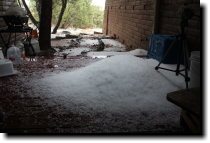 It was typical New Mexico hail -- lentil-sized, not like the
baseballs we heard about in Colorado Springs a few days later that
killed some zoo animals. I hear this area does occasionally
get big hailstones, but it's fortunately rare.
It was typical New Mexico hail -- lentil-sized, not like the
baseballs we heard about in Colorado Springs a few days later that
killed some zoo animals. I hear this area does occasionally
get big hailstones, but it's fortunately rare.
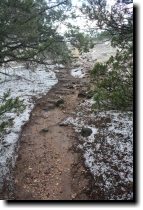 But before that, as soon as the squall ended, we went out to walk the
property and take a look the "snow" and in particular at "La Cienega"
or "the swamp", our fanciful name for an area down at the bottom of
the hill where water collects and there's a little willow grove.
There was indeed water there -- covered with a layer of
floating hail -- but on the way down we also had a new "creek" with
several tributaries, areas where the torrent carved out little
streambeds.
But before that, as soon as the squall ended, we went out to walk the
property and take a look the "snow" and in particular at "La Cienega"
or "the swamp", our fanciful name for an area down at the bottom of
the hill where water collects and there's a little willow grove.
There was indeed water there -- covered with a layer of
floating hail -- but on the way down we also had a new "creek" with
several tributaries, areas where the torrent carved out little
streambeds.
![[pugnacious bullsnake]](http://shallowsky.com/nature/reptiles/bullsnakes/img_2590.jpg)
![[pugnacious bullsnake]](http://shallowsky.com/nature/reptiles/bullsnakes/img_2602.jpg)
![[Tarantula, resting after climbing up our glass patio door]](http://shallowsky.com/nature/invertebrates/nm-tarantulas/?pic=img_1610.jpg)
![[Tiny baby centipede]](http://shallowsky.com/nature/invertebrates/micro-centipedes/?pic=img_1591.jpg)
![[Nambe Lake]](http://shallowsky.com/images/nambe-lake-grey-jays//?pic=20170719_115516.jpg)
![[Grey jay taking bread from my hand.]](http://shallowsky.com/images/nambe-lake-grey-jays//?pic=img_7668.jpg)
![[Buck in velvet, drinking at the pond]](http://shallowsky.com/blog/images/nature/img_1146.jpg)
![[Tiger salamander with gills]](http://shallowsky.com/nature/tiger-salamander/img_7612T.jpg)
![[Tiger salamander with gills]](http://shallowsky.com/nature/tiger-salamander/img_7605T.jpg) I got a tip that there were tiger salamanders with gills swimming
around below Los Alamos reservoir, so I had to go see for myself.
I got a tip that there were tiger salamanders with gills swimming
around below Los Alamos reservoir, so I had to go see for myself.
![[Rosy-finches]](http://shallowsky.com/images/rosy-finches/?pic=img_0966.jpg)
![[Roadrunner]](http://shallowsky.com/images/rosy-finches/?pic=img_0955.jpg)
![[Snowy view of the Rio Grande from Overlook]](http://shallowsky.com/images/snow-lameelk/?pic=img_0856.jpg)
![[bull elk in the yard]](http://shallowsky.com/images/snow-lameelk/?pix=bullelk.jpg)
![[Sunset light on the Sangre de Cristos]](http://shallowsky.com/images/snow-lameelk/img_0851T.jpg) Some of the sunsets have been pretty nice, too.
Some of the sunsets have been pretty nice, too.
![[Dave climbs the Frijoles Overlook trail]](http://shallowsky.com/blog/images/frijoles-overlook/img_6182.jpg)
![[Canyon Tree Frog on the Rio Grande]](http://shallowsky.com/blog/images/frijoles-overlook/img_6168.jpg)
![[Chick Keller shows a burdock leaf]](http://shallowsky.com/blog/images/frijoles-overlook/img_6218.jpg)
![[Double rainbow]](http://shallowsky.com/images/hummer-rainbow/img_0470-1024.jpg)
![[Hummingbirds and rainbow]](http://shallowsky.com/images/hummer-rainbow/img_0482T.jpg)
![[grackle]](http://shallowsky.com/Birds/Perching_Birds/great_tailed_grackle.jpg)
![[Flying ant courtesy of Jen Macke]](http://peecnature.org/wp-content/uploads/2016/06/IMG_7673-single-harvester.jpg)
![[Female (left) and male junipers in spring]](http://shallowsky.com/blog/images/juniper-male-female/img_4887.jpg)
![[Female juniper closeup]](http://shallowsky.com/blog/images/juniper-male-female/img_4892.jpg)
![[male juniper closeup showing pollen cones]](http://shallowsky.com/blog/images/juniper-male-female/img_4896.jpg)
![[Juniper titmouse attacking my window]](http://shallowsky.com/blog/images/titmouse-attack/img_9941c.jpg)
![[ Mountain chickadee ]](http://shallowsky.com/nature/birdcount2015/img_9808T.jpg) No big deal, right? Most counties have a
No big deal, right? Most counties have a
![[ Two very late-season sandhill cranes ]](http://shallowsky.com/nature/birdcount2015/img_9852T.jpg) Sure enough, when I got there at 8, there was disappointment over how
few birds there were. But actually that continued all day: the
promised sun never came out, and I think the birds were hoping for
warmer weather. We did see a good assortment of woodpeckers and
nuthatches in a small area of Water Canyon, and later, a pair of very
late-season sandhill cranes made a low flyover just above where we
stood on Estante Way; but mostly, it was disappointing.
Sure enough, when I got there at 8, there was disappointment over how
few birds there were. But actually that continued all day: the
promised sun never came out, and I think the birds were hoping for
warmer weather. We did see a good assortment of woodpeckers and
nuthatches in a small area of Water Canyon, and later, a pair of very
late-season sandhill cranes made a low flyover just above where we
stood on Estante Way; but mostly, it was disappointing.
![[ Scaled quail ]](http://shallowsky.com/nature/birdcount2015/img_9846T.jpg) But what with all the predators, there had been no quail. We had lunch,
keeping our eyes on the feeder area, when they showed up. Three of
them, no, six, no, nine. I kept watch while Dave went over to another
window to see if there were any more headed our way. And it turns out
there was a whole separate flock, nine more, out in the yard.
Eighteen quail in all, a record for us!
We'd suspected that we had two different quail families visiting us, but
when you're watching one spot with quail constantly running in and
out, there's no way to know if it's the same birds or different ones.
It needed two people watching different areas to get our high count ot 18.
And a good thing: we were the only bird counters in the county who saw
any quail, let alone eighteen. So I did get to make a contribution after all.
But what with all the predators, there had been no quail. We had lunch,
keeping our eyes on the feeder area, when they showed up. Three of
them, no, six, no, nine. I kept watch while Dave went over to another
window to see if there were any more headed our way. And it turns out
there was a whole separate flock, nine more, out in the yard.
Eighteen quail in all, a record for us!
We'd suspected that we had two different quail families visiting us, but
when you're watching one spot with quail constantly running in and
out, there's no way to know if it's the same birds or different ones.
It needed two people watching different areas to get our high count ot 18.
And a good thing: we were the only bird counters in the county who saw
any quail, let alone eighteen. So I did get to make a contribution after all.
![[Fetid marigold, which actually smells wonderfully minty]](http://shallowsky.com/blog/images/fetid/img_9406-crop.jpg) The street for a substantial radius around my mailbox has a wonderful,
strong minty smell.
The smell is coming from a clump of modest little yellow flowers.
The street for a substantial radius around my mailbox has a wonderful,
strong minty smell.
The smell is coming from a clump of modest little yellow flowers.
![[Fetid goosefoot]](http://shallowsky.com/blog/images/fetid/img_4110.jpg) Another local plant which turns strikingly red in autumn has an even
worse name: fetid goosefoot. On a recent hike, several of us made a
point of smelling it. Sure enough: everybody except one found it
minty and pleasant. But one person on the hike said "Eeeeew!"
Another local plant which turns strikingly red in autumn has an even
worse name: fetid goosefoot. On a recent hike, several of us made a
point of smelling it. Sure enough: everybody except one found it
minty and pleasant. But one person on the hike said "Eeeeew!"
![[Albireo, from Jefffisher10 on Wikimedia Commons]](https://en.wikipedia.org/wiki/Albireo#/media/File:Albireo_20150919.jpg)
![[Wildflowers on the Quemazon trail]](http://shallowsky.com/blog/images/nature/img_4164.jpg) One of the adjustments we've had to make in moving to New Mexico is
getting used to the backward (compared to California) weather.
Like, rain in summer!
One of the adjustments we've had to make in moving to New Mexico is
getting used to the backward (compared to California) weather.
Like, rain in summer!
![[Snakeweed in bloom]](http://shallowsky.com/lasenda/img_9367T.jpg) Then come September, especially in a rainy year like this one,
and all that snakeweed suddenly bursts into a glorious carpet of gold.
Then come September, especially in a rainy year like this one,
and all that snakeweed suddenly bursts into a glorious carpet of gold.
![[Palmer's amaranth, pigweed]](http://shallowsky.com/blog/images/img_9150.jpg) We'd been wondering about it for quite some time. It's quite an
attractive plant when small, with pretty patterns on its leaves
that remind me of some of the decorative houseplants we used to
try to grow when I was a kid.
We'd been wondering about it for quite some time. It's quite an
attractive plant when small, with pretty patterns on its leaves
that remind me of some of the decorative houseplants we used to
try to grow when I was a kid.
![[Myotis bat hanging just outside the front door]](http://shallowsky.com/blog/images/batskink/img_9186c.jpg) We got a surprise a few nights ago when flipping the porch light on
to take the trash out: a bat was clinging to the wall just outside
the front door.
We got a surprise a few nights ago when flipping the porch light on
to take the trash out: a bat was clinging to the wall just outside
the front door.
![[Woodrat released from trap]](http://shallowsky.com/blog/images/batskink/img_9182.jpg) We've had several woodrats recently try to set up house near the house or
the engine compartment of our Rav4, so we've been setting traps regularly.
Though woodrats are usually nocturnal, we caught one in broad daylight as
it explored the area around our garden pond.
We've had several woodrats recently try to set up house near the house or
the engine compartment of our Rav4, so we've been setting traps regularly.
Though woodrats are usually nocturnal, we caught one in broad daylight as
it explored the area around our garden pond.
![[chipmunk caught in our rat trap]](http://shallowsky.com/blog/images/batskink/img_9191.jpg) And then I picked up the trap, looked in -- and discovered it was a
pretty funny looking woodrat. With a furry tail and stripes.
A chipmunk! We've been so envious of the folks who live out on the
canyon rim and are overloaded with chipmunks ... this is only the
second time we've seen here, and now it's probably too spooked to
stick around.
And then I picked up the trap, looked in -- and discovered it was a
pretty funny looking woodrat. With a furry tail and stripes.
A chipmunk! We've been so envious of the folks who live out on the
canyon rim and are overloaded with chipmunks ... this is only the
second time we've seen here, and now it's probably too spooked to
stick around.
![[Baby Great Plains skink]](http://shallowsky.com/blog/images/batskink/img_9198.jpg) Later that day, we were on our way out the door, late for a meeting,
when I spotted a small lizard in the den. (How did it get in?)
Fast and lithe and purple-tailed, it skittered under the sofa as soon
as it saw us heading its way.
Later that day, we were on our way out the door, late for a meeting,
when I spotted a small lizard in the den. (How did it get in?)
Fast and lithe and purple-tailed, it skittered under the sofa as soon
as it saw us heading its way.
![[Bee in cholla blossom]](http://shallowsky.com/images/la-senda-plants/chollabloom/img_9069.jpg) We have three or four cholla cacti on our property. Impressive, pretty
cacti, but we were disappointed last year that they never bloomed.
They looked like they were forming buds ... and then one day the
buds were gone. We thought maybe some animal ate them before the
flowers had a chance to open.
We have three or four cholla cacti on our property. Impressive, pretty
cacti, but we were disappointed last year that they never bloomed.
They looked like they were forming buds ... and then one day the
buds were gone. We thought maybe some animal ate them before the
flowers had a chance to open.
![[Desert willow in bloom]](http://shallowsky.com/images/la-senda-plants/chollabloom/img_9046.jpg) Other plants besides cacti are blooming. Last fall we planted a desert
willow from a local native plant nursery. The desert willow isn't actually
native to White Rock -- we're around the upper end of its elevation
range -- but we missed the Mojave desert willow we'd planted back in
San Jose, and wanted to try one of the Southwest varieties here.
Apparently they're all the same species, Chilopsis linearis.
Other plants besides cacti are blooming. Last fall we planted a desert
willow from a local native plant nursery. The desert willow isn't actually
native to White Rock -- we're around the upper end of its elevation
range -- but we missed the Mojave desert willow we'd planted back in
San Jose, and wanted to try one of the Southwest varieties here.
Apparently they're all the same species, Chilopsis linearis.
![[Baby piñon cones]](http://shallowsky.com/blog/images/pinoncones/img_8778.jpg)
![[piñon spikes with no cones]](http://shallowsky.com/blog/images/pinoncones/img_8792.jpg)
![[Firefox bookmarks dialog]](http://shallowsky.com/blog/images/screenshots/bookmark-dialog.jpg)
![[Firefox bookmarks dialog showing keyword]](http://shallowsky.com/blog/images/screenshots/bookmark-dialog-birdmap.jpg)
![[mule deer stag with one antler]](http://shallowsky.com/blog/images/unistags/img_8386sm.jpg) This fellow stopped by one evening a few weeks ago. He'd lost one of
his antlers (I'd love to find it in the yard, but no luck so far).
He wasn't hungry; just wandering, maybe looking for a place to bed down.
He didn't seem to mind posing for the camera.
This fellow stopped by one evening a few weeks ago. He'd lost one of
his antlers (I'd love to find it in the yard, but no luck so far).
He wasn't hungry; just wandering, maybe looking for a place to bed down.
He didn't seem to mind posing for the camera.
![[two mule deer stags with one antler each]](http://shallowsky.com/blog/images/unistags/img_8426sm.jpg)
![[young bullsnake]](http://shallowsky.com/blog/images/snaketrap/img_6863.jpg) It was a young bullsnake. Now slender and maybe a bit over two feet long,
it will eventually grow into a larger relative of the gopher snakes
that I used to see back in California. (I had a gopher snake as a pet
when I was in high school -- they're harmless, non-poisonous and
quite docile.)
It was a young bullsnake. Now slender and maybe a bit over two feet long,
it will eventually grow into a larger relative of the gopher snakes
that I used to see back in California. (I had a gopher snake as a pet
when I was in high school -- they're harmless, non-poisonous and
quite docile.)
![[young bullsnake caught in mousetrap]](http://shallowsky.com/blog/images/snaketrap/img_6878.jpg)
![[Sangre de Cristos gold with aspens]](http://shallowsky.com/blog/images/aspens/img_6833c.jpg)
![[Sangre de Cristos gold with aspens]](http://shallowsky.com/blog/images/aspens/img_1243c.jpg)
![[double rainbow]](http://shallowsky.com/doublerainbow/img_9703.jpg)
![[Double rainbow with the Rokinon 8mm fisheye]](http://shallowsky.com/doublerainbow/?pic=img_6492.jpg)
![[Bushnell Trophycam vs. Raspberry Pi Crittercam]](http://shallowsky.com/blog/images/trophy-vs-critter/img_0865.jpg) Having grown frustrated with the high number of false positives on my
Having grown frustrated with the high number of false positives on my
![[blown-out image from Bushnell Trophycam]](http://shallowsky.com/blog/images/trophy-vs-critter/ek000017.jpg) What few nighttime shots there were were mostly so blown out you
couldn't see any detail to be sure. Doesn't this camera know how to
adjust its exposure? The shot here has a creature in it. See it?
I didn't either, at first. It's just to the right of the bush.
You can just see the curve of its back and the beginning of a tail.
What few nighttime shots there were were mostly so blown out you
couldn't see any detail to be sure. Doesn't this camera know how to
adjust its exposure? The shot here has a creature in it. See it?
I didn't either, at first. It's just to the right of the bush.
You can just see the curve of its back and the beginning of a tail.
![[coyote caught on the TrophyCam]](http://shallowsky.com/blog/images/trophy-vs-critter/ek000003.jpg) The final night, I strapped it to a piñon tree facing a little
clearing in the woods. Only two morning rabbits, but during the night
it caught a coyote. And only 5 false positives. I've never caught a
coyote (or anything else larger than a rabbit) with the PiCam.
The final night, I strapped it to a piñon tree facing a little
clearing in the woods. Only two morning rabbits, but during the night
it caught a coyote. And only 5 false positives. I've never caught a
coyote (or anything else larger than a rabbit) with the PiCam.
![[female hummingbird at the window feeder]](http://shallowsky.com/blog/images/nature/mirror-mirror.jpg)
![[Mouse peeking out of the trap]](http://shallowsky.com/blog/images/mousemovie/peekout.jpg) We caught another mouse! I shot a movie of its release.
We caught another mouse! I shot a movie of its release.
![[Mouse about to fall out of the trap]](http://shallowsky.com/blog/images/mousemovie/fallout.jpg) Dave finally got impatient, picked up the trap and turned it opening down,
so the mouse would slide out.
Dave finally got impatient, picked up the trap and turned it opening down,
so the mouse would slide out.
![[scruffy mouse, just released from trap]](http://shallowsky.com/blog/images/mousemovie/scruffy.jpg)
![[Mouse bounding away]](http://shallowsky.com/blog/images/mousemovie/leap.jpg) Then it headed up the hill a ways before finally lapsing into the
high-bounding behavior we've seen from other mice and rats we've released.
I know it's hard to tell in the last picture -- the photo is so small --
but look at the distance between the mouse and its shadow on the ground.
Then it headed up the hill a ways before finally lapsing into the
high-bounding behavior we've seen from other mice and rats we've released.
I know it's hard to tell in the last picture -- the photo is so small --
but look at the distance between the mouse and its shadow on the ground.
![[Mouse released from trap]](https://i.ytimg.com/vi/ClnYBugR9pA/1.jpg)
![[White-lined sphinx moth on pale trumpets]](http://shallowsky.com/nature/invertebrates/sphinxmoths/img_6577T.jpg)
![[Sphinx moth eye]](http://shallowsky.com/nature/invertebrates/sphinxmoths/img_6584eye.jpg) I've seen them before, on hikes, but only gotten blurry shots with
my pocket camera. But with the pale trumpets blooming, the sphinx
moths come right at sunset and feed until near dark. That gives a
good excuse to play with the DSLR, telephoto lens and flash ...
and I still haven't gotten a really sharp photo, but I'm making
progress.
I've seen them before, on hikes, but only gotten blurry shots with
my pocket camera. But with the pale trumpets blooming, the sphinx
moths come right at sunset and feed until near dark. That gives a
good excuse to play with the DSLR, telephoto lens and flash ...
and I still haven't gotten a really sharp photo, but I'm making
progress.
![[White throated woodrat in a trap]](http://shallowsky.com/nature/woodrat/img_6165c.jpg) One great thing about living in the country: the wildlife.
I love watching animals and trying to photograph them.
One great thing about living in the country: the wildlife.
I love watching animals and trying to photograph them.
![[White throated woodrat bounding away]](http://shallowsky.com/nature/woodrat/img_6168c.jpg) We drove quite a bit farther than we had for the mouse. Woodrats can
apparently range over a fairly wide area, and we didn't want to let it
go near houses. We hiked a little way out on a trail, put the trap down
and opened both doors. The woodrat looked up, walked to one open end
of the trap, decided that looked too scary; walked to the other open
end, decided that looked too scary too; and retreated back to the
middle of the trap.
We drove quite a bit farther than we had for the mouse. Woodrats can
apparently range over a fairly wide area, and we didn't want to let it
go near houses. We hiked a little way out on a trail, put the trap down
and opened both doors. The woodrat looked up, walked to one open end
of the trap, decided that looked too scary; walked to the other open
end, decided that looked too scary too; and retreated back to the
middle of the trap.
![[PIR sensor]](http://shallowsky.com/images/night-vision/img_6122.jpg) In my last crittercam installment,
In my last crittercam installment,
![[PIR sensor pins]](http://shallowsky.com/images/night-vision/img_6124.jpg)
![[piñon mouse]](http://shallowsky.com/images/night-vision/snap-2014-06-26-23-33-24-400.jpg)
![[house finch chick]](http://shallowsky.com/images/baby-housefinches/img_6072.jpg)
![[Cicadas mating]](http://shallowsky.com/nature/invertebrates/cicadas/img_5952.jpg)
![[Possible cicada emergence holes]](http://shallowsky.com/nature/invertebrates/cicadas/img_5958.jpg)
![[Fendler's Hedgehog Cactus flower]](http://shallowsky.com/nature/invertebrates/cicadas/img_5961.jpg) So our Rice Krispies mystery was solved. And by the way, I don't
recommend googling for combinations like cicada rice krispies ...
unless you want to catch and eat cicadas.
So our Rice Krispies mystery was solved. And by the way, I don't
recommend googling for combinations like cicada rice krispies ...
unless you want to catch and eat cicadas.
![[Sonogram of ruby-crowned kinglet]](http://shallowsky.com/blog/images/screenshots/sonogram.jpg)
![[Northern Flicker on our deck]](http://shallowsky.com/blog/images/img_5609.jpg)
![[LB, our black squirrel]](http://shallowsky.com/squirrels/little-blackie/img_8962T.jpg)
![[black squirrel LB hanging by his feet]](http://shallowsky.com/squirrels/little-blackie/img_8940T.jpg) This morning he was quite entertaining, when he decided I was coming
out too slowly (I try not to make sudden movements when approaching
wild animals) and jumped from the fencepost to run along the gate.
I met him halfway, and offered the nut to him as he sat on the gate.
He grabbed it, but his nervousness about being in a different place
made him too hasty, and he missed his grab and the nut went bouncing
down onto the driveway.
This morning he was quite entertaining, when he decided I was coming
out too slowly (I try not to make sudden movements when approaching
wild animals) and jumped from the fencepost to run along the gate.
I met him halfway, and offered the nut to him as he sat on the gate.
He grabbed it, but his nervousness about being in a different place
made him too hasty, and he missed his grab and the nut went bouncing
down onto the driveway.
![[Huge flock of grackles]](http://shallowsky.com/blog/images/trips/4corners2013/img_8041.jpg) Then, in the evening, a convocation of grackles -- several hundred of
them -- in the tree just across from the third-floor balcony at our
casino hotel.
All chattering with each other, making an amazing variety of noises
as they flew from branch to branch, occasionally bickering or feeding
each other or landing on a branch too weak to support them.
Then, in the evening, a convocation of grackles -- several hundred of
them -- in the tree just across from the third-floor balcony at our
casino hotel.
All chattering with each other, making an amazing variety of noises
as they flew from branch to branch, occasionally bickering or feeding
each other or landing on a branch too weak to support them.
![[Don't park under a grackle tree]](http://shallowsky.com/blog/images/trips/4corners2013/img_8052.jpg) Unfortunately, in all that time, one thing that never occurred to us was
that our car was parked right under that tree. We realized that the
next morning.
Unfortunately, in all that time, one thing that never occurred to us was
that our car was parked right under that tree. We realized that the
next morning.
![[House finch]](http://shallowsky.com/Birds/Perching_Birds/house_finch.jpg) I was awakened at 6:30 this morning by what sounded like a young house
finch learning to sing, just outside my window.
It got me thinking.
I was awakened at 6:30 this morning by what sounded like a young house
finch learning to sing, just outside my window.
It got me thinking.
![[Dinosaur egg (okay, not really)]](http://shallowsky.com/blog/images/humor/img_7301.jpg) Happy Easter! In keeping with the season, here's a dinosaur egg I
spotted on a recent hike.
Happy Easter! In keeping with the season, here's a dinosaur egg I
spotted on a recent hike.
![[Eurasian Collared Dove]](http://shallowsky.com/Birds/Other/eurasian_collared_doveT.jpg)
![[Shooting star]](http://shallowsky.com/nature/wildflowers/purple/?pic=img_7226.jpg)
![[Indian warrior and hound's tongue blooming in Coal Mine Ridge]](http://shallowsky.com/blog/images/nature/img_7285.jpg) Dave had to keep waiting for me while I argued with the camera
over macro focus distances. So if you like wildflowers, get out there
and take a look!
Dave had to keep waiting for me while I argued with the camera
over macro focus distances. So if you like wildflowers, get out there
and take a look!
![[Western bluebird]](http://shallowsky.com/Birds/Perching_Birds/western_bluebird2.jpg)
![[Phantom stump horse]](http://shallowsky.com/blog/images/humor/stumphorse.jpg) But then I spotted an even more unusual beast -- a phantom horse
rearing out of the ground, ears pricked forward, eyes and mouth open
and mane whipped by a wind we could not feel on this pleasant, windless day.
But then I spotted an even more unusual beast -- a phantom horse
rearing out of the ground, ears pricked forward, eyes and mouth open
and mane whipped by a wind we could not feel on this pleasant, windless day.
![[Mis American Green Cross]](http://shallowsky.com/blog/images/humor/img_6639.jpg)
![[Miss American Green Cross, side view]](http://shallowsky.com/blog/images/humor/img_6642.jpg) The statue was
The statue was ![[Grossly fat California ground squirrel at Morro Rock]](http://shallowsky.com/nature/squirrels/jabba-the-sqrl.jpg)
![[Young and fierce alligator lizard]](http://shallowsky.com/nature/reptiles/dragonliz.jpg)
![[Young and fierce alligator lizard]](http://shallowsky.com/nature/reptiles/img_6096.jpg)
![[Dragonfly nymph]](http://shallowsky.com/images/bugs/?pic=img_3853.jpg)
![[CA newt larva with gills and legs]](http://www.shallowsky.com/images/newts/img_3859.jpg)
![[garter snake]](http://shallowsky.com/images/snakes/img_3870c.jpg)
![[ Newt tadpole ]](http://shallowsky.com/images/newts/?pic=img_3625.jpg)
![[ Newt tadpole ]](http://shallowsky.com/images/newts/?pic=img_3626.jpg)
![[ Adult and larval newt ]](http://shallowsky.com/images/newts/?pic=img_3643c.jpg)
![[ Detail of larval newt from previous photo ]](http://shallowsky.com/images/newts/?pic=img_3643-detail.jpg)
![[Tasmanian Devil]](http://shallowsky.com/images/tasmania/bonorong/img_8616c.jpg) The LA Times had a great article last weekend about
The LA Times had a great article last weekend about
![[Greg Irons and devil]](http://shallowsky.com/images/tasmania/bonorong/img_8582c.jpg) But surprisingly, the best part was the tour. I'm usually not much for
guided tours, and Dave normally hates 'em. But this one was given by
Greg Irons, the director of the park who's featured in the Times
article, and he's fantastic. He obviously loves the animals and he knows
everything about them -- Dave called him an "animal nerd" (that's a
compliment, really!) And he's a great showman, with a lively and
fact-filled presentation that shows each animal at its best while
keping all ages entertained. If you didn't love marsupials, and
particularly devils and wombats, before you come to Bonorong,
I guarantee you will by the time you leave.
But surprisingly, the best part was the tour. I'm usually not much for
guided tours, and Dave normally hates 'em. But this one was given by
Greg Irons, the director of the park who's featured in the Times
article, and he's fantastic. He obviously loves the animals and he knows
everything about them -- Dave called him an "animal nerd" (that's a
compliment, really!) And he's a great showman, with a lively and
fact-filled presentation that shows each animal at its best while
keping all ages entertained. If you didn't love marsupials, and
particularly devils and wombats, before you come to Bonorong,
I guarantee you will by the time you leave.
![[Tasmanian devil tug-o-war]](http://shallowsky.com/images/tasmania/bonorong/img_8635c.jpg)
![[ferocious killer Tasmanian devil]](http://shallowsky.com/images/tasmania/bonorong/img_8587c.jpg) Of course, I have a lot more photos from Bonorong:
Of course, I have a lot more photos from Bonorong:
![[Acorn woodpecker]](http://shallowsky.com/Birds/Other/acorn_woodpecker2.jpg)
![[trail silvery with termites]](http://shallowsky.com/images/termites-rsa/img_2714T.jpg)
![[hollow orange]](http://shallowsky.com/blog/images/holloworange.jpg) Hollow oranges keep turning up on our lawn under the orange tree.
Sometime we even find them still attached to the tree.
Hollow oranges keep turning up on our lawn under the orange tree.
Sometime we even find them still attached to the tree.
![[Wild turkey chicks scuffling]](http://shallowsky.com/nature/turkeys/img_9932c.jpg) Late last week in the field next to the parking lots at Rancho San
Antonio we had a chance to watch a wild turkey family foraging in
the dry grass. Two adults and twenty chicks -- that's quite a brood!
Late last week in the field next to the parking lots at Rancho San
Antonio we had a chance to watch a wild turkey family foraging in
the dry grass. Two adults and twenty chicks -- that's quite a brood!
![[tiny frog at Picchetti Ranch]](http://shallowsky.com/nature/frogs/img_1402.jpg)
![[Newt nookie at Lake Ranch]](http://shallowsky.com/nature/newtnookie/img_4438T.jpg)
![[California newt laying her egg sac]](http://shallowsky.com/nature/newtnookie/img_4488T.jpg)
![[Skipper butterflies mating on my shoulder]](http://shallowsky.com/images/skippermate/w15007T.jpg)

![[Raccoon at the door]](http://shallowsky.com/images/raccoon/img_1151-sm.jpg)
![[big fish in Penitencia Cr]](http://shallowsky.com/blog/images/alum/cascadefish.jpg)
![[newt stuck in mud]](http://shallowsky.com/images/mudpond/pict1303T.jpg)
![[small owl, maybe a young screech owl?]](http://shallowsky.com/Birds/Raptors/unknown_owl.jpg) Later, on the trail, a spotted towhee burst out of a tree and flew
past us. Then a small woodpecker emerged from the
same cluster of branches the towhee had just left. As we drew nearer
we could hear quite a commotion up in the branches ... a dozen or more
small birds, mostly chickadees, chattering and darting in and out
like bees around a hive. It seemed centered on ... that unmoving
spot there ... wait, doesn't it look a bit owl-shaped to you?
Later, on the trail, a spotted towhee burst out of a tree and flew
past us. Then a small woodpecker emerged from the
same cluster of branches the towhee had just left. As we drew nearer
we could hear quite a commotion up in the branches ... a dozen or more
small birds, mostly chickadees, chattering and darting in and out
like bees around a hive. It seemed centered on ... that unmoving
spot there ... wait, doesn't it look a bit owl-shaped to you?
![[bullfrog]](http://shallowsky.com/blog/images/bullfrog.jpg) And as long as I'm posting nature pictures, the bullfrogs are back
at the Walden West Scum Lake. Just floatin' there, though ... they
weren't making any noise or moving around.
And as long as I'm posting nature pictures, the bullfrogs are back
at the Walden West Scum Lake. Just floatin' there, though ... they
weren't making any noise or moving around.
![[young mockingbird who thinks he's a quail or a wren]](http://shallowsky.com/images/mockchicks/oak2T.jpg) The young mockingbird fledgelings have decided they like us.
Oak in particular took a liking to our backyard, and particularly
the lawn. It seems he wants to be a quail when he grows up: he loves
to run (not hop) around the yard, and flies only when threatened
(though once he gets going, he flies quite competently). When he's
not being a quail he practices being a wren, cocking his tail up
the way wrens do.
I managed to get couple of
The young mockingbird fledgelings have decided they like us.
Oak in particular took a liking to our backyard, and particularly
the lawn. It seems he wants to be a quail when he grows up: he loves
to run (not hop) around the yard, and flies only when threatened
(though once he gets going, he flies quite competently). When he's
not being a quail he practices being a wren, cocking his tail up
the way wrens do.
I managed to get couple of
![[goldfinch and two house sparrows at the thistle sock]](http://shallowsky.com/images/feeder/feeder_goldfinch1T.jpg)
![[Arboreal salamander in the backyard]](http://shallowsky.com/blog/images/spotmander-sm.jpg) It was motionless at first, and Dave worried that he'd hurt it
moving the bin. But it was just resting; eventually it woke up and
moved off to find a damper and less exposed spot.
It was motionless at first, and Dave worried that he'd hurt it
moving the bin. But it was just resting; eventually it woke up and
moved off to find a damper and less exposed spot.
![[rough-skinned newtlet in hand]](/blog/images/newtlet-hand.jpg)
![[rough-skinned newtlet]](/blog/images/newtlet-close.jpg)
![[tarantula]](/images/tarantulas/img_5050.jpg) Mostly, tarantulas are hard to see. They stay in their underground
burrows for most of their lives; if they do come out of the burrow,
it's likely to be at night.
Mostly, tarantulas are hard to see. They stay in their underground
burrows for most of their lives; if they do come out of the burrow,
it's likely to be at night.
![[Variable checkerspot butterflies on yerba santa]](http://shallowsky.com/images/butterflies/checkerspot-yerbasanta2.jpg)
![[Variable checkerspot butterflies on buckeye flowers]](http://shallowsky.com/images/butterflies/checkerspot-buckeye.jpg)
![[RSS feed]](https://shallowsky.com/images/logos/rssicon-25x25.png)
![[Mastodon icon]](https://shallowsky.com/images/logos/mastodon.svg)
![[Twitter icon]](https://shallowsky.com/images/logos/twitter-bird-white-on-blue-25x25.png)
![[envelope]](https://shallowsky.com/images/logos/envelope-25x25.png)

_-_Rodriquez_Feeders_-_Portal_-_AZ_-_2015-08-03at08-32-026_(20984843604).jpg)